Article
Jul 24, 2026
Demand Generation vs Lead Generation: What's the Difference?
Demand generation vs lead generation explained: how they differ across goals, funnel stage, and metrics, and how to run both so they feed each other.
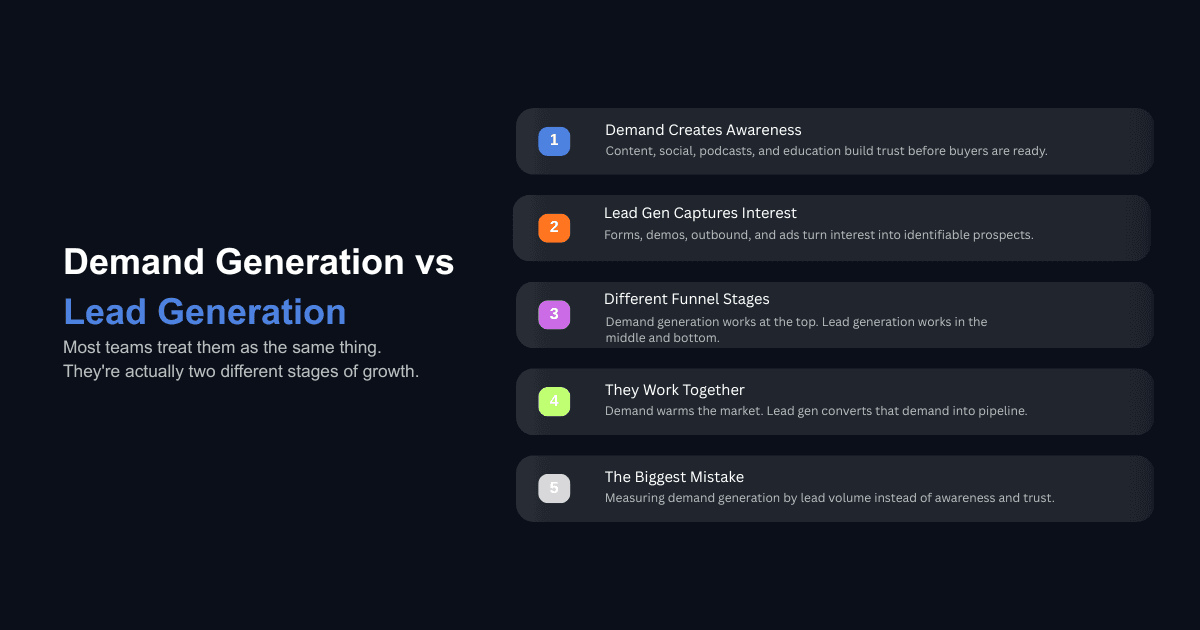
Most revenue teams have run into the same problem. The dashboard shows plenty of leads, the forms are filling, the cost per lead looks reasonable, and then almost none of those contacts turn into real conversations. Sales complains the leads are cold. Marketing points at the volume and says it is doing its job. Both are partly right, and the reason usually comes down to a difference that gets blurred in most planning meetings: demand generation and lead generation are not the same thing, and treating them as interchangeable is what produces a pipeline full of people who never buy.
This guide breaks down what each one actually does, how they differ across goals, funnel stage, and metrics, and how to run both so they feed each other instead of working against each other.
What Is Demand Generation?
Demand generation is the work of making a market aware that a problem exists and that a solution exists for it. It sits at the top of the funnel and reaches buyers before they are ready to purchase, often before they would describe themselves as shopping at all. The goal is awareness, trust, and familiarity, so that when someone does start researching, your company is already a name they recognize.
The activities that carry demand generation are educational content, thought leadership, podcasts, social presence, webinars, and brand advertising. None of these ask for much in return at the moment of contact. A prospect reads a useful article or watches a breakdown of a problem they have, and the return on that comes later, when they enter the market already trusting your point of view.
What Demand Generation Is Not
Demand generation is not supposed to produce leads directly, and this is where most teams get it wrong. When a company measures a LinkedIn thought leadership program by cost per marketing qualified lead, it will almost always conclude the program is failing and cut it. That is one of the more expensive mistakes in B2B marketing, because the value of demand generation shows up as branded search growth, faster sales cycles, and higher win rates rather than as form fills you can attribute in a single report.
What Is Lead Generation?
Lead generation captures the contact details of people who are already showing interest, converting that interest into named prospects your sales team can follow up with. It operates in the middle and bottom of the funnel, working with buyers who are in market and comparing options. If demand generation grows the number of people who care about the problem, lead generation is the mechanism that turns that interest into contactable pipeline.
The tactics here are gated content, demo pages, paid search, competitor comparison campaigns, and outbound prospecting. The stack overlaps heavily with demand generation, but it is configured for a different outcome. A landing page, a CRM, a paid media account, and a prospecting tool can all serve either motion depending on what you ask them to optimize for. There are many lead generation approaches worth building on, and increasingly teams are learning how to generate B2B leads with AI to research accounts and personalize outreach at a scale manual work cannot reach.
Demand Generation vs Lead Generation: The Core Differences
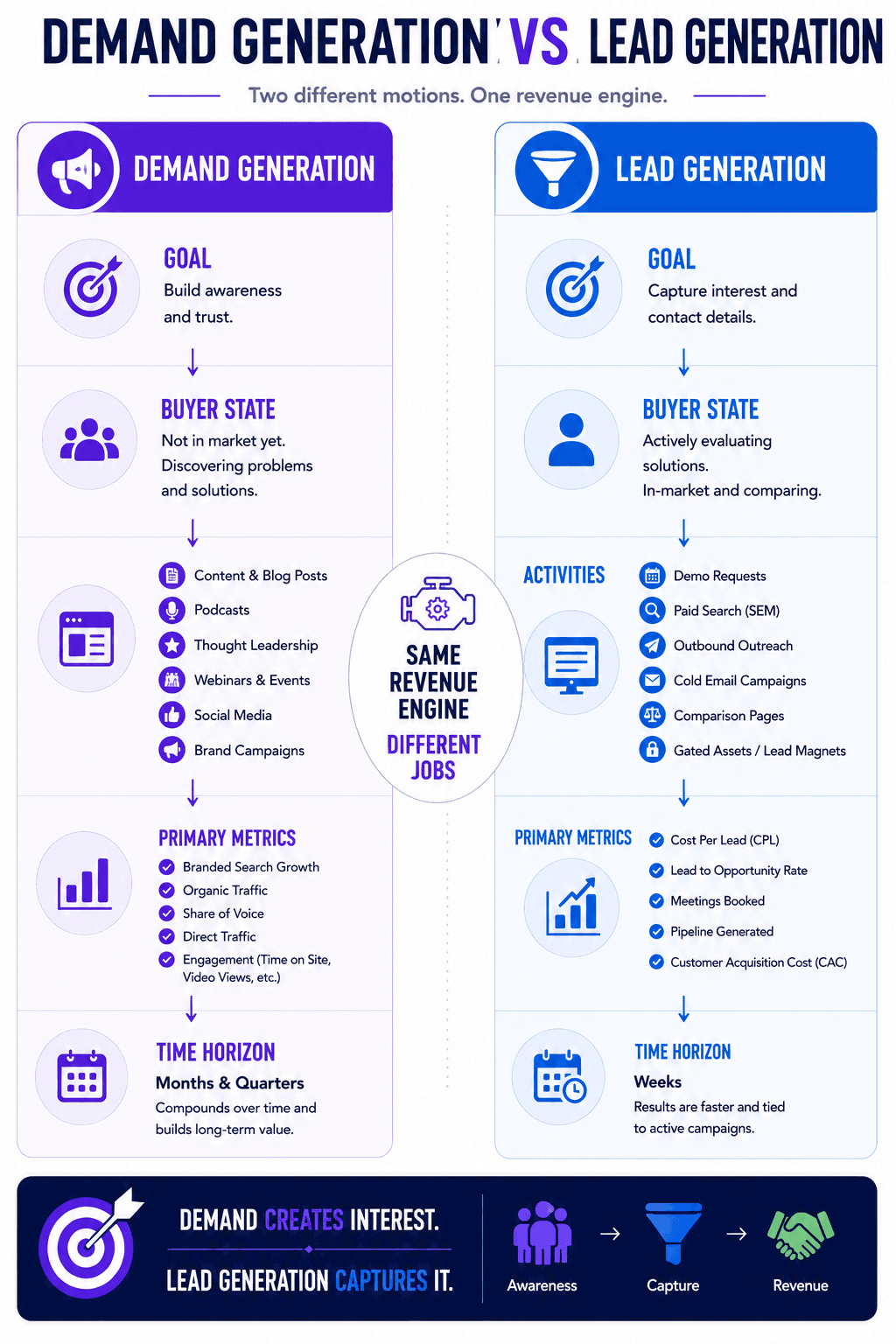
The two motions differ across five dimensions that matter for how you plan and measure them.
Dimension | Demand Generation | Lead Generation |
Goal | Build awareness and trust | Capture contact details |
Funnel stage | Top of funnel | Middle and bottom of funnel |
Buyer state | Not yet in market | Actively evaluating |
Primary metrics | Branded search, organic traffic, share of voice | Cost per lead, lead to opportunity rate |
Timeline | Compounds over quarters | Measured in weeks |
The point worth holding onto is that they fail in different ways. Pour budget into lead capture before demand exists and you harvest a thin list of contacts who do not recognize your company and rarely convert. Build plenty of awareness with no way to identify and follow up with interested buyers and you generate traffic that never becomes pipeline. A healthy program runs both and judges each on its own timeline rather than forcing one set of metrics onto the other.
Why the Difference Matters More in 2026
The gap between these two motions has widened because of how buyers now make decisions. Gartner has reported that B2B buyers spend only about 17% of the buying journey meeting with potential suppliers, and that 67% of buyers prefer a purchasing experience with no sales rep involved. Most of the decision happens during independent research, which means whether your lead generation works at all depends on whether the buyer already knows and trusts you before they raise their hand.
A large share of that research happens where you cannot see it. Prospects read comparison threads, watch category breakdowns, ask their network, and browse review sites, and none of that shows up in your analytics. Research suggests 60 to 70 percent of the B2B buying journey happens in this dark funnel before a buyer visits your website directly. Demand generation is how you stay present during that quiet phase, and part of that presence comes from reading the market well. Learning what buying signals are worth tracking and how intent data reveals which accounts are researching now lets you tell the difference between an account that is warming up and one that is ready to talk.
The cost side reinforces the same point. Cold email and paid search sent to an audience that has never heard of you need more touchpoints, run longer, and convert lower than the same campaigns sent to a warm audience. This is a large reason cold outreach often fails before the first email is sent. When the audience is aware of you, the same outbound motion closes faster and at a higher rate.
How the Two Work Together
The most useful way to think about demand generation and lead generation is as sequential stages of one engine. Demand generation creates the conditions, and lead generation converts the resulting interest into named opportunities. A team that only runs demand generation builds an audience that never buys. A team that only runs lead generation eventually exhausts the pool of people who already know them and spends more each quarter to reach the ones who do not.
There is a rough benchmark for the balance. LinkedIn's 2024 B2B marketing data points to a 60/40 split favoring demand generation over lead generation, though earlier stage companies often start closer to the reverse and shift as they grow. Most companies over invest in lead capture, which shrinks the buyer pool over time and pushes acquisition costs up.
The clearest illustration of the payoff comes from Cognism, which shifted away from traditional lead generation toward ungated content and brand led media. The company reported a close rate near 0.2% from content leads compared with almost 20% from direct inbound inquiries, along with a large increase in inbound pipeline after the change. The lesson is that demand generation lowers the cost of every lead that lead generation captures, and lead generation gives demand generation the customer stories and data that make the next round of content sharper. Teams that get this working often find they can book more sales meetings without adding headcount, because the pipeline is filling with people who arrive already convinced.
Common Questions
Is demand generation better than lead generation?
Neither is better because they do different jobs. Demand generation grows the number of buyers who trust you, and lead generation converts that trust into contactable pipeline. The right question is not which to choose but whether the two are sequenced so awareness feeds capture. When companies frame it as a choice, they usually end up underfunding demand generation, since it does not show up neatly in a pipeline report, and then wonder why their lead quality keeps dropping.
How do you measure demand generation vs lead generation?
Match the metric to the stage. For lead generation, track cost per lead, lead to opportunity conversion, and cost per qualified opportunity, since raw lead volume hides quality problems. For demand generation, look at branded search volume, organic traffic growth, direct traffic, and the share of new pipeline that comes from audiences exposed to your content. Asking every new customer where they first heard of you is one of the more honest measures available, because the answer rarely traces back to the form they eventually filled out. Pulling these signals together is part of what revenue intelligence does for teams that want a connected view of what is actually driving deals.
Where does cold email fit, demand generation or lead generation?
Cold email is a lead generation and outbound motion, since it reaches out to capture interest and start conversations directly. It works far better on top of demand generation. When the accounts you email already recognize your company from content, podcasts, or a strong social presence, reply rates and meeting rates rise. Running cold email against a completely cold audience is possible, but it demands more volume and better infrastructure to produce the same result, which is why targeting and timing matter as much as the copy.
Which should a company invest in first?
If your target accounts do not know your brand, lead capture tactics will produce low quality contacts, so building awareness first is usually the safer sequence. That said, most companies cannot pause revenue while they build demand over several quarters, so the practical answer is to run both from the start with the balance weighted toward whichever side of the funnel is weakest. A useful starting exercise is to figure out where your ideal buyers actually are and how to find them, then decide how much of your effort should go to making them aware versus capturing the ones already looking.

The Takeaway
Demand generation and lead generation are stages of the same pipeline, not rival philosophies. Demand generation builds the awareness and trust that make buyers receptive, and lead generation captures that interest as named, followable opportunities. Run lead generation alone and you exhaust your market. Run demand generation alone and you build an audience with no way to convert it. The teams that grow efficiently in 2026 have both motions connected, measured on their own timelines, and sequenced so awareness feeds capture.
If you want help building a system where the two work together and your outbound reaches accounts that already recognize you, book a call with our team and we will map out where your pipeline is weakest and what to fix first.