Article
Jul 20, 2026
What Is Lead Generation? Definition, Process, Examples & Tools
Lead generation explained: the definition, the process stage by stage, real examples, and the tools that turn interest into pipeline.

Most teams treat lead generation as a volume problem. They push more traffic, buy more lists, and send more emails, then wonder why the pipeline still looks thin at the end of the quarter. The issue is rarely effort. It is that the word "lead" gets used loosely, so activity and results drift apart until nobody can tell which channel is actually producing revenue.
This guide fixes that by starting with a plain definition and then walking through how lead generation works in practice: the stages of the process, the different types of leads, the difference between inbound and outbound, real examples you can copy, and the categories of tools that do the work. By the end you should be able to look at your own program and see exactly where interest is being created and where it is leaking out.
What lead generation actually means
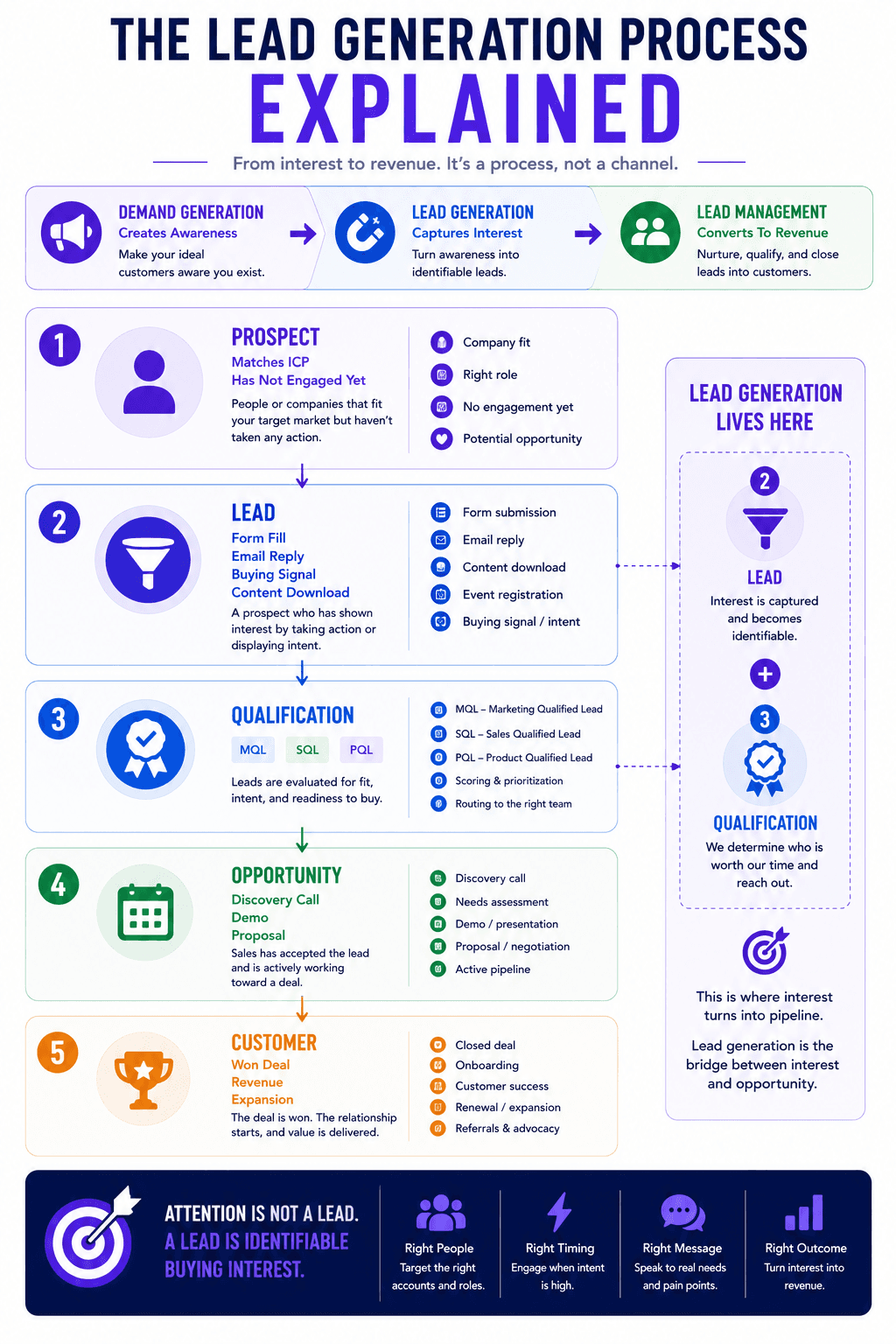
Lead generation is the process of attracting potential buyers and capturing enough information or intent to move them toward a purchase. A lead is a person or company that has shown some signal of interest, whether that is filling out a form, downloading a resource, replying to an email, or matching a set of buying signals you track. The goal is not attention on its own. The goal is a repeatable way to turn interest into named contacts and, eventually, into revenue.
It helps to keep three terms separate because people mix them up constantly. A prospect is anyone who fits your target market but has not engaged yet. A lead is a prospect who has taken an action or shown intent. An opportunity is a lead that sales has qualified and is actively working toward a deal. Lead generation lives in the middle of that chain, and it also sits inside a larger flow that SalesEcho lays out clearly: demand generation creates awareness, lead generation converts that awareness into identifiable contacts, and lead management routes, nurtures, and closes them. When a team says its lead gen is broken, the real problem is often in one of the stages on either side of it.
If you want the same definitional treatment applied to a related topic, our breakdown of what AI transformation is follows the same structure of definition, examples, and roadmap.
Why lead generation matters
The practical reason is predictability. A business that can reliably create qualified leads can forecast revenue, plan headcount, and invest with some confidence. A business that depends on referrals and luck cannot, which is why lead generation tends to be the first thing under pressure when growth stalls.
Buyer behavior has also changed in a way that raises the stakes. Most B2B buyers now do the majority of their research independently before they ever speak to a salesperson, a shift that Search Engine Land documents in its lead generation guide. By the time someone raises their hand, they have already formed opinions from your content, your competitors, and third party reviews. Your lead generation has to be present during that research window, not just at the moment someone is ready to buy.
None of this is easy, which shows up in the data. Lead generation consistently ranks as one of the hardest parts of the job, with roughly 61 percent of marketers naming it their top challenge in CIENCE's process guide. The teams that struggle usually have plenty of activity. What they lack is a clear process, which is what the rest of this guide covers.
The lead generation process, stage by stage
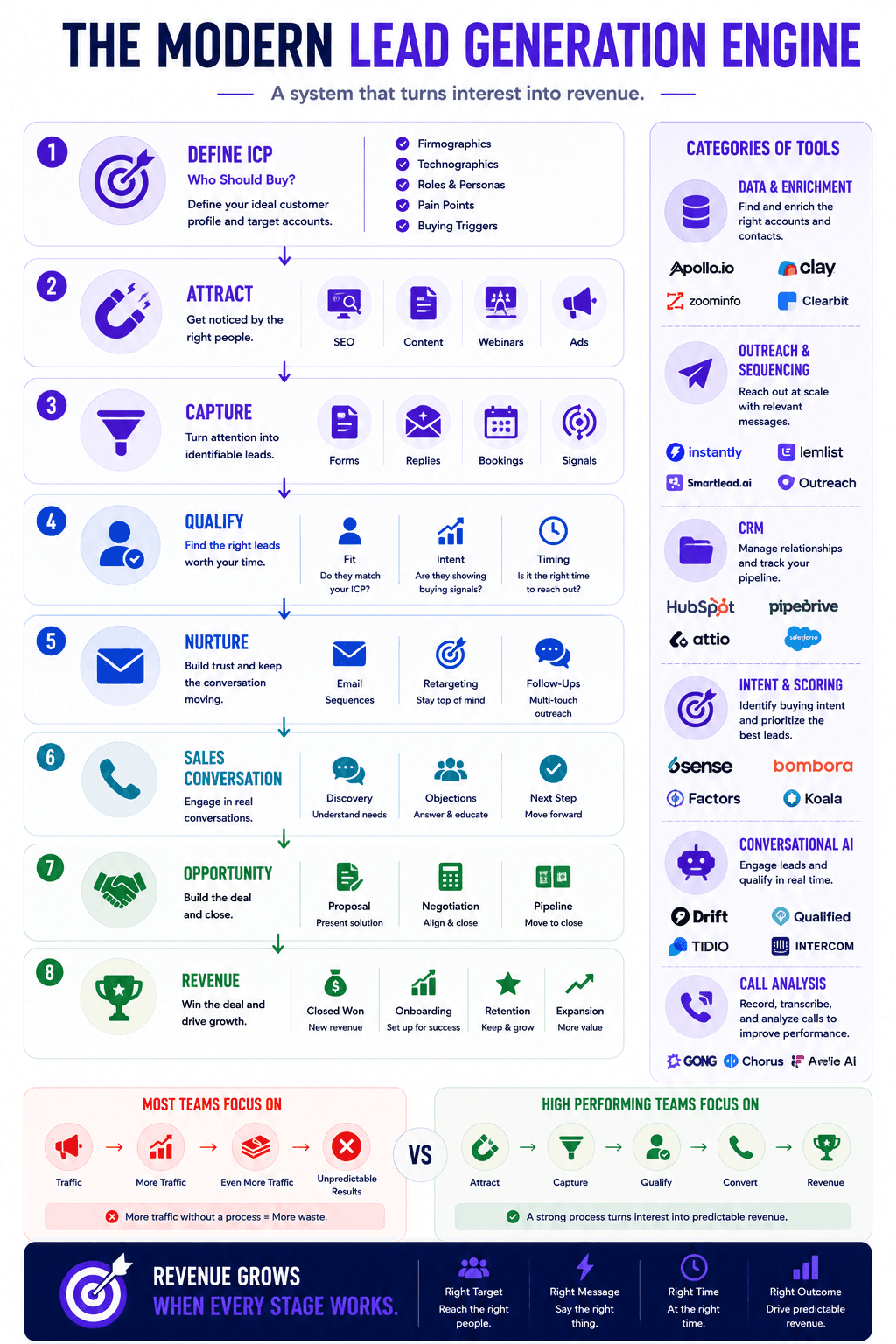
Lead generation is easier to fix when you treat it as a sequence of stages rather than a single campaign. Each stage has a job, and a weak stage caps everything downstream. The four stages below cover the core of what ZoomInfo describes as the standard B2B process.
Define your ideal customer profile
Everything starts with knowing who you are trying to reach. Your ideal customer profile, or ICP, describes the firmographic and demographic traits of the accounts most likely to buy, stay, and expand. That includes company size, industry, revenue, and the specific roles you need to reach inside the organization. Without a precise ICP, lead generation collapses into a volume game where you pay to reach people who were never going to buy. Most conversion problems that look like messaging problems are actually targeting problems underneath.
Attract and capture
Once you know who you are targeting, you create reasons for them to engage. On the inbound side this means content, search visibility, and offers that give someone a reason to share their contact details. On the outbound side it means reaching decision makers directly through email and other channels before they start looking. The capture step matters as much as the attract step, because traffic that never converts into a known contact is not a lead. A form, a reply, a booked call, or a tracked buying signal is what turns interest into something you can act on.
Qualify and score
Not every lead deserves the same treatment, so you sort them by fit and intent. This is where the common lead categories come in. A marketing qualified lead, or MQL, has engaged enough with your marketing to be worth attention. A sales qualified lead, or SQL, has been vetted for direct outreach. A product qualified lead, or PQL, has used your product in a way that signals real buying intent. CIENCE's guide breaks these types down and explains why routing them differently matters. Scoring leads on fit and behavior lets your team spend time where it counts. If you run sales calls as part of qualification, our method for auditing sales calls with AI shows how to pull objections and buying signals out of every conversation so scoring reflects what buyers actually said.
Nurture and hand off
Leads that are not ready yet still have value, so you keep them warm with relevant follow up until timing lines up. The handoff between marketing and sales is where a lot of pipeline quietly dies, usually because the two teams define a "good lead" differently. Closing that gap pays off directly. Research cited by ZoomInfo found that closely aligned sales and marketing teams grow about 19 percent faster and are around 15 percent more profitable, which makes shared definitions and clear routing rules worth the effort. One enterprise team we worked with roughly doubled its sales efficiency after tightening this stage, mostly by acting on lead timing and buying signals instead of working leads in the order they arrived.
Inbound vs outbound lead generation
Inbound and outbound describe two directions of the same goal, and most strong programs use both. Inbound attracts people who are already searching for a solution, through search optimized content, gated resources, and a website built to convert. These channels compound because a piece of content that ranks keeps producing leads long after it is published, and the cost per lead tends to fall as the asset matures.
Outbound works the other way by reaching specific accounts and decision makers before they start looking. Cold email, targeted outreach on professional networks, and signal based prospecting all fall here. Outbound gives you control and speed, which matters when you need pipeline this quarter rather than in six months. It depends heavily on accurate data and messaging that reads like a person wrote it, which is why we ran a direct comparison of which AI writes the best cold outreach emails for SaaS. The right balance between the two comes down to your sales cycle, how mature your market is, and how quickly you need results.
Lead generation examples
The stages and channels above become clearer with concrete plays. These are common approaches that map to real intent rather than generic tactics.
Content and SEO is the durable inbound play. You publish material that answers the questions your buyers are already searching, rank for those terms, and route readers toward a next step. A glossary page, a comparison of tools, or a step by step buyer guide with a clear call to action all pull in high intent traffic without ongoing ad spend.
Gated assets turn anonymous readers into known leads. A template, a calculator, an ROI checklist, or a research report gives someone a reason to trade an email address for something useful, which starts the relationship on a value exchange rather than a cold pitch.
Targeted cold email is the outbound counterpart. You build a tight list from your ICP, personalize based on a real signal, and lead with a clear reason for reaching out. Done with clean data and honest copy, it reaches buyers who would never have found you through search.
Webinars and live sessions attract serious prospects in high consideration categories. You teach something genuinely useful, record it, and follow up with a summary and a next step, which moves mid funnel interest toward a sales conversation.
Referral and partnership programs borrow trust from brands your audience already knows. Co branded content, affiliate arrangements, and simple referral incentives tend to convert at higher rates because credibility is built in before the first conversation. If you want a broader set of patterns to model, our roundup of real world business transformation examples shows how teams across industries structure and copy proven approaches.
Lead generation tools
Tools support the process, but they do not replace it. A stack bolted onto a program without a clear ICP or qualification logic mostly automates the same waste faster. It helps to think in categories rather than brand names, because each category does a specific job.
Data and enrichment tools build and verify the list your outreach depends on, adding firmographic and contact detail so you are not guessing at accuracy. Sequencers handle the mechanics of multi step outreach across email and other channels. A CRM is the system of record that keeps marketing and sales working from the same information, which is what prevents the handoff problems described earlier. Scoring and intent tools watch for behavioral and buying signals so you can prioritize the leads most likely to convert, and conversational AI is increasingly used to qualify and book meetings in real time on high intent pages. Call analysis tools turn recorded conversations into structured insight about objections and buying signals.
Two distinctions are worth keeping straight when you evaluate any of this. The first is the difference between AI tools and AI agents, which we cover in why most businesses waste money on the wrong solution, because buying a tool when you needed an agent is a common and expensive mistake. The second is picking tools around your workflow rather than the reverse, which is the core argument in our workflow first guide to implementing AI. For the data layer specifically, our guide to AI data transformation tools covers how to keep the information feeding your lead gen clean and usable. It is also worth watching where the technology is heading, since large organizations are already running AI agents alongside human teams at scale, a shift we looked at in why McKinsey deployed 25,000 AI agents.
Frequently asked questions
What is the difference between lead generation and demand generation?
Demand generation creates awareness and interest across a market, often before anyone is ready to buy. Lead generation converts that interest into identifiable contacts you can nurture and sell to. Demand gen fills the top of the funnel with attention, and lead gen captures the people that attention produced. Teams that run demand gen without a capture and qualification step generate a lot of awareness and very few contacts they can actually work.
What makes a good lead?
A good lead combines fit and intent. Fit means the person or company matches your ICP on the traits that predict a successful sale, such as industry, size, and role. Intent means they have shown a real signal, whether that is engaging with your content, replying to outreach, or matching a buying trigger you track. A lead strong on both needs far less effort to qualify and close, while a lead with fit but no intent belongs in nurture and a lead with intent but poor fit usually wastes sales time.
How do you generate leads without buying lists?
Buying generic lists tends to produce poor data, low engagement, and deliverability damage that outlasts the campaign. The durable alternative is to build lists from a precise ICP and reach people based on fit and real signals. On the inbound side, that means content and search assets that attract people already looking for a solution. On the outbound side, it means enriched, verified data and personalized outreach to accounts that match your profile. Fewer, higher quality leads consistently outperform large cold lists.
Should you build lead generation in house or outsource it?
The answer depends on your timeline, your internal skill, and how quickly you need predictable pipeline. Building in house gives you control but takes time to develop the data, tooling, and process to a point where it produces reliably. Outsourcing to a specialist can shorten that curve, especially for outbound, where infrastructure and deliverability take real expertise. If you go the partner route, it helps to understand what an AI transformation partner does and how that role differs from a vendor, so you can tell the difference between a team that runs a system for you and one that just sells you software.
Bringing it together
Lead generation is not a volume exercise. It is a process that turns interest into qualified pipeline, and it works when a few things line up. Target for fit before you chase volume, because a precise ICP fixes most problems that look like messaging or channel issues. Treat the work as a process with clear stages rather than a set of disconnected tactics, so you can see where interest is created and where it leaks. Keep your data clean and your sales and marketing definitions shared, since that alignment is where forecastable revenue actually comes from.

If your pipeline feels more like luck than a system, that is usually a sign the process underneath needs work rather than more spend. Book a 45 minute call with our team and we will walk through where your lead generation is leaking and what it would take to fix it.