Article
Aug 19, 2026
Why Outbound Is Moving From Mass Campaigns to Micro-Segmented Campaigns
Outbound is shifting from mass sends to micro-segmented campaigns. See how signal-based segmentation lifts replies and which tool to pick in 2026.

Most outbound teams still run the playbook that worked five years ago. You pull a large list, load one offer, and send at volume until enough replies come back to fill a pipeline. That approach built a lot of companies, and it still runs in most sales orgs today. The returns have thinned, because sending cold email has never been cheaper or faster, so nearly everyone is doing it and buyers now sort through more generic pitches than they can read. Many of those campaigns are quietly dying in inboxes that used to convert.
The teams still getting results have changed the shape of their campaigns rather than the volume. They take the same total market they always targeted and split it into many small campaigns, each built around a specific signal and written for a specific type of buyer. This is what micro-segmented outbound campaigns look like in practice, and the shift is worth understanding because it changes how you plan lists, write copy, and measure what is working. This guide walks through the model and where the tooling actually matters.
What mass campaign outbound actually was
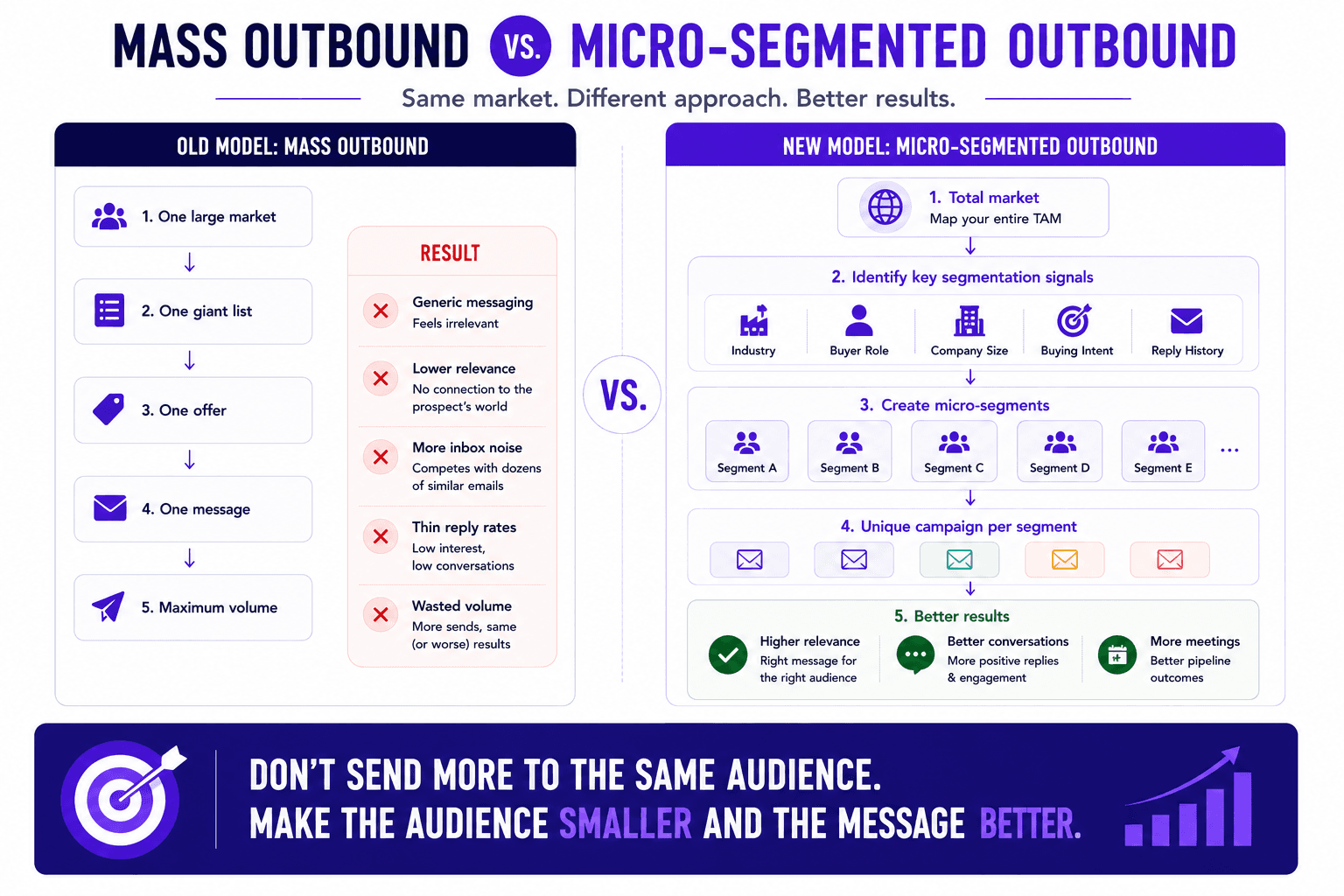
The volume model is simple to describe. You define a broad audience, build the biggest list you can, attach a direct response offer, and add a light call to action asking for a quick call. When the channel was quiet, relevance mattered less, because your email was often one of the only cold messages in someone's inbox that week. A generic pitch could still land because it had room to breathe.
That advantage came from scarcity, which no longer exists now that cold sending is cheap and common. A buyer who once received a handful of cold emails now receives many, and most of them read the same. When every message uses the same structure and the same vague promise, the reader stops distinguishing between them and clears the batch at once. The offer that used to carry a campaign now needs to be genuinely strong to survive, and most companies do not have an offer that stands that far above the market.
The volume model has not stopped working entirely. Teams with a rare offer or a clear cost advantage can still send broadly and convert. For everyone else, adding more volume to a generic campaign mostly adds noise, raises the risk to sending reputation, and produces the same thin reply rate at a larger scale. Because the ceiling is structural, the fix has to change the structure of the campaign rather than its size.

What micro-segmentation means in practice
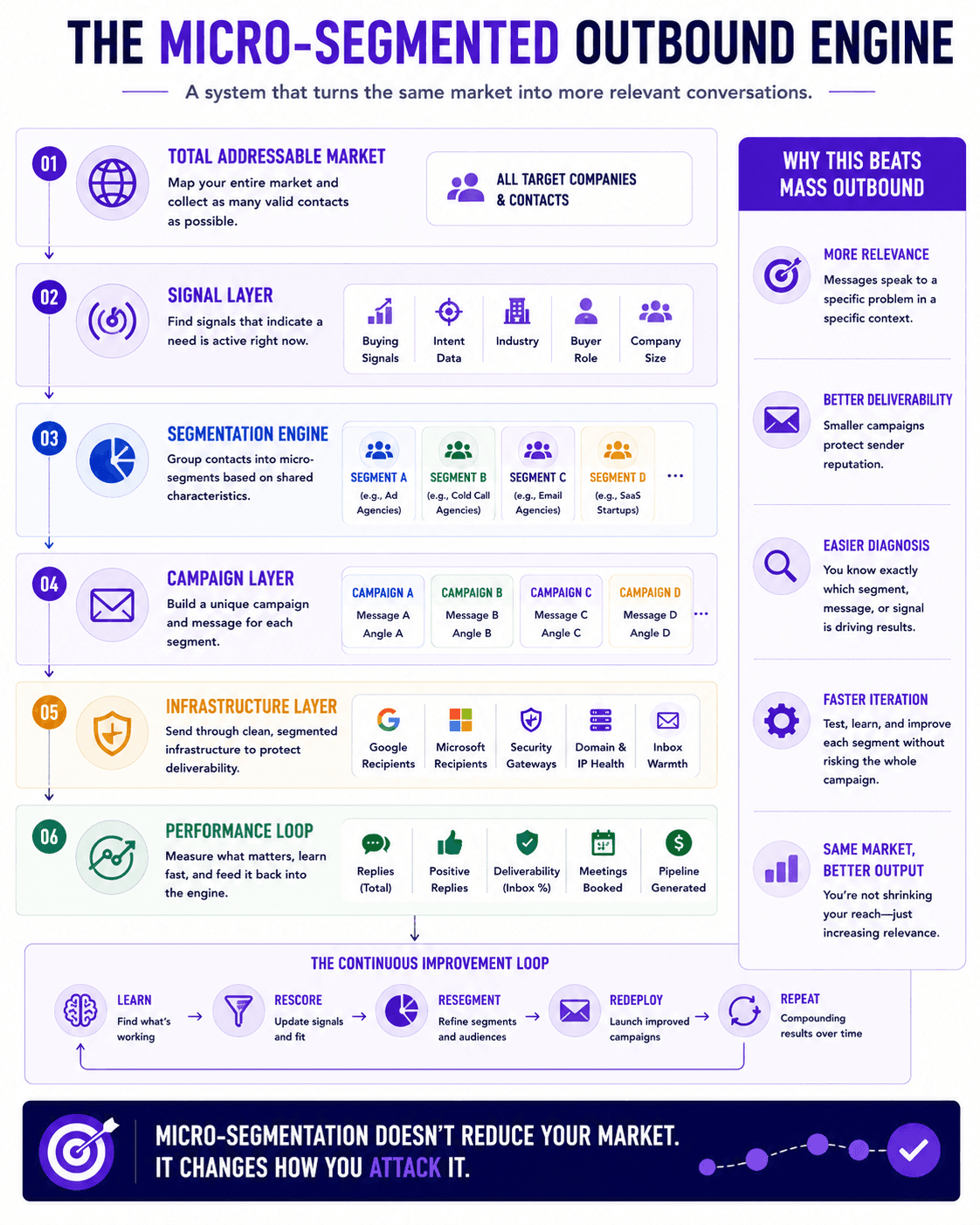
Micro-segmentation starts from the same place as the old model. You still map your total addressable market and gather as many real contacts inside it as you can. The difference is what happens next. Instead of treating that market as one audience, you divide it into many smaller groups, and you build a separate campaign for each group with messaging written for that group alone.
The groups come from attributes you can observe. You might split by industry, by the buyer's role, by the size of the company, or by the way the prospect already goes to market. A useful example from teams running this well is segmenting an agency list by the channel each agency sells, then writing to a cold calling shop about one problem and to an email shop about another. Each message reads as if it was written for that reader because, at the segment level, it was.
Modern tooling is what makes this practical. Splitting a market into dozens of segments and researching each one by hand used to take days, so almost no one did it. Research and enrichment tools now do that work at scale, which lets a small team produce many tailored campaigns in the time it once took to launch one. The result moves cold email closer to a direct marketing channel, where each email functions like an ad written for a single reader. We cover that framing in more depth in our piece on how cold email is becoming one-to-one advertising.
The signals worth segmenting on
Segments are only as good as the signals behind them. The strongest signals tell you that a specific problem is active right now, which gives your message a reason to exist beyond a general pitch.
Buying signals and intent data
The most reliable signals show that a need is live. A company that is hiring for a role you serve, expanding into a new market, or researching a category is easier to reach because the timing lines up with a real problem. We break these down in our guides on what buying signals are and what intent data is, and in our walkthrough of how revenue teams use buying signals to generate pipeline. Segmenting on these lets you write about the situation the buyer is already in rather than guessing at one.
Buyer role
The same company looks different depending on who you write to. A message to an operations lead about time and process reads nothing like a message to a finance lead about a line item on the budget, even when you are selling the same thing. Splitting a segment by role and adjusting the angle for each one often surfaces conversations you would miss with a single company-wide pitch, including from people you would not normally contact for that product.
Reply history
Reply history is the signal most teams ignore. People who have responded with interest to a cold email before are more likely to do it again, so scoring your list by past positive replies and running dedicated campaigns to those contacts tends to produce reply rates well above a cold list. If you have years of reply data sitting in a sequencer, that data is a segment you already own.
Segment your infrastructure, not just your list
Segmentation applies to sending infrastructure as much as to messaging. The inbox on the receiving end matters, because a Google inbox, a Microsoft inbox, and an inbox sitting behind a security email gateway each behave differently. Copy that lands well in one can bounce or filter in another.
Teams running micro-segmented campaigns match their sending setup to the receiving environment and treat each combination as its own small campaign. You might keep separate variants for Google recipients and Microsoft recipients, and remove or hold contacts protected by strict gateways unless you sell into enterprise, since those addresses make up a large share of a typical list and tend to drag down deliverability. Our guide to cold email infrastructure setup covers how to build this spread.
The practical payoff is control. When performance drops, you can see which specific micro-segment caused it and pause only that one, rather than shutting down the whole program while you diagnose the problem. If Microsoft delivery softens for a single industry segment, that segment pauses and the rest keep running. In a large mass campaign, a delivery problem in one corner of the list hides inside the average and forces a blunt response across everything.
Does micro-segmentation mean sending less volume?
No. Micro-segmentation changes how a market is organized, not how much of it you contact. You are still working the same total addressable market and reaching the same contacts you would have reached with a mass campaign. Those contacts are simply sorted into groups, and each group receives a message built for it.
In most cases the total send volume stays similar or grows, because tighter relevance improves deliverability and gives you room to run more sequences safely. What changes is the ratio of effort to result, since the same number of emails produces more conversations when fewer of them are generic. If your goal is more booked meetings without adding headcount, this structure is usually how teams get there, a point we expand on in how to get more sales meetings in 2026.
Is micro-segmentation just account-based marketing?
The two overlap but solve different problems. Account-based marketing concentrates coordinated effort on a defined set of high value accounts, often with sales and marketing working the same named list together. Micro-segmentation is a way to structure outbound across your whole market, including accounts you would never place on an ABM list.
You can think of micro-segmentation as bringing part of the ABM mindset, relevance built from real attributes, to a much larger audience. ABM goes deep on a few accounts with heavy personalization, while micro-segmentation goes moderately deep across many segments and uses tooling to hold quality steady as the audience grows. Many teams run both, using ABM for a short list of priority accounts and micro-segmented campaigns for the broader market underneath it. The cold email frameworks high-performing teams use show how these fit together in one program.
Which tool should you actually use?
Micro-segmentation depends on one core capability: pulling a market, enriching it with real data, and splitting it by signal without a week of manual work. That points to the data and enrichment layer as the tool decision that matters most, since your sequencer and inbox setup only handle what this layer produces.
Two common approaches sit at the ends of a spectrum. A high volume data platform like Apollo gives you broad contact coverage at a low price and works well when your main need is reach. A research and enrichment platform like Clay gives you the segmentation logic itself, running automated research across a list so you can build many signal-driven segments and write to each one. We compare these directly in our Apollo vs Clay breakdown, and cover the volume option in our review of the best unlimited B2B data enrichment tool.
For a team committed to micro-segmented campaigns, Clay is the stronger primary tool. Its value comes from turning attributes and signals into clean segments and personalized inputs at scale, which is the exact work micro-segmentation requires. A cheaper data source such as Apollo or an unlimited enrichment tool can feed it where you need raw volume. If you only ever plan to run broad sends, that added capability is more than you need and a simpler data tool will do the job. If segmentation is the point of your outbound, the enrichment engine is the piece worth building around. For a wider view of the category, our roundup of prospecting tools for B2B sales teams lists the main options.
Closing
Outbound is getting harder for a specific reason. The easy version, one list and one offer at maximum volume, no longer clears the noise it helped create. The teams still filling pipeline have moved to micro-segmented outbound campaigns, sorting the same market by signal and writing to each group as if it were the only one. The change asks more of your list building and your tooling, and it rewards you with conversations a generic campaign would never start.
If you want help building a micro-segmented outbound system that books qualified calls, book a 45 minute call with our team and we will map it out with you.