Article
Aug 24, 2026
How to Build a Multichannel Outbound System in 2026
A practical guide to building a multichannel outbound system in 2026: the layers, sequencing, tooling, and orchestration that book meetings.

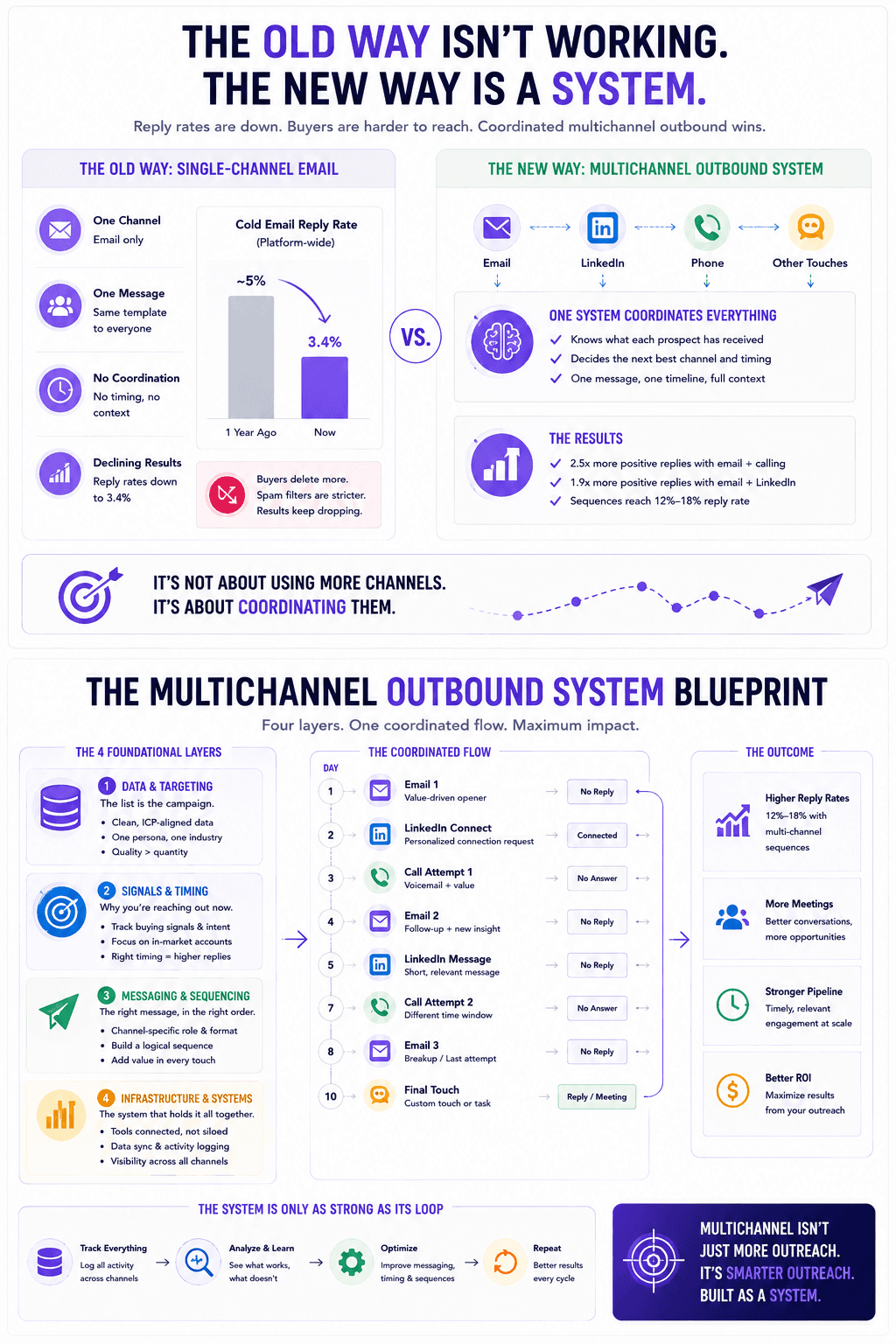
The math on single-channel email has changed. The platform-wide cold email reply rate now sits around 3.4%, down from roughly 5% a year earlier and well below where it was five years ago. Inboxes are fuller, spam filters are stricter, and buyers have trained themselves to delete anything that reads like a template. If email is the only thing you run, you feel this decline directly in your booked-meeting count.
The teams still hitting their pipeline targets did not find a better email trick. They stopped treating email, LinkedIn, and phone as separate motions and started running them as one coordinated system. A multichannel outbound system is the operating layer that decides which prospect gets which touch, on which channel, at which moment, based on what they have already done. This guide walks through what that system is actually made of, how to sequence the channels together, what tooling holds it in place, and how to keep it from breaking as you scale. If your goal is simply more sales meetings without adding headcount, this is the structure that gets you there.
What a multichannel outbound system actually is
Most teams that say they run multichannel outbound are really running several channels at once with no connection between them. Someone sends the email campaign. Someone else works LinkedIn. A rep dials from a separate list. Each channel has its own list, its own message, and its own timing, and nobody can see the full picture of what a single prospect has received.
The difference between running channels and coordinating them
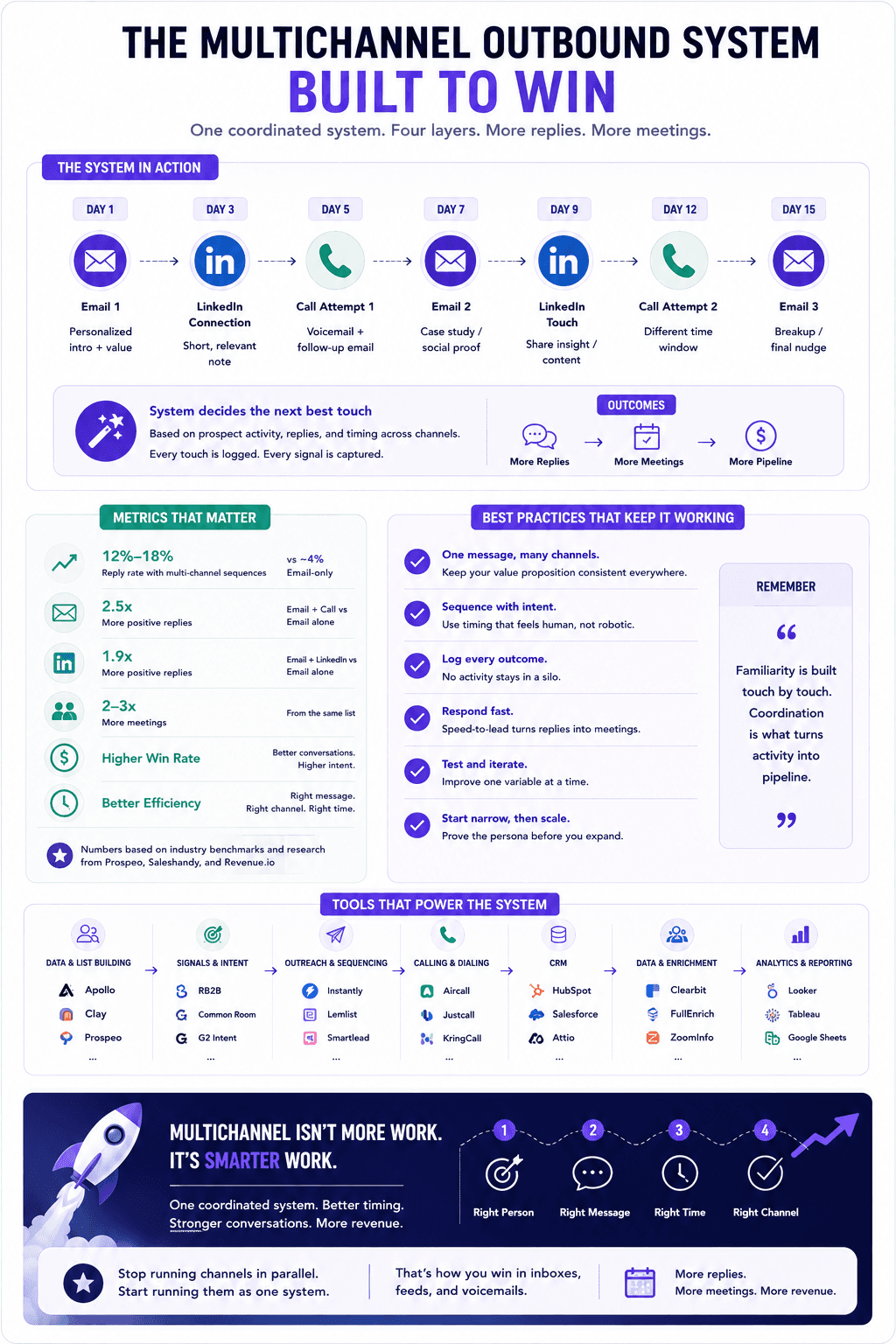
Running channels means you have activity across email, LinkedIn, and phone. Coordinating them means the system knows you emailed a prospect on Monday, so it queues the LinkedIn touch for Wednesday and holds the call until Friday, and it will not fire a second email until the call outcome is logged. That coordination is what produces the lift. Analysis of over 53 million cold emails found that adding a second channel meaningfully raises positive reply rates, with email paired with calling producing about 2.5 times the positive replies of email alone and email paired with LinkedIn producing about 1.9 times. Sales cadence data points the same direction, with well-built multi-channel sequences reaching a 12% to 18% reply rate against a roughly 4% email-only response rate.
The reason is simple. The first time a prospect sees your name they treat you as a stranger. By the third or fourth touch across different channels, you are familiar, and familiarity is what makes a call land warm instead of cold. Repeating the same message five times in the same inbox becomes spam. Spreading three related touches across three channels becomes a campaign.
Why the coordination is the hard part
The channels themselves are commodities. Anyone can buy an email tool, a LinkedIn automation tool, and a dialer. The difficulty is that these tools rarely talk to each other, so the coordination falls on a person tracking it in a spreadsheet, which holds together for a handful of accounts and collapses at any real volume. When different people handle different channels, the message drifts. The email pushes one value proposition, the call script leans on another, and the LinkedIn note says a third thing, so instead of reinforcing each other the touches confuse the prospect about what you do. A working system removes that drift by keeping one message and one timeline per prospect, no matter how many channels touch them.
The four layers underneath every working system
Before you design a single sequence, four layers need to be in place. Skipping any one of them is the most common reason outbound programs stall, and the failure usually gets blamed on copy when the real problem sits further down the stack.
Data and targeting: the list is the campaign
A multichannel system amplifies whatever list you feed it. Feed it a bad list and you simply reach the wrong people faster across more channels. Data quality, not messaging, is the single largest driver of outbound performance, and if your reply rate is under 2% with healthy deliverability, the list is almost always the cause. Build a tightly matched list around one persona and one industry at a time rather than a broad spread. The teams with the cleanest reply rates start narrow, prove a persona works, and only then expand, which is also how micro-segmented outbound campaigns consistently outperform mass sends.
Signals: why you are reaching out now
A static list tells you who fits your profile. A signal tells you who is likely in the market right now. Reaching out to an account with no signal is a coin flip on timing, while reaching out to an account that just raised funding, hired for a relevant role, or started researching your category gives every message a real reason to exist. Understanding what buying signals are and which ones are worth tracking is the difference between outreach that feels timely and outreach that feels random. Layered on top of that, intent data shows which accounts are actively researching a solution like yours, so you can prioritize the accounts already leaning in. Signals also have a shelf life. A funding announcement is worth acting on in week one and mostly stale by day 90, so the system needs to act on them within days, not at the next monthly list refresh.
Deliverability infrastructure: the part that quietly kills campaigns
Deliverability is a design decision, not an IT afterthought. Inbox providers now enforce strict complaint thresholds, and exceeding them damages the reputation of your entire sending setup rather than just one campaign, as Apollo notes in its sequence guidance. That means separating your outbound domains from your primary brand domain, warming them gradually, verifying every address before it enters a sequence, and keeping per-mailbox volume conservative. Getting this cold email infrastructure setup right is what lets the rest of the system run at all, because a sequence that lands in spam produces nothing regardless of how good the copy is.
Orchestration: one source of truth, one decision layer
Orchestration is where most stacks actually fail. Teams buy a signal tool, an enrichment tool, and a sequencer, then assume that connecting them equals coordinating them. It does not. Integration moves data between tools. Orchestration passes context between steps so a rep never has to patch the gap by hand. In practice that means one source of truth for account status, usually the CRM, one decision layer that owns routing and trigger logic, and one place to review a prospect's full history before anyone touches the account. This is the same principle behind an AI-powered sales operations system: the value is not in any single tool but in the logic that connects them.
How to sequence email, LinkedIn, and phone together
Once the four layers exist, the sequence is where they come together. The goal is a coordinated path that meets each prospect where they respond, without overwhelming them.
A realistic touch pattern over 18 to 21 days
The effective range for a multichannel sequence is around 8 to 12 touches across three or more channels over three to four weeks. A workable shape starts with a LinkedIn connection request on day one, a signal-anchored email on day three, a LinkedIn message on day seven after the connection is accepted, a value-add email around day ten, and a call in the second week once your name has already appeared several times. Seeing you three or four times before the phone rings is what turns a cold dial into a familiar one. Most meetings get booked between the sixth and tenth touch, which is exactly where many teams give up, since a large share of reps stop after a single follow-up. The specific cold email frameworks high-performing teams use give you a starting cadence you can adapt to your own segments.
Let behavior branch the sequence, not a fixed timer
A rigid timer treats every prospect the same. A good system reacts to what the prospect actually does. An accepted connection unlocks the next LinkedIn step. A click on a link changes the angle of the following message. A prospect who views your profile three times in a week is showing more intent than someone who opened one email, and the sequence should escalate accordingly. Behavior also decides speed on the way in. When a prospect replies with interest, speed to lead determines how many of those positive replies become held meetings, because a warm reply cools fast if it sits unanswered for hours.
When to stop: restraint as a design choice
More touches is not the same as better outbound. If every non-reply triggers another channel, the system turns into a pressure machine that trains prospects to mark you as spam. Sensible stopping rules keep the program healthy: pause for five to seven days after two unanswered follow-ups, avoid sending again unless you have a genuinely new angle rather than just a new channel, and stop the sequence entirely after three to five touches with no response. A prospect who engaged but did not book can move to a lighter nurture cadence, then be re-engaged a month or two later with a fresh signal and a new reason to reach out. Restraint protects deliverability and keeps your best accounts open for the next cycle.
How do you keep a multichannel system from breaking at scale?
Individual reps can hold a few accounts together in their head. Teams cannot, and this is where systems fail as volume grows. Three problems show up repeatedly.
The first is message drift, where the email, the call, and the LinkedIn note each emphasize something different and the prospect loses track of what you offer. The fix is a single core narrative that stays consistent across channels, worded differently for each one so it does not read as copy-paste. The second is double-touching, where a prospect ends up in two campaigns at once and receives three messages in a day. This is prevented by using the CRM as the single source of truth for who is currently enrolled and in what. The third is broken handoffs, where a rep touches an account without seeing that it was already worked, which happens whenever conversation history lives in a tool the rep does not check. Solving all three comes down to the orchestration layer described earlier: one status of record, one decision layer, and full visibility into history before anyone acts. A useful operating model here is the rolling cohort, where you work 300 to 500 tightly matched accounts through a 21-day primary sequence followed by a nurture cadence, which keeps the volume manageable and the data clean enough to learn from.
What tools do you need to build a multichannel outbound system?
The honest answer is fewer than most stacks contain. A typical outbound sequence in 2026 touches somewhere between eight and fifteen tools, and much of that sprawl is tax rather than capability. Rather than picking products, pick the jobs the system has to do and let one tool own each job cleanly.
You need a data and enrichment layer to build and verify lists, a signal source to tell you who is in market, email sending infrastructure with proper domain and mailbox setup, a LinkedIn workflow tool, a way to queue calls, a sequencing layer that coordinates touches across all of those, and a CRM that owns account status and reporting. The specific vendors are interchangeable and worth comparing on fit, which is what a cold email stack breakdown for B2B is for. What is not interchangeable is the operating logic that connects them. On the build-versus-buy question, teams with a capable operator can assemble this themselves, while teams without one increasingly lean on AI SDR systems that handle the prospecting layer so their people focus on conversations rather than tool babysitting. Either way, consolidating the data-to-sequence handoff tends to give the fastest return, since manually pulling from a data provider and importing into a sequencer is where most rep time quietly disappears.
How many channels should you actually run?
Two channels done well beats four done poorly, every time. Adding a channel only helps if you can coordinate it, and a half-built third channel usually creates more noise than pipeline. Start with email as the volume foundation, then add the one channel your buyers actually use.
If your prospects are active on LinkedIn, add a LinkedIn touch as your second channel, since it earns trust and warms the account before the harder asks. If they live in an industry where LinkedIn is thin or the deal size is large enough to justify the effort, add the phone instead, because most senior buyers still accept a well-timed call and the conversation gives you feedback no deleted email ever will. The point is not to be everywhere. It is to be present on the channels where your specific buyers respond, with enough coordination that each touch reinforces the last. This is the same reasoning behind the ongoing LinkedIn versus cold email comparison: the channels are complements, not competitors, and the teams that stopped choosing between them are the ones pulling ahead.
Building the system that compounds
A multichannel outbound system is not a stack of tools bolted together. It is a coordinated operating layer where clean data, timely signals, solid deliverability, and one decision layer feed a sequence that meets prospects where they respond. Three things separate the programs that work from the ones that stall. Coordination beats volume, so fewer well-timed touches outperform more scattered ones. Signals beat static lists, so reaching out with a real reason beats reaching out on schedule. And infrastructure comes first, because the best sequence in the world produces nothing from the spam folder. Get those right and the system compounds, with each month outperforming the last as your domains strengthen, your targeting tightens, and your data teaches you what actually books meetings.
If you would rather have this built and run for you than assemble it piece by piece, book a call with our team and we will map the system to your pipeline.