Article
Aug 26, 2026
How to Build an AI Outbound Agent for Prospecting and Personalization
Learn how to build an AI outbound agent for prospecting and personalization: the layers, signals, guardrails, and build-vs-buy decision.

Most sales reps spend the majority of their week on work that has nothing to do with selling. They build lists, hunt for contact details, read through LinkedIn profiles, and write research notes that go stale before the email even sends. The list you pulled on Monday is already decaying by Friday, because people change jobs, companies shift priorities, and budgets freeze without warning.
An AI outbound agent exists to close that gap. It handles the research, drafting, and sending that sit between a raw list and a booked meeting, and it does the work continuously instead of in the bursts a human can manage. The goal is not to remove people from outbound. It is to give the top of the funnel a system that runs on signals and verified data rather than guesswork. This guide walks through what an AI outbound agent actually is, the layers it needs to work, how to build the prospecting and personalization sides, and where a human still has to stay involved.
What an AI Outbound Agent Actually Is (and What It Isn't)
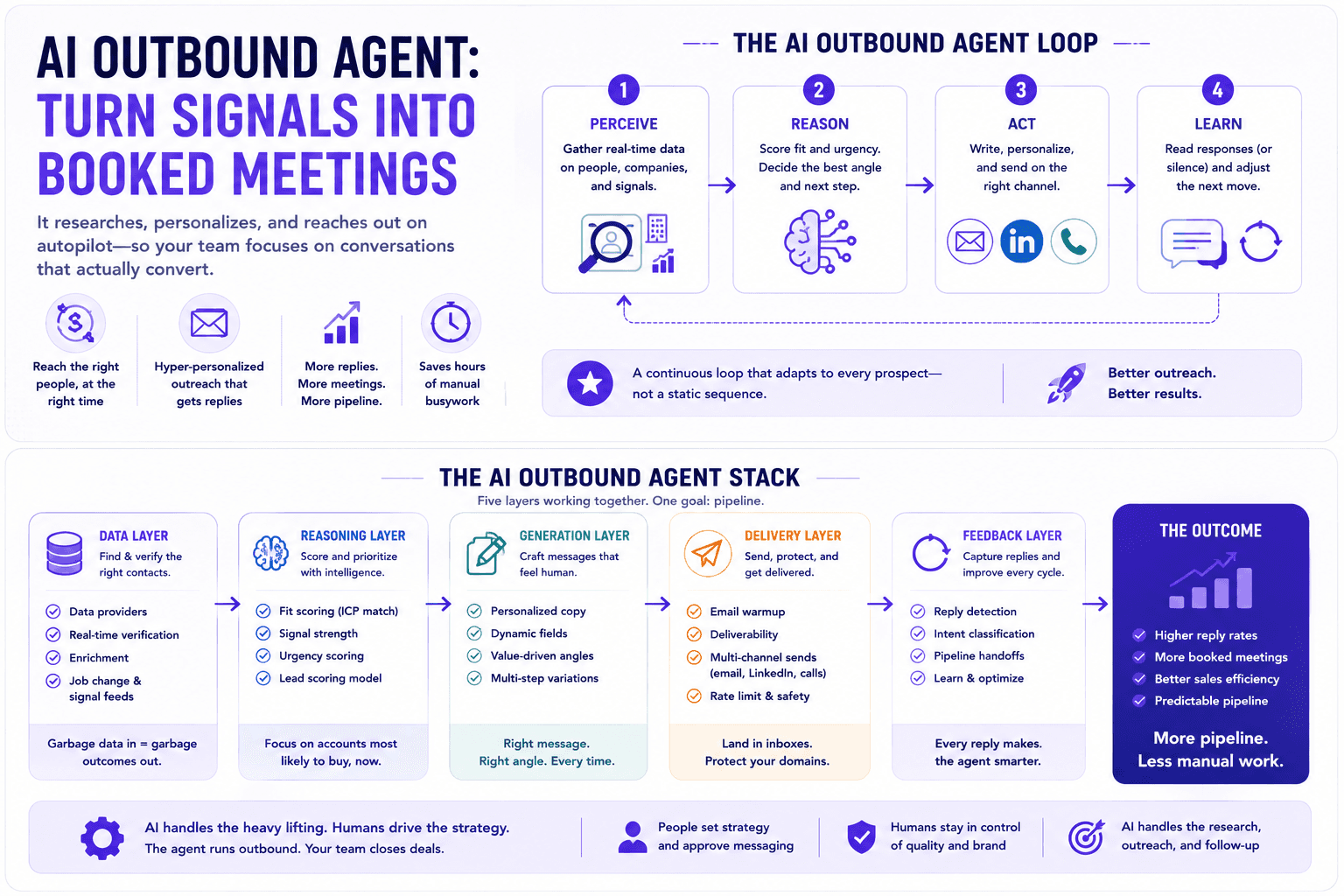
A traditional sales sequence is a fixed pipe. It sends step one, waits, then sends step two, regardless of who is on the other end or how they responded. An AI outbound agent adds a decision loop on top of that pipe. It reads each prospect's context, decides what to say and whether to say anything at all, and adjusts based on what comes back. That feedback loop is the difference between automation and an agent.
The clearest way to think about the loop is in four steps. The agent perceives by pulling data about a person and their company. It reasons by deciding whether the account fits and what angle makes sense. It acts by writing and sending on the right channel. Then it learns by reading the reply, or the silence, and choosing the next move. This perceive, reason, act, learn cycle is what separates a real agent from a sequencer with an AI logo on it.
The term itself covers three different product categories that get compared as if they were the same thing. Sequencing platforms automate the sending but still need a person to load contacts and write the messages. Autonomous AI SDRs run the full motion with minimal human involvement. All-in-one agent platforms combine the data layer, the sending layer, and an agent doing the operational work, while keeping people in control of strategy and approvals. Knowing which category you actually need shapes everything you build after.
The Layers Underneath a Working Agent
No single product does the whole job well. An AI outbound agent is an assembly of layers, and the weakest one caps the quality of everything downstream. There are five that matter.
The data layer sources and verifies who you are reaching. The reasoning layer decides who fits and how urgent they are. The generation layer writes the message. The delivery layer sends it and protects your domains. The feedback layer reads responses and feeds them back into the loop.
The mistake we see constantly is teams pouring attention into the reasoning and generation layers, the visible AI part, while starving the data layer. That is backwards. A brilliant prompt writing to a stale, unverified list produces beautifully personalized bounces. The unglamorous foundation of a reliable contact source and real-time verification does more for results than swapping which model writes your first line. Garbage contacts in, garbage outcomes out, just faster and at higher volume. Build the data layer first, then work up.

How to Build the Prospecting Side
Prospecting is where most agents either earn their keep or quietly waste money. The work breaks into three parts: deciding who to reach, ranking them, and making sure the contact data is real.
Start With Signals, Not Static Lists
The biggest shift in prospecting is not about the AI itself. It is about what the AI operates on. Static firmographic lists tell you who might be a fit. Signals tell you who is likely to be looking right now. A buying signal is any observable event that raises the odds an account is in the market: a leadership change, a funding round, a hiring surge, a new technology adoption, a public strategic shift. When a target account hires a new VP, the agent can trigger a sequence that references that specific hire while the moment is still fresh.
This is where intent data does its work. Job-change monitoring is one of the highest-value signals available. When a decision-maker who evaluated your product at a previous company moves into a new role, an agent can catch that transition within hours instead of weeks, which turns a cold contact into a warm one that most competitors never notice. The point of building on signals is that your list stops going stale, because it is rebuilt continuously from live events rather than downloaded once and worked until it dies.
Score for Fit and Urgency
Once accounts are flowing in, the agent needs to rank them. Outbound lead scoring combines fit (does this match your ideal customer profile) with signal strength (how many buying triggers are firing and how recent they are). The reasoning layer uses that score to decide which accounts get worked first and which sit in a lower-priority bucket. One enterprise team we worked with doubled its sales efficiency after moving to this approach, because reps were engaging accounts at the right time instead of working a list in whatever order it happened to load.
Verify the Data Before It Reaches the Inbox
This is the foundation that decides whether everything above it matters. The agent should enrich each lead with the details it needs to reason and personalize, then run every address through email verification before a single message is queued. Skipping verification is how a well-built agent ends up sending polished emails to addresses that bounce, which drags your sender reputation down and takes the good addresses with it.
How to Build the Personalization Side
Personalization is the part everyone talks about and most teams get wrong. Swapping a first name and a company name into a template is not personalization. It is a mail merge, and buyers recognize it instantly.
Real personalization is research-grounded. The generation layer should write a personalized first line that references the actual reason this account is a fit right now, drawn from the signal that surfaced them and the research the agent pulled. The message answers an unspoken question in the prospect's head, which is why you are writing to me, specifically, today.
The way to make this repeatable is to encode your rules once rather than re-prompting for every batch. Building a reusable skill for cold email personalization lets you lock in your ICP context, your voice, your framework, and your quality checks so the agent produces consistent output at volume. Reply rates depend far more on targeting quality and message relevance than on which model you use, so the effort belongs in the research and the rules, not in chasing a slightly better writing engine.
One caution worth stating plainly: personalization quality tends to drop as volume climbs unless each prospect carries genuine signal context. If the agent has nothing specific to say about an account, it should say less rather than manufacture relevance. A short, honest message beats a long one padded with fake familiarity.
Guardrails, Human Oversight, and Deliverability
An agent that can act is an agent that can cause damage at machine speed. The controls below are not optional extras. They are what makes the difference between a demo that impresses and a system you can actually run in production.
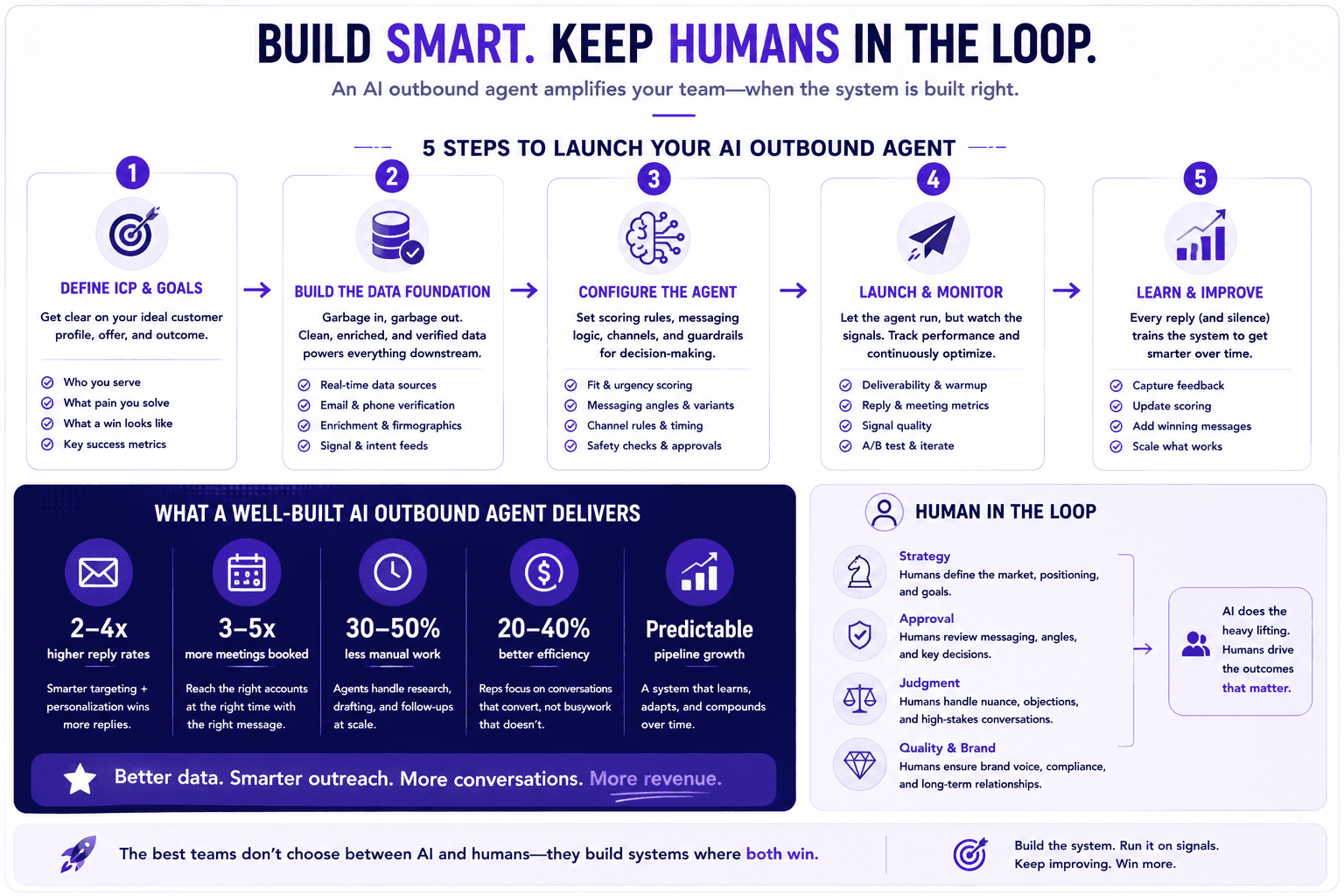
Where Should a Human Stay in the Loop?
The useful way to think about oversight is per action, by risk, not once for the whole agent. A single agent can read data on its own, monitor its own sending on a dashboard, and still stop to ask a person before it does anything hard to reverse. The deciding factor is blast radius, meaning how difficult it would be to undo an action, not how capable the agent is.
For outbound, that usually means the agent can research, score, and draft autonomously, while a person reviews messaging for new segments, approves any change to sending volume, and signs off before the agent contacts high-value strategic accounts. List every action the agent can take, then gate only the small set that would be expensive or embarrassing to get wrong. Everything else can run without a checkpoint. This keeps the system fast where speed is safe and careful where it is not.
How Do You Keep an Agent From Wrecking Deliverability?
Deliverability is the constraint that quietly decides whether any of this works, because an agent that lands in spam is just an expensive way to talk to no one. The cold email infrastructure underneath the agent has to be built before you scale sending: authenticated domains, warmed inboxes, sensible daily limits, and monitoring that flags reputation problems early.
Two general agent-security principles apply directly here. Grant the agent only the access each task needs rather than broad permissions it will rarely use, and require human approval on any irreversible action. Treat every external input the agent reads, from web pages to email replies, as untrusted, since an agent that acts on what it reads can be misled by what it reads. Log every send and every decision so you can review what happened when something goes wrong. These controls sound heavy, but they mostly involve setting boundaries once and letting the agent operate inside them.
Build vs. Buy
Should You Build Your Own or Use a Platform?
The honest answer depends on where your friction actually is. If your main problem is running cadences for accounts already in your pipeline, you need a sequencing tool, not an agent. If your problem is figuring out which accounts to work and what to say, you need the agent layers described above.
Most small and mid-size teams get the best balance from an all-in-one platform with agents built in, because assembling the data, reasoning, generation, and delivery layers yourself is real engineering work. Comparing the AI sales agents built for B2B is a reasonable starting point. That said, teams that want full control over the logic and want the system to compound over time often build their own. We documented how we built an AI lead generation engine that handles sourcing, research, and personalization, and the pattern there applies whether you buy the pieces or build them. Start with the layer causing the most friction and expand from there. A stack you use consistently beats a more sophisticated one that sits half-configured.
What Reply Rates Are Realistic?
Set expectations before you start, because unrealistic targets lead teams to abandon systems that were actually working. Well-targeted AI outbound typically sees single-digit reply rates on cold email, in the range of three to eight percent, with higher rates on LinkedIn. Generic AI output with weak targeting performs worse than a smaller manual campaign. The lever that moves reply rate is not the AI tool. It is the quality of your targeting and the relevance of your message, which is exactly why the data and personalization layers deserve most of your attention.
Follow-up matters as much as the first touch. When a positive reply comes in, speed of response decides how many of those replies turn into booked meetings, and an agent that handles after-hours responses captures interest a human would miss overnight.
Bringing It Together
Building an AI outbound agent for prospecting and personalization comes down to three things. Get the data layer right first, because everything above it inherits its quality. Build prospecting on live signals and verified contacts so your list stops decaying. Ground personalization in real research rather than merge tokens, and keep a human at the small number of checkpoints where a mistake would be costly.
The teams that win with this are not the ones with the most advanced model. They are the ones who built the boring layers properly and set clear boundaries for what the agent can do on its own. If you are trying to figure out where your outbound is losing the most time or pipeline, and which layer to build first, book a call with our team and we will help you map it out.