Article
Sep 29, 2026
What Is a Multichannel Outbound Strategy?
A multichannel outbound strategy coordinates email, LinkedIn, and phone into one motion. What it is, why it lifts replies, and how channels combine.
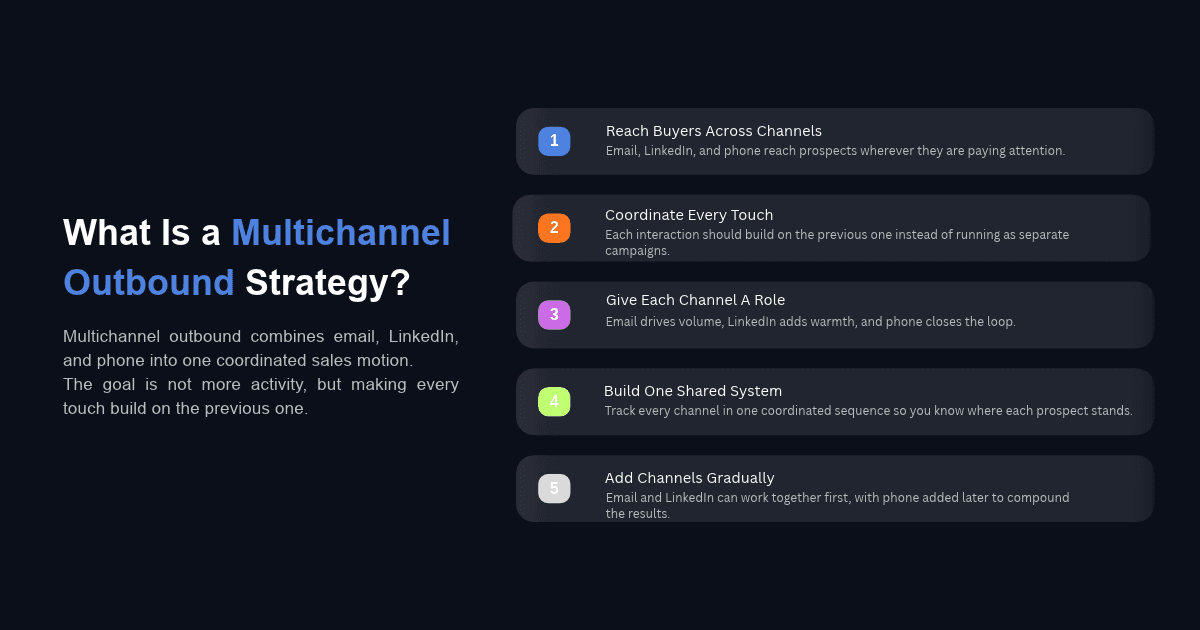
A multichannel outbound strategy reaches prospects across several channels, most commonly email, LinkedIn, and phone, as part of one coordinated motion rather than through separate, isolated efforts. The definition matters because the word coordinated is doing most of the work. Sending the same message across three channels at random is not a strategy, it is noise on three channels. A real multichannel strategy sequences the channels intentionally so each touch builds on the last.
The reason this approach has become the default for serious outbound is straightforward: it works far better than any single channel. Coordinated sequences across email, LinkedIn, and phone can lift response rates by roughly 287% over single-channel outreach, a difference large enough to separate a pipeline that works from one that quietly dies. This guide explains what a multichannel outbound strategy actually is, why it produces that lift, what role each channel plays, and the principle that makes it work.
Why single-channel outreach falls short
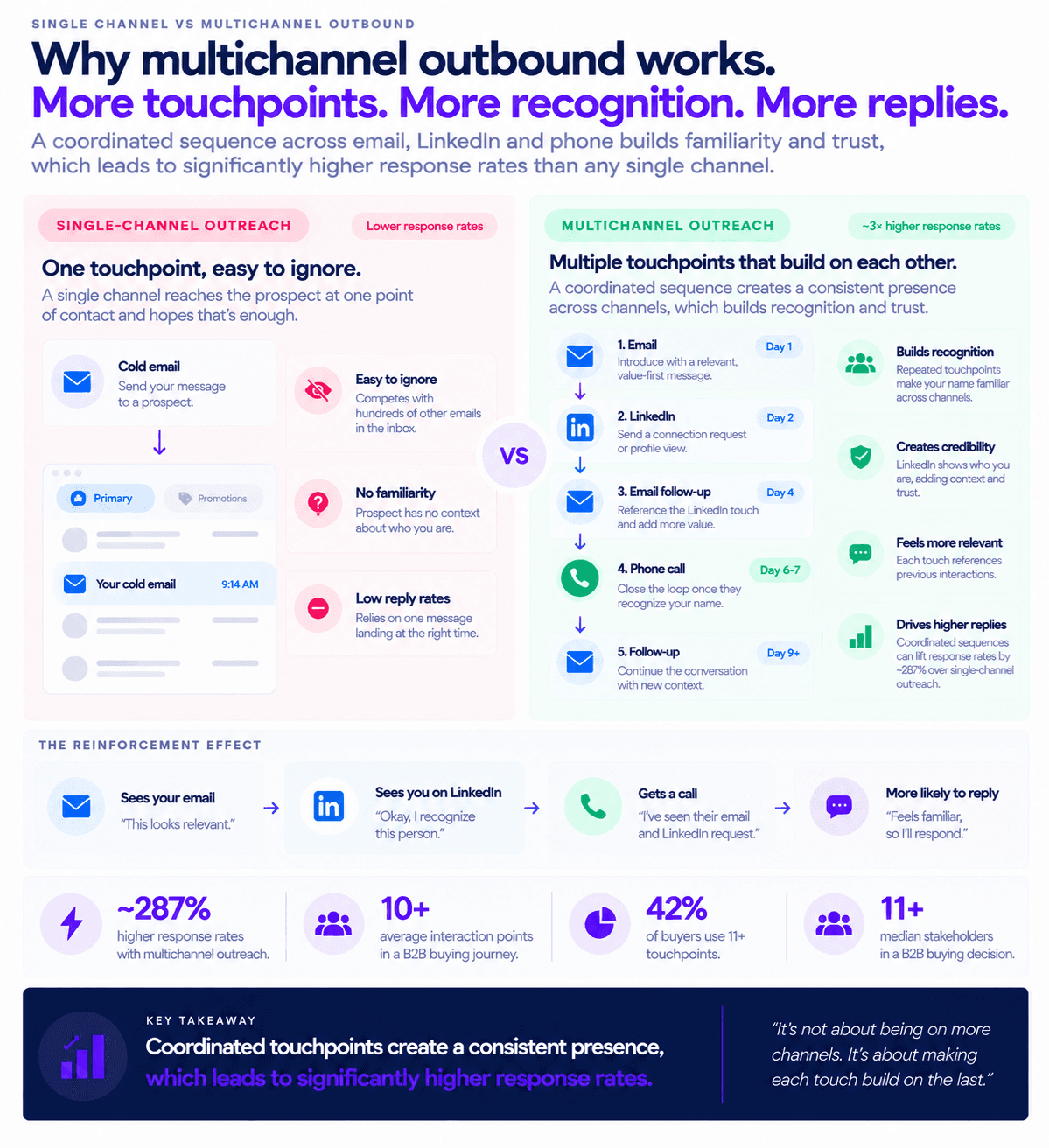
The case for multichannel starts with how buyers behave. B2B buyers now use an average of ten or more interaction points across their purchase journey, and 42% use eleven or more touchpoints before making a decision, spread across email, social platforms, and phone. A single-channel program, however well executed, reaches a buyer at one point of contact and hopes that is enough, which leaves it invisible everywhere else the buyer is paying attention.
Buying committees have also grown, with the median B2B decision now involving more than eleven stakeholders. Reaching a committee that size through one channel is close to impossible, since different stakeholders live on different platforms and check them at different times. Meeting the buying group wherever its members are paying attention on a given day is what a multichannel approach does, and it is why single-channel outreach increasingly underperforms regardless of how good the message is.
Why coordination produces the lift
The headline statistic that multichannel drives around three times more replies is consistent across benchmark sources, with independent reports finding that multichannel sequences produce two to three times more replies than single-channel ones on the same target list. The lift does not come from volume alone, since blasting more messages would simply annoy people. It comes from a reinforcement effect.
A prospect who receives a cold email, then sees a LinkedIn connection request from the same person, then gets a follow-up email that references the LinkedIn touch, experiences a coherent narrative that a single email cannot create. The repetition across channels builds recognition, and recognition lowers the psychological barrier to responding, so by the time a call lands the prospect already knows the name. This is the mechanism behind the numbers, and it is why coordination rather than raw activity is what produces the result. It is also the difference between a genuine multichannel strategy and simply running three channels in parallel, which produces noise rather than pipeline.
The role each channel plays
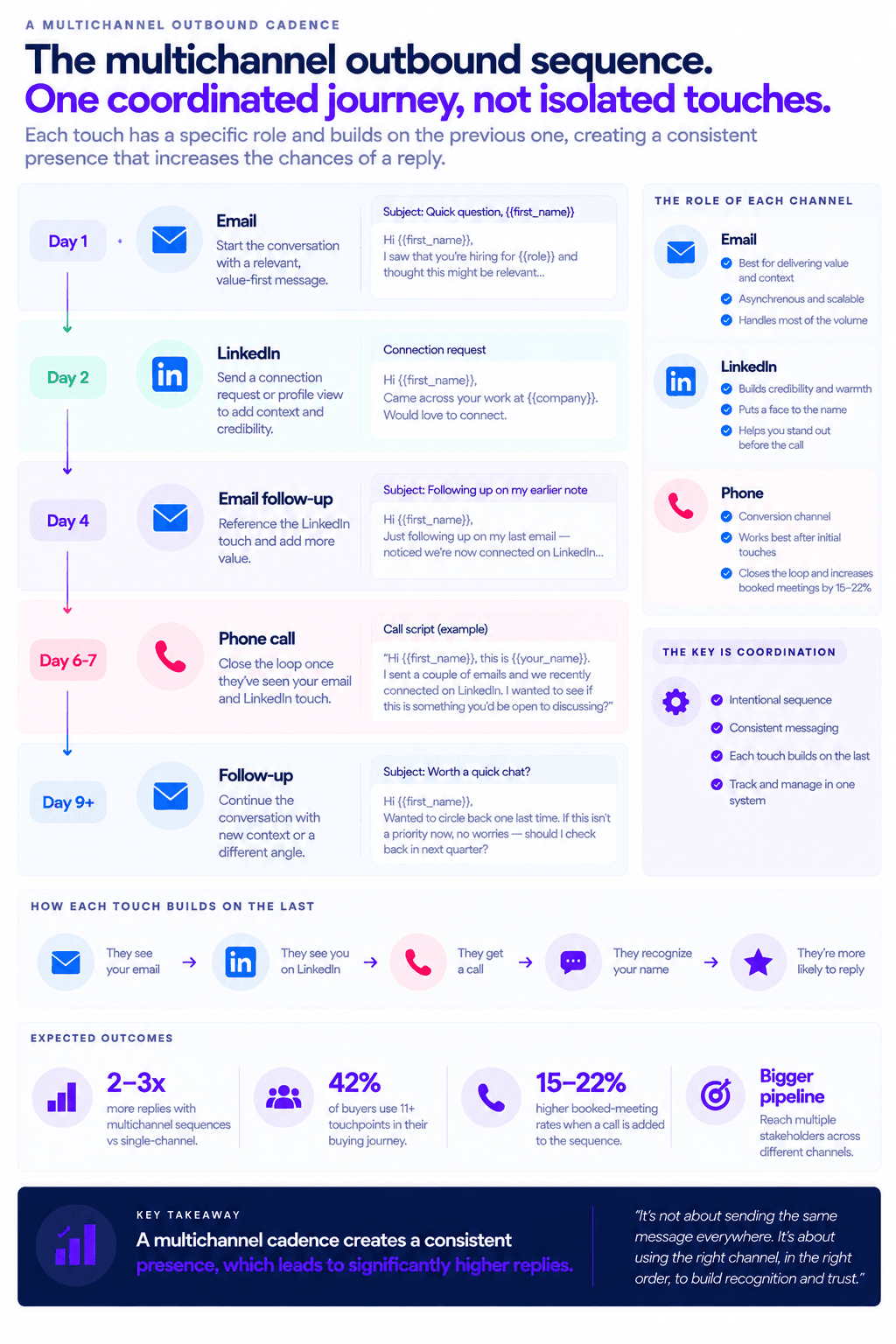
A multichannel strategy works because each channel does a distinct job, not because the same message appears everywhere. Email is the workhorse, cheap to scale, asynchronous, and ideal for delivering value and context that a prospect reads on their own schedule, and it does most of the volume in a sequence. LinkedIn adds credibility and warmth, since a profile view and a connection request put a face to the name and let the prospect see who is reaching out, which softens the later touches. Phone is the conversion channel, the one that closes the loop, and its role in the sequence is specific.
Understanding how the channels differ in strengths and costs is worth its own decision, covered in cold email versus LinkedIn versus cold calling. The important point for strategy is that the phone is rarely the first or second touch. It works best as the touch that closes the loop once a prospect has already seen the sender in their inbox and on their feed, and adding one call attempt per sequence at that point lifts booked-meeting rates by 15 to 22%. The channels are complementary, and the sequence in which they are used is part of the strategy, which is the subject of building a multichannel cadence.
Multichannel is a system, not a set of tactics
The final part of the definition is that a multichannel strategy requires architecture behind it. Each touchpoint has to be planned, the order of channels has to be intentional, the message at each stage has to build on what came before, and data from every channel has to feed a shared view of where each prospect sits in the journey. Without that architecture, multichannel activity produces noise rather than pipeline, which is why so many teams try multichannel and conclude it does not work.
That architecture is exactly what a full outbound lead generation system provides, and a multichannel strategy is the orchestration layer within it. The number of touches across those channels is a specific question worth deciding deliberately, addressed in how many touches a sequence should have. Getting the targeting right so the coordinated effort reaches the right accounts still depends on the buying signals and intent data underneath it, and running the motion as a connected engine is what makes it repeatable, closely related to the existing multichannel outbound system. Speed matters once a prospect engages on any channel, which is why acting fast on a reply belongs in the strategy too.
How much lift each combination adds
The headline figure of roughly three times more replies is the ceiling, and it helps to see the smaller lifts that build toward it, because they show that even a partial move to multichannel pays off. Adding LinkedIn to an email sequence, coordinated rather than parallel, lifts reply rates by around 30 to 50% over email alone at the same volume. Bringing the phone in on top of email and LinkedIn lifts conversion by a further 28 to 37% compared with sticking to one channel. Across the whole motion, brands coordinating three or more channels see materially higher purchase rates than single-channel programs.
The practical takeaway is that you do not need all three channels running perfectly on day one to benefit. A coordinated two-channel motion of email and LinkedIn already outperforms email alone, and adding the phone as a later step compounds the gain. This is why building the strategy inside a proper outbound system matters, since the targeting from a clear ideal customer profile and the prioritization from lead scoring decide whether the coordinated effort lands on accounts worth the extra channels. Segmenting the audience so each group gets a relevant version of the sequence, as in micro-segmented outbound campaigns, is what keeps a multichannel motion personal at scale, and the whole point is to book more meetings than any single channel could on its own.
What channels does a multichannel outbound strategy use?
The proven core is email, LinkedIn, and phone, sometimes supplemented by other touchpoints. Email carries most of the volume because it is scalable and asynchronous, LinkedIn adds credibility and warmth through profile views and connection requests, and phone is the conversion channel that closes the loop after the digital touches have built recognition. Some programs add SMS, voicemail, or paid touchpoints, but the three-channel core of email, LinkedIn, and phone is what the benchmark data consistently shows driving the largest lift.
What is the difference between multichannel and omnichannel outbound?
The distinction is coordination. A basic multichannel approach can mean running channels in parallel with little coordination, where each operates in isolation and the results are weaker. An omnichannel or cross-channel approach coordinates the channels into a single motion, so the messaging at each stage references and builds on the others and a shared view tracks where each prospect sits. In practice the strategies that produce the large response lifts are the coordinated kind, so the useful goal is coordination regardless of the label, since parallel channels without coordination produce noise rather than pipeline.
Why does multichannel outbound work better than single-channel?
Two reasons. First, buyers spread their attention across ten or more channels and buying committees involve many stakeholders, so a single channel simply cannot reach everyone who matters. Second, coordinated touches across channels create a reinforcing narrative that builds recognition, which lowers the barrier to responding, so a prospect who has seen you in their inbox and on their feed is far more likely to take a call. Together these produce the roughly threefold lift in replies that benchmark data consistently reports for coordinated multichannel sequences.
Bringing it together
A multichannel outbound strategy coordinates email, LinkedIn, and phone into one intentional motion rather than running them as separate efforts. It works because buyers spread their attention across many channels and large committees, and because coordinated touches build a recognition that a single channel cannot, producing roughly three times the replies of single-channel outreach. Each channel plays a distinct role, with email carrying volume, LinkedIn adding warmth, and phone closing the loop, and the whole thing depends on the architecture that plans the sequence and tracks each prospect. Coordination, not raw activity across three channels, is what makes it a strategy.
If you want help building a coordinated multichannel outbound motion, book a call with the Novoslo team and we will show you exactly how it works.