Article
Aug 13, 2026
How to Send 10,000 Cold Emails a Day
Learn the infrastructure, inbox math, and warmup process behind sending 10,000 cold emails a day without burning your domains or landing in spam.
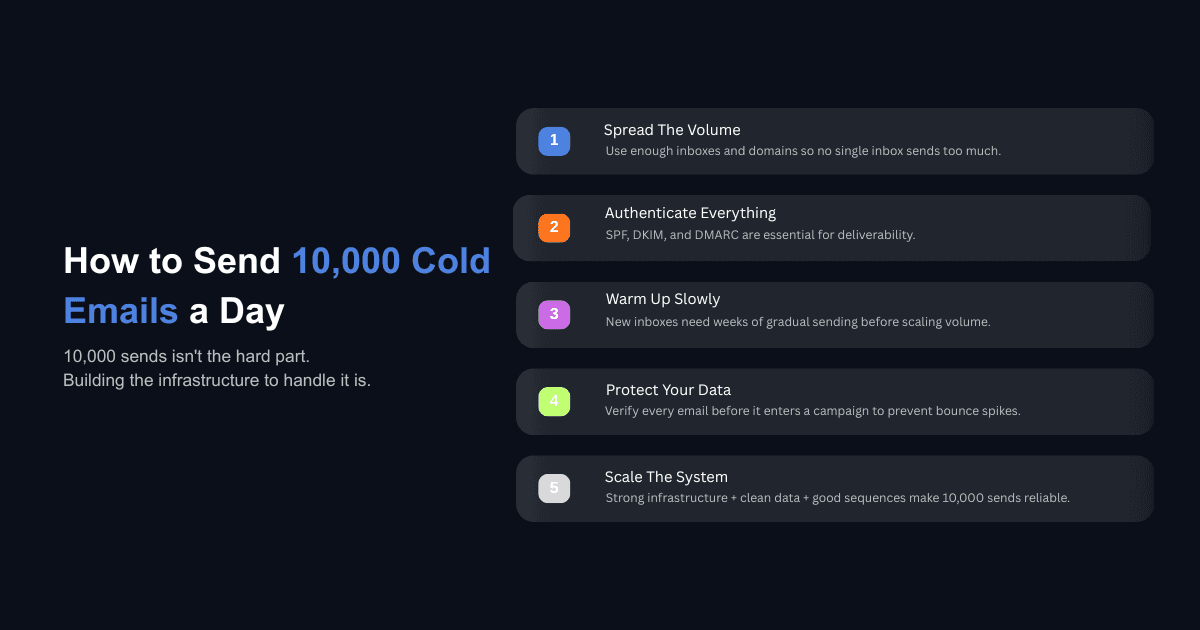
Sending 10,000 cold emails a day sounds like the hard part. It isn't. Any campaign tool can push that many messages out the door. The hard part is landing them in the inbox at that volume, day after day, without your domains getting flagged and your reply rate quietly falling to zero.
Most teams get this backwards. They fixate on the number, buy a tool, load a list, and start blasting. Within two weeks their open rates collapse and they blame the copy. The copy was probably fine. What broke was the system underneath it, and that system was never built to carry high volume in the first place.
This guide walks through what actually makes 10,000 sends a day possible: the inbox and domain math, the authentication setup, the warmup process, and the campaign structure that keeps replies coming in. We will also cover which tool makes the most sense once the foundation is in place. If you want a predictable outbound channel rather than a burned out set of domains, this is the order to build it in.
What 10,000 a Day Actually Requires
The first thing to understand is that email providers do not react to how many emails your campaign sends in total. They react to how many emails each individual inbox sends. Gmail and Microsoft watch the behavior of a single address, and a single address that jumps from a handful of sends to several hundred in a day looks nothing like a real person. That pattern is what gets flagged, not the size of your campaign.
So the goal is not really "send 10,000 from one place." The goal is to build enough sending capacity, spread across enough inboxes, that no single inbox ever does anything a provider would treat as suspicious. When you frame it this way, the number stops being a quota and becomes a capacity question: how many well-behaved inboxes do I need running in parallel to reach 10,000 total safely?
This reframe matters because it changes what you buy and how you set it up. You are not looking for one powerful sending account. You are building a fleet of ordinary-looking ones. Teams that understand this scale cleanly. Teams that don't tend to end up in the pattern we cover in why most cold email campaigns are dying in 2026, where the infrastructure was wrong before a single word of copy was written.
The Infrastructure Math: Domains, Inboxes, and Sending Limits
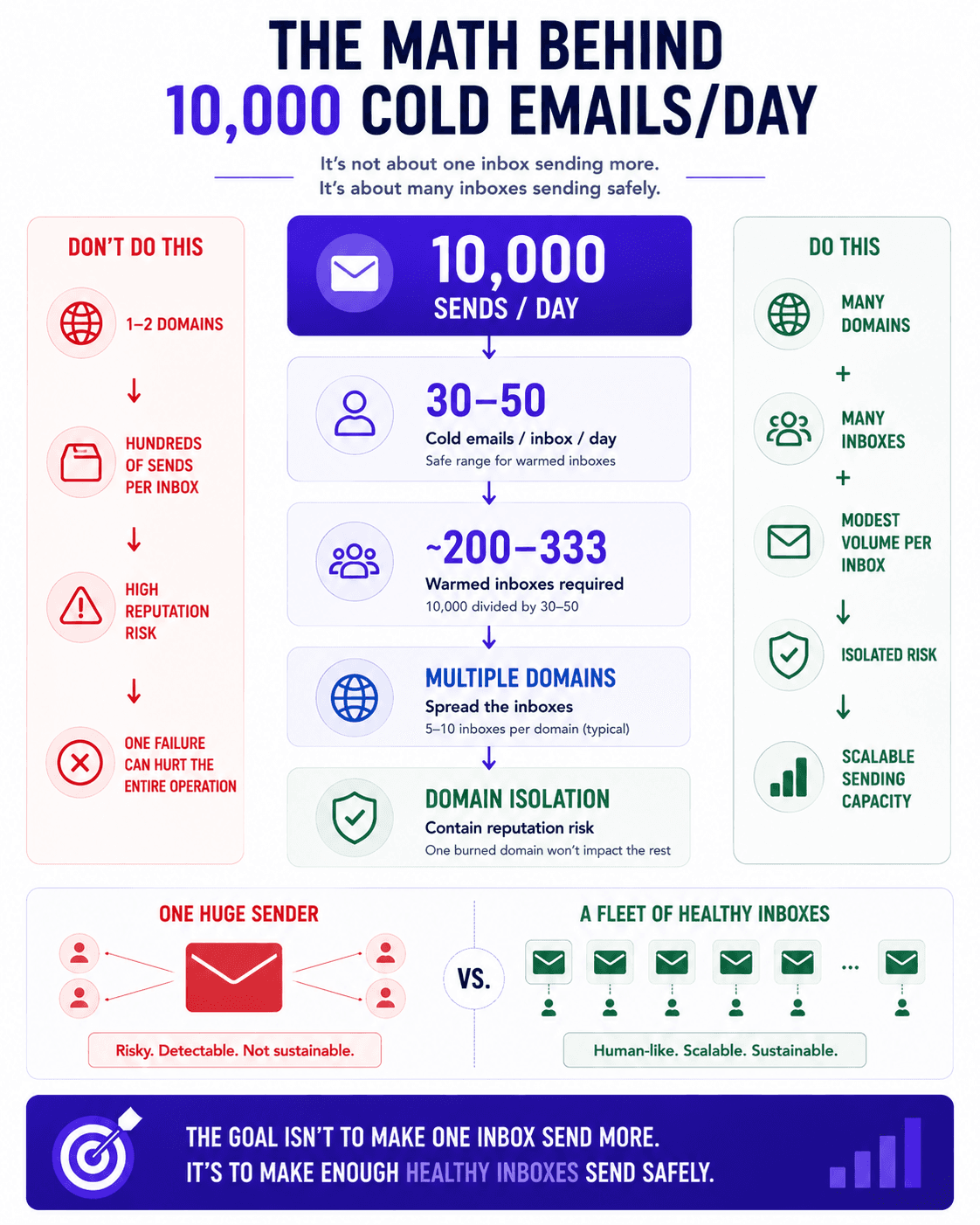
Once you accept that per-inbox volume is the real constraint, the math is straightforward. You work backwards from a safe daily send per inbox, then add inboxes and domains until the total reaches your target.
How many inboxes you need
The safe ceiling for a warmed inbox sits in the range of roughly 30 to 50 cold sends per day. Providers like Google Workspace will technically let you send far more, but deliverability practitioners consistently recommend staying well below those technical limits because the risk climbs sharply as you push a single inbox harder. Newer inboxes start much lower, often 5 to 10 a day, and earn their way up over several weeks.
If you plan around a conservative number per inbox, reaching 10,000 a day means running a few hundred inboxes in parallel. That sounds like a lot, and it is, which is exactly why high volume is an infrastructure project rather than a copywriting one. The count is not the point. The point is that every inbox stays inside a range that looks human.
Spreading across domains
You do not put all those inboxes on one domain. A common structure is to run a handful of inboxes per domain and spread the total across many domains. This does two things. It keeps each domain's daily footprint modest, and it isolates risk so that a problem on one domain does not take the whole operation down with it.
Domain isolation is one of the most underrated parts of a serious setup. We break the full architecture down in our guide to the best cold email infrastructure setup for B2B companies, but the principle is simple: separate your sending domains from your primary company domain, and separate them from each other, so reputation damage stays contained.
Why one burned domain shouldn't matter
When you scale by adding inboxes and domains rather than by pushing existing ones harder, a single burned domain becomes a minor event instead of a crisis. You pull it, warm a replacement, and the rest of the system keeps running. Teams that concentrate all their volume on one or two domains have no such buffer. The whole channel goes dark the moment one domain's reputation drops. Choosing where those inboxes live also matters, which is why it helps to compare the best cold email inbox providers before you commit to a setup at this scale.
Domain and Authentication Setup
With the math settled, the next job is standing up the domains and authenticating them properly. This is the least glamorous part and the part most teams rush. It is also the part that quietly decides whether your emails reach the inbox at all.
Buying and structuring sending domains
Buy separate domains for sending, kept distinct from your main brand domain. Many teams use close variations of their primary domain so replies still feel legitimate to a prospect who checks. Point each sending domain's forwarding to your real website, so anyone who visits lands somewhere real rather than on a blank page.
SPF, DKIM, and DMARC
Every sending domain needs three DNS records in place before it sends anything: SPF, DKIM, and DMARC. These are what tell receiving servers your mail is authorized and not spoofed. This is not optional at volume. Since early 2024, Google and Yahoo have required proper authentication and a DMARC policy for anyone sending above a few thousand messages a day to personal inboxes, and Microsoft has since enforced its own version of these rules. Alongside authentication, providers hold senders to a strict spam-rate ceiling that applies regardless of how much you send, so clean sending habits matter at every volume.
Set these records up once per domain, verify them, and confirm they resolve correctly before you point any traffic through. Skipping this step is the fastest way to land in spam no matter how good your list and copy are. Once you are live, you will want a way to watch reputation across every domain at once, which is where tracking deliverability across multiple domains with Claude Code becomes useful for catching problems early.
Warming Up Before You Scale
Warmup is the step people most want to skip and least can afford to. A brand-new inbox that immediately starts sending cold email looks like exactly what spam filters are built to catch. Warmup fixes this by having your inboxes send and receive normal-looking mail among trusted accounts first, which builds a track record before any prospect ever hears from you.
Plan for several weeks of warmup, often four or more, before an inbox carries meaningful cold volume. Ramp gradually. Start low, add a little each day, and resist the urge to open the throttle early. One detail that trips teams up: warmup sends count against your daily ceiling. If a safe cap is around 40 a day and warmup is using 20 of those slots, you have 20 real cold slots, not 40.
List quality belongs in this same conversation. Sending to unverified addresses drives bounces, and a bounce spike does more damage to your reputation than high volume ever will. Verify every address before it enters a sequence. Our roundup of the best email verification tools for cold email covers the options, but the rule is simple: clean data at high volume is safe, and dirty data at any volume is not.
Building the Campaign and Sequence
Infrastructure gets your emails delivered. The campaign is what turns delivery into replies. At 10,000 sends a day you need both a large, steady supply of leads and a sequence worth sending.
Sourcing enough leads
High volume needs a high volume of good contacts, which means building or buying tens of thousands of verified leads a month. You can pull these from a lead database, work with a list builder, or enrich raw lists yourself. The best prospecting tools for B2B sales teams will get you most of the way, and if you want to filter and clean lists programmatically, enriching your lead list with Claude Code is a reliable path. Whatever the source, verify before you send.
Structuring the sequence
A cold sequence is usually a first email plus a few follow-ups spread across a couple of weeks. Keep each message short and built around a single ask. Industry benchmark data shows elite senders keep first emails under 80 words with one clear call to action, and that the first email carries the majority of a sequence's replies. Your opener sets the ceiling for everything that follows, so it deserves the most attention.
The mechanics of a strong sequence are their own subject. If you want proven structures to model, the cold email frameworks high-performing teams use is a good starting point, and it pairs well with a review of the cold email mistakes that kill reply rates so you know what to avoid before you scale a broken sequence to thousands of sends.
Common Questions
How many cold emails can you send per inbox per day?
For a warmed inbox, plan around 30 to 50 cold sends a day as a safe working range. Technical provider limits are much higher, but those numbers invite trouble because email filters watch per-inbox behavior, and a single inbox pushing hundreds of cold emails looks nothing like a real person. New inboxes should start far lower, in the range of 5 to 10 a day, and climb slowly over several weeks. Remember that warmup sends count toward the cap, so your real cold capacity per inbox is the ceiling minus whatever warmup is using.
Is sending 10,000 cold emails a day actually worth it?
It depends entirely on the quality of the system behind the volume. Ten thousand well-targeted, verified emails from properly warmed inboxes can produce a steady stream of replies and booked calls. Ten thousand sends to a dirty list from cold inboxes produces spam complaints and burned domains. Volume amplifies whatever you already have. If your targeting, list quality, and copy are strong, more volume compounds the result. If any of those are weak, more volume just burns your infrastructure faster. Most teams are better served fixing the fundamentals first, then scaling volume once the system is proven.
What tool should you use to send at this volume?
For running cold email at scale, a dedicated cold outreach platform is the right choice over a general marketing tool, because these platforms are built for multi-inbox rotation, warmup, and sequence management. The two most common options are Smartlead and Instantly, and both handle high-volume, multi-inbox sending well. Instantly is the more approachable starting point, with a built-in lead database, native warmup, and a clean workflow, which is why we walk through it in detail in our guide on how to use Instantly AI for cold email. Smartlead tends to appeal to teams that want deeper control and unlimited inbox rotation.
If you are deciding between the leading platforms, our Smartlead vs Instantly vs PlusVibe comparison breaks down the tradeoffs. Our overall recommendation for most B2B teams getting to this volume is Instantly, since it combines sending, warmup, and lead sourcing in one place and shortens the path to a working system. Whichever you choose, the tool is the last decision, not the first. It only performs as well as the infrastructure and list feeding it, which is the full picture we lay out in the best cold email stack for B2B companies.
Bringing It Together
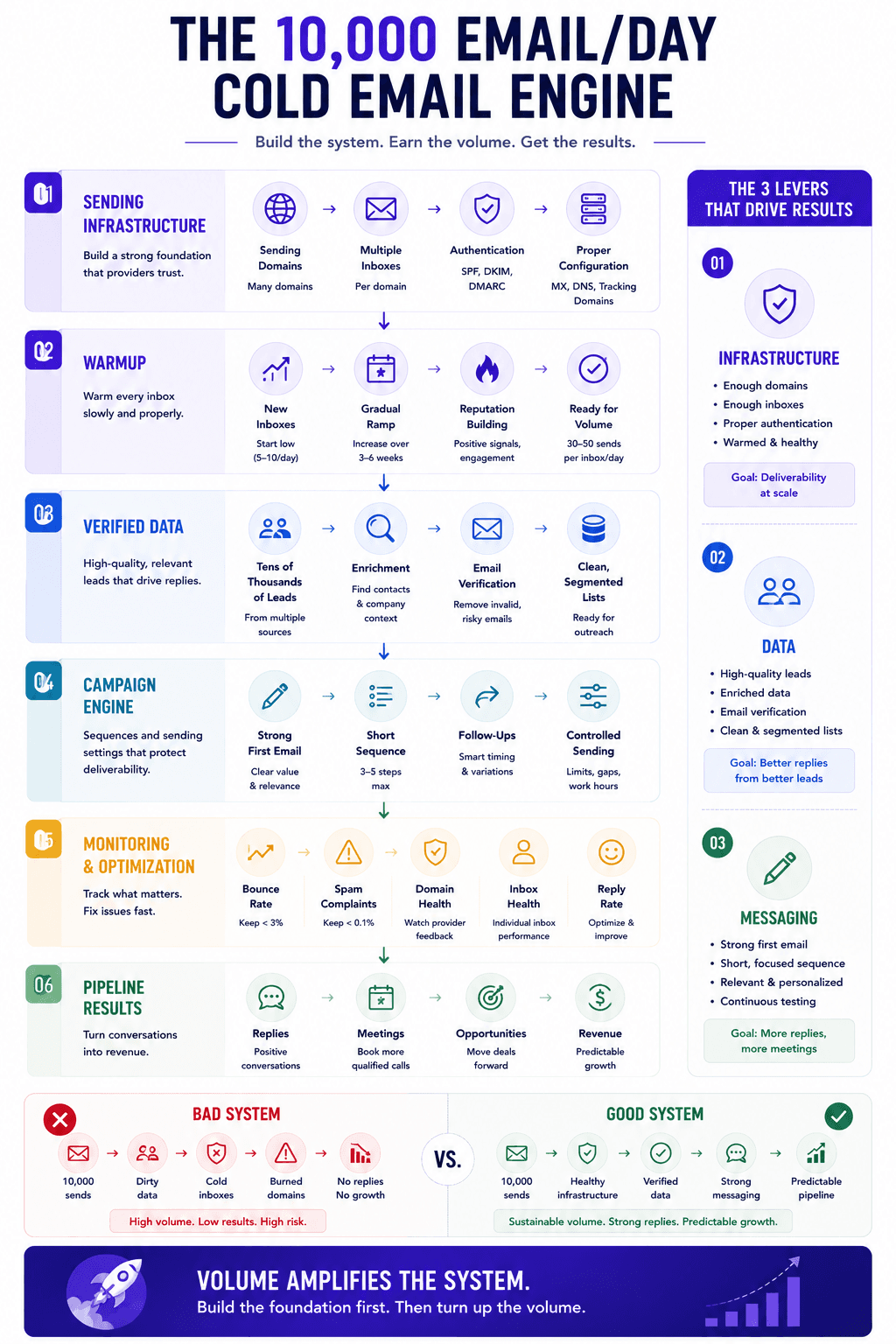
Sending 10,000 cold emails a day is an infrastructure achievement, not a sending trick. The volume follows the system, and the system comes down to three levers. First, spread your sending across enough inboxes and domains that no single inbox ever behaves in a way a provider would flag. Second, authenticate and warm everything properly before it carries real volume. Third, feed the machine verified data and a sequence built around a strong first email.
Get those three right and 10,000 sends a day becomes a reliable channel rather than a gamble. Get any of them wrong and volume just speeds up the damage. Build the foundation first, prove it works at a smaller scale, then turn up the volume with confidence.
If you would rather have this built and run for you instead of assembling it piece by piece, book a call with our team and we will map out the infrastructure your volume goals actually require.