Article
Oct 1, 2026
Cold Email vs LinkedIn vs Cold Calling: What Should You Use?
Cold email vs LinkedIn vs cold calling compared: the strengths, benchmarks, and cost of each, when to use which, and why the best answer is all three.

The question of which outbound channel to use is usually framed as a choice, and the framing is the first mistake. Cold email, LinkedIn, and cold calling each do something the others cannot, and the teams that win outbound use them together in a coordinated sequence rather than betting on one. Still, understanding what each channel is genuinely good at, and what it costs, is what lets you use them well and decide where to start if you cannot run all three at once.
This guide compares the three channels honestly: the strengths, the benchmarks, and the real costs of cold email, LinkedIn, and cold calling, when each one is the right tool, and how they combine into something stronger than any single channel.
Cold email: scale, cost, and asynchronous reach
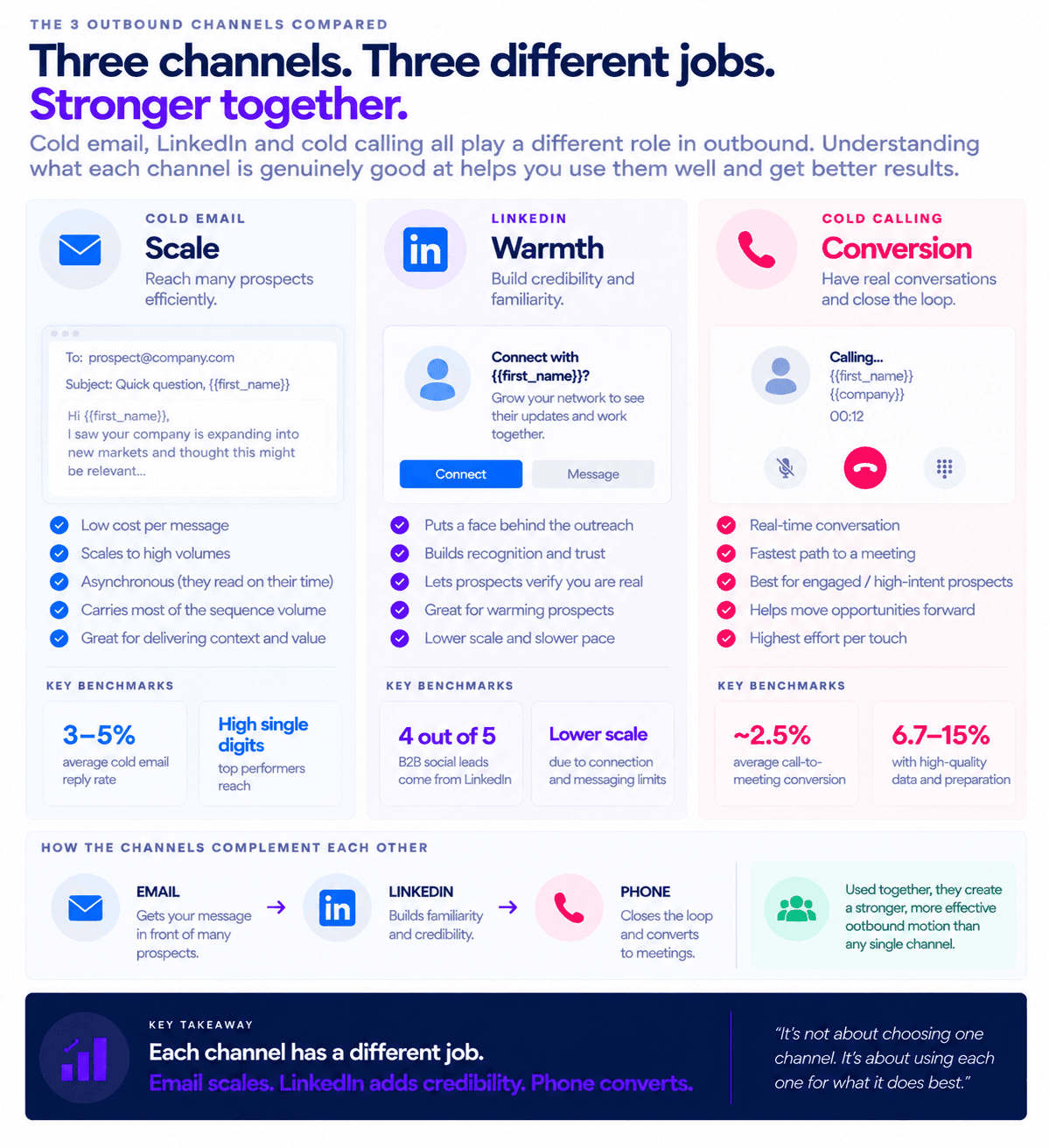
Cold email is the workhorse of outbound because it scales and costs little per message. It reaches many prospects asynchronously, so a buyer reads it on their own schedule, and it carries context and value that a call cannot deliver in the same way. On pure return, email remains one of the most efficient channels in B2B. The trade-off is that inboxes are crowded and reply rates have fallen, with average cold email reply rates now sitting around 3 to 5% and top performers reaching the higher single digits.
Email's effectiveness depends almost entirely on two things beneath the message: deliverability and relevance. A message that lands in spam never had a chance, which is why a sound cold email infrastructure setup is non-negotiable, and a generic message gets ignored regardless of where it lands, which is why a personalized opening matters more than volume. Used well, email is the channel that does most of the work in a sequence, and understanding why so many cold email campaigns fail is what keeps it effective.
LinkedIn: credibility, warmth, and visibility
LinkedIn does something email cannot, which is put a face and a profile to the outreach before a live conversation happens. A profile view and a connection request let a prospect see who is reaching out and check that they are real, which builds recognition and lowers the friction on later touches. LinkedIn is also where B2B buyers spend time between meetings, and it generates four of every five B2B social leads, making it the strongest social channel for reaching a professional audience.
The limitation is scale and pace. LinkedIn caps how many connection requests and messages you can send, so it cannot carry the volume email does, and it works more slowly since it depends on a prospect accepting a request and engaging. Its best role is warming a prospect and adding credibility alongside the other channels rather than carrying a campaign alone, and the head-to-head trade-offs with email specifically are worth a closer look in LinkedIn DMs versus cold email.
Cold calling: intent, speed, and conversion
Cold calling is the most direct channel and the one that closes the loop, and reports of its death are overstated. Over half of B2B sales leads still involve cold calls, most sales leaders consider calling essential, and 82% of buyers will agree to a meeting from a cold call when the outreach is relevant. The phone converts a conversation into a meeting faster than any other channel, which is why it remains central to serious outbound.
The honest trade-offs are effort and conversion rate per attempt. The average cold call-to-meeting conversion rate sits around 2.5%, though teams using high-quality data and signal-anchored preparation reach 6.7 to 15%, which shows how much data quality and timing move the result. Calling is labor-intensive, since it requires a person on the phone in real time, and it works best when speed matters and when the prospect has already seen the sender elsewhere. Anchoring calls to a buying signal and moving quickly when a prospect engages, as covered in speed to lead, is what lifts the phone from a low-conversion grind to a high-conversion channel.
The answer is not one channel, it is the right combination
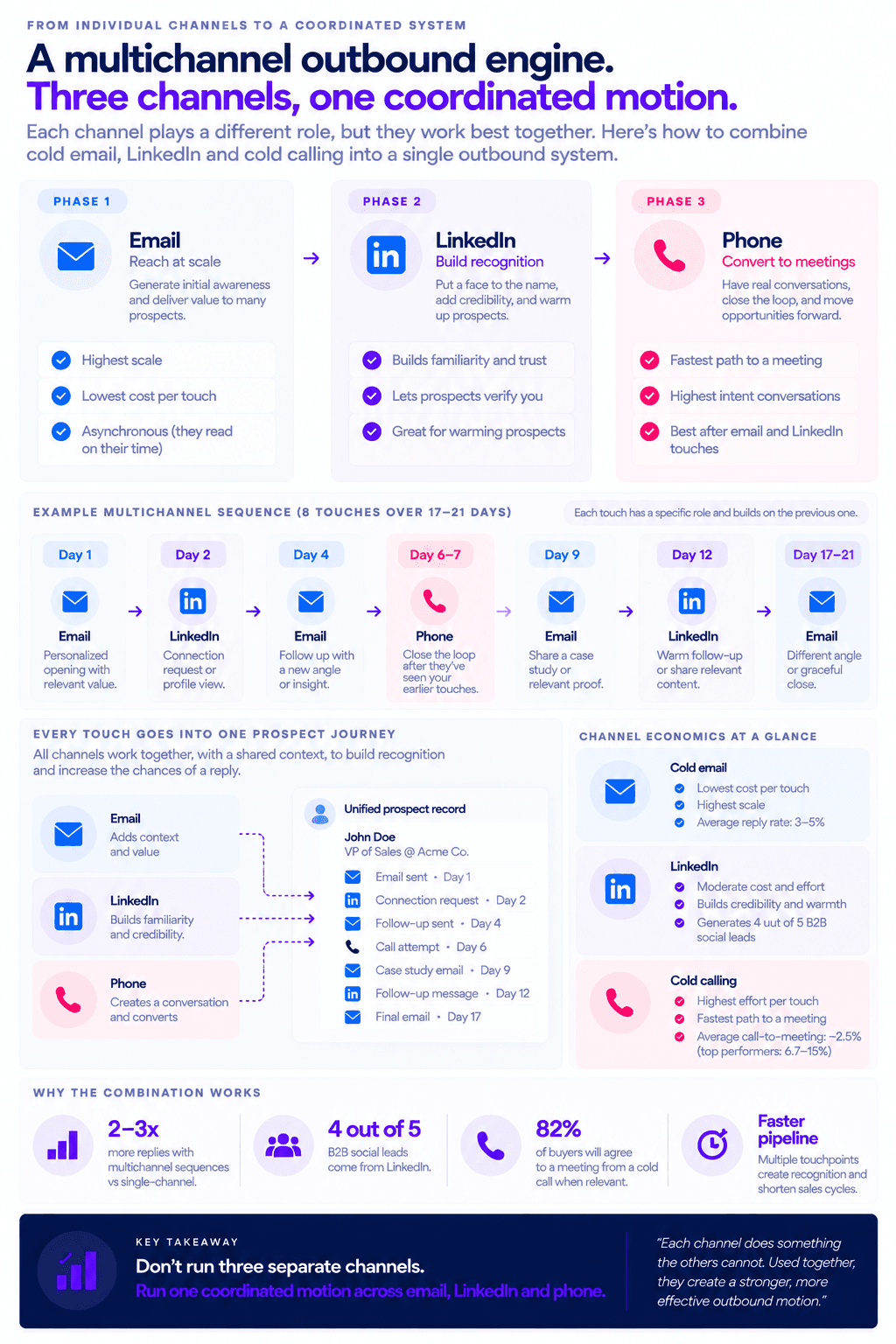
Comparing the three channels leads to a clear conclusion: they are complementary rather than competing. Email alone converts in the low single digits and phone alone somewhat higher, while a coordinated approach across all three lands well above either, which is why multichannel sequences produce two to three times more replies than single-channel ones. Each channel covers the others' weaknesses, with email providing scale, LinkedIn providing warmth, and phone providing conversion.
The sequence in which they are used is what makes the combination work. The phone performs best not as the first touch but as the one that closes the loop after a prospect has already seen the sender in their inbox and on their feed, and adding one call attempt at that point lifts booked-meeting rates by 15 to 22%. How the channels combine into one motion is the subject of what a multichannel outbound strategy is, the specific choreography is covered in building a multichannel cadence, and the number of touches to run across them is addressed in how many touches a sequence should have. All of it sits inside a broader outbound system.
Where to start if you cannot run all three
If you have to begin with one channel, email is usually the right starting point because it scales, costs little, and lets a small team reach many of the right accounts quickly, provided the deliverability and targeting are sound. Add LinkedIn next to warm prospects and build credibility, since it complements email naturally and requires no new infrastructure. Introduce the phone once the first two are running, using it as the loop-closer for prospects who have engaged but not yet converted, since that is where it produces the largest lift. Building the channels in this order lets you launch quickly and layer in the higher-effort channel where it pays off most.
Cost and effort compared
Choosing where to invest also means weighing what each channel costs to run, not just how it converts. Cold email has the lowest cost per touch and the highest leverage, since one person supported by the right prospecting tools can reach hundreds of accounts a week, though the hidden cost is the infrastructure and data work required to keep it landing. LinkedIn sits in the middle, cheap in tooling but limited by the manual pace of connection requests and messages and by the platform's own limits, so it does not scale the way email does. Cold calling is the most expensive per touch, because it needs a person on the phone in real time, and its return depends heavily on the quality of the data and preparation behind each call.
That cost profile is why the sequencing recommendation follows the economics as well as the conversion data. Email does the volume because it is cheap and scalable, LinkedIn adds warmth at moderate cost, and the phone is reserved for the point in the sequence where its higher cost is justified by its higher conversion. Weighing cost against conversion this way is part of choosing among B2B lead generation strategies rather than defaulting to whichever channel feels most comfortable, and it is why most teams that can afford only one channel start with the one that scales cheapest.
Which is better, cold email or cold calling?
Neither is better in isolation, because they do different jobs. Cold email scales cheaply and delivers context asynchronously, reaching many prospects at low cost but with reply rates in the low single digits. Cold calling converts a conversation into a meeting far faster and works especially well for engaged or high-intent prospects, but it is labor-intensive and has a low conversion rate per cold attempt unless backed by good data and timing. The strongest results come from using both, with email building recognition and the phone closing the loop, rather than choosing one over the other.
Is cold calling still effective in 2026?
Yes, particularly as part of a multichannel approach. Over half of B2B leads still involve cold calls, most sales leaders regard calling as essential, and a large majority of buyers will agree to a meeting from a relevant call. Its conversion rate improves dramatically with high-quality data and signal-anchored preparation, moving from a low-single-digit average to double digits for well-prepared teams. The phone works best as the touch that closes the loop after email and LinkedIn have built recognition, rather than as a cold first contact.
Should you use email, LinkedIn, and phone together?
Yes, when you can, because they are complementary and coordinated use produces two to three times more replies than any single channel. Email carries the volume and delivers value, LinkedIn adds warmth and credibility, and the phone converts. The key is coordination, so the channels reference and reinforce each other in an intentional sequence rather than running in parallel. If you cannot run all three at once, start with email, add LinkedIn, and introduce the phone as the loop-closer once the first two are working.
Bringing it together
Cold email, LinkedIn, and cold calling are not competing options but complementary channels, each doing something the others cannot. Email scales and delivers context, LinkedIn builds warmth and credibility, and the phone converts conversations into meetings. Their benchmarks reflect those roles, and the teams that win outbound coordinate all three in a sequence where email builds recognition and the phone closes the loop. If you must start with one, begin with email, add LinkedIn, and bring in the phone where it pays off most, then combine them as your capacity grows.
If you want help combining email, LinkedIn, and phone into one coordinated motion, book a call with the Novoslo team and we will show you exactly how it works.