Article
Aug 12, 2026
How to Find B2B Leads with Claude Code
How to find B2B leads with Claude Code: source, enrich, and qualify prospects, plus a straight answer on whether to build or buy.
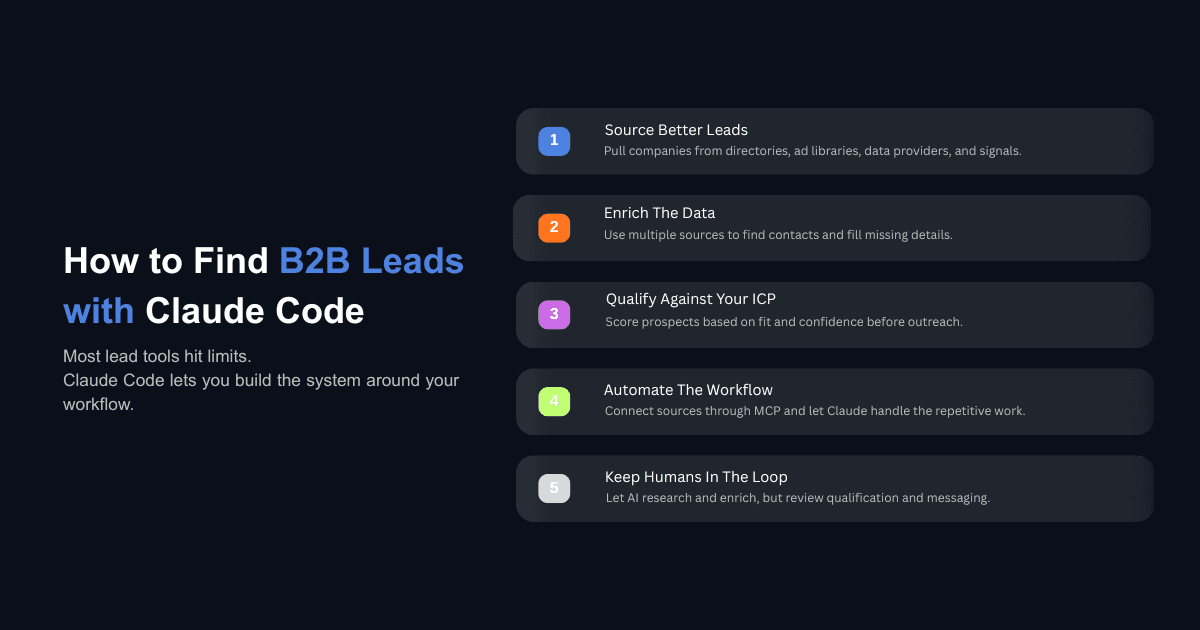
Most teams hit a wall with off the shelf lead tools before they realize it. The row limits creep up, the per record billing starts to sting, and processing large lists turns into a waiting game where you click run and come back hours later. For a while you work around it. Then the workarounds become the job.
Claude Code changes what a small team can build for itself here. It is Anthropic's agentic coding tool, and teams are now using it to source, enrich, and qualify prospects without leaning entirely on platforms that were built for someone else's scale. The interesting part is that you do not need to be a developer to get value from it.
This is a practical look at how to find B2B leads with Claude Code, what the system actually looks like under the hood, and a straight answer at the end on which route makes sense for your situation. We run cold email systems for B2B companies, so most of what follows comes from watching where these builds help and where they quietly fail.
What "finding leads with Claude Code" actually means
The first thing to get clear on is that Claude Code is not another contact database. It does not ship with a pile of company records you can filter. It is an agent that reads your instructions, works through a task, and calls other tools to do the parts it cannot do alone. Salesforge makes this distinction well in their breakdown of Claude Code for lead generation, noting that on its own it can research companies, process prospect lists, apply your ideal customer profile, remove duplicates, and prepare outreach, but it needs to be connected to real data to fetch contacts.
So the mental model is a loop. You source a list of companies or people, enrich those records with contact details and context, qualify them against your ideal customer profile, and route the good ones into a campaign. Claude Code can orchestrate all four steps once it is wired to the right data sources. The value is in running that loop faster and cheaper than a stack of separate tools, and in shaping every step around exactly how your team works.
Why teams outgrow standard platforms
The platforms most teams start with are good products. They are built to serve thousands of users at once, which means they carry limits that protect the platform rather than serve your specific workflow. You run into caps on how many rows a table can hold, caps on total storage across a workspace, and delays when you try to clear old data. On top of that, pricing models can shift toward charging per record or per custom action, which quietly changes the economics of high volume work.
None of that is a knock on the tools. A platform that errors even a fraction of the time affects a huge number of customers, so it has to be conservative. When you build for yourself, the system only has to be optimized for you, and you can fix an error the moment it happens rather than waiting on a vendor. That is the trade at the center of this whole decision, and we come back to it at the end.
The building blocks of a Claude Code lead system
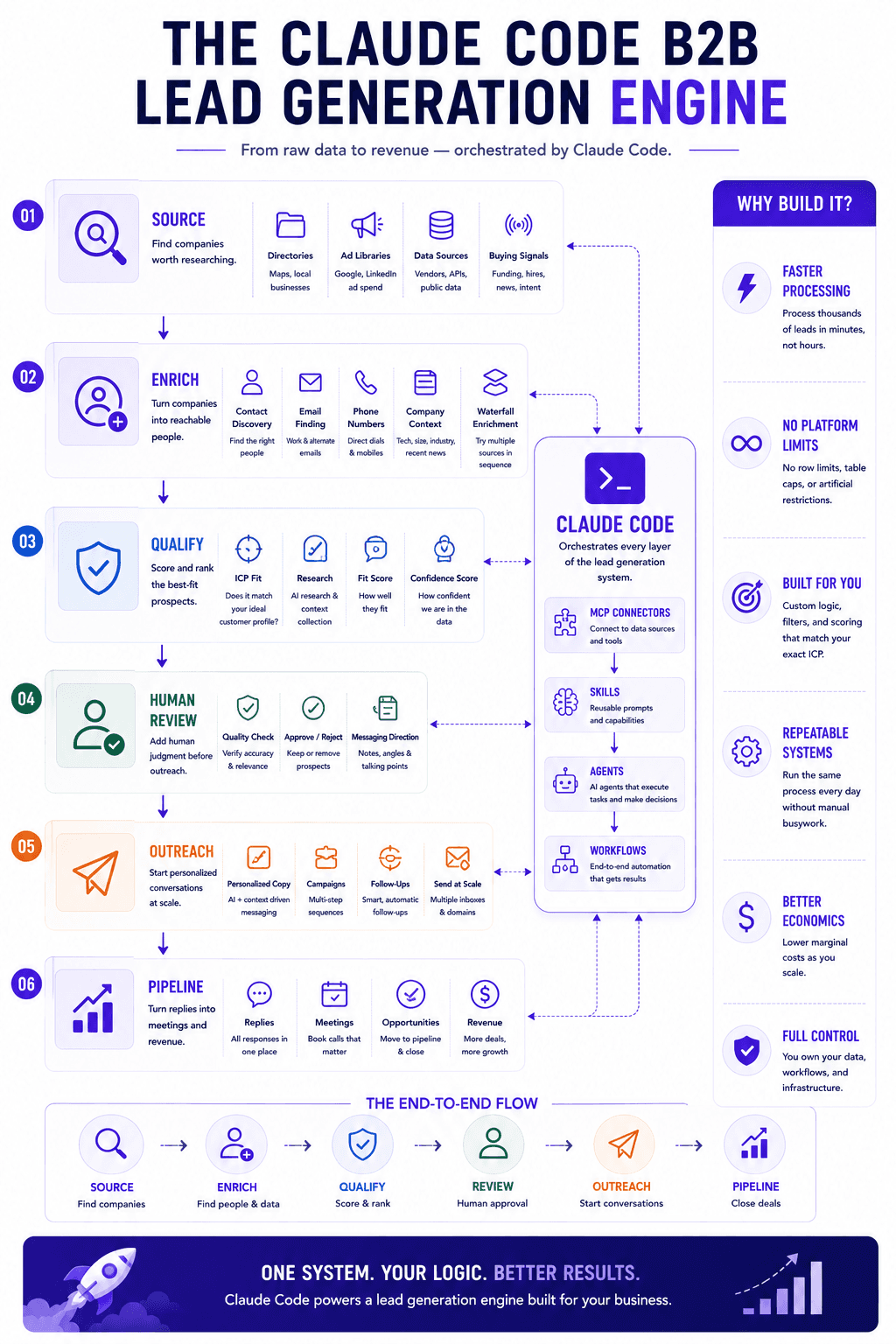
A working setup is really a handful of components stitched together. You do not need all of them on day one, and most teams should not try to build them all at once. Here is what the pieces tend to be.
Sourcing: where the raw list comes from
Sourcing is about getting a list of companies worth researching. There are a few reliable approaches. You can scrape local business directories like Google Maps, and the practical tip there is to query by zip code rather than by city or state, since broad queries return capped results and miss a lot of businesses. You can scrape ad libraries on platforms like Google and LinkedIn to find companies actively running ads, which tends to surface warmer targets because a company spending on ads usually has budget set aside for growth. You can also pull from data vendors, and the market has moved well beyond the two or three names everyone knows.
Signal based sourcing is worth calling out separately. Instead of pulling a static list, you tell the system what a ready to buy account looks like, such as a company that recently raised funding or just posted its first sales hire. Clearcue's guide to building a lead gen workflow with Claude Code describes how signal detection paired with an agent can surface the most relevant slice of a large pool automatically. If buying signals are new to you, our explainer on what buying signals are and how GTM teams use them covers the ones worth tracking.
Enrichment: turning companies into reachable people
Once you have companies, enrichment finds the actual humans and their contact details. This is where a waterfall approach earns its keep. Rather than relying on one data provider, you run a record through several in sequence until you get a validated result. If your primary vendor has no match for a company, an AI search layer can look across public sources to locate contacts, and it can keep hunting for alternate emails when the obvious work address bounces. Sometimes the person you want is reachable through a second company they advise or consult for, and a flexible system can find that path.
The payoff is match rate. Pulling directly from a single source, you might end the day with a fraction of your list validated. A layered approach can push that materially higher, which means fewer wasted sends and more real conversations. We wrote a full walkthrough on how to enrich a lead list using Claude Code if you want the mechanics. For connecting the data itself, our rundown of the best Claude MCPs for lead generation shows which providers wire in cleanly.
Qualification: scoring against your ICP
The last building block is qualification. Enrichment can add a research layer that segments companies on the criteria that matter to you, such as whether a medical practice runs multiple locations or how long a firm has been operating. Each record gets a fit assessment and a confidence score, which lets you narrow to the right accounts before anyone reaches out. Done well, this is the difference between a list that looks big and a list that actually books meetings. Our piece on how GTM teams use Claude Code for prospecting goes deeper on the scoring side.
How to find B2B leads with Claude Code step by step
The advice we give most often is to resist building the whole machine at once. Pick the single task that slows your team down the most and solve just that. For a lot of teams the bottleneck is processing speed or list preparation, so start where the pain is real.
From there the flow is straightforward. Connect your data sources through the Model Context Protocol, which lets Claude Code talk to lead databases and sales platforms directly instead of you shuffling CSVs between tools. If a connection is new to you, you can ask Claude Code to fetch the documentation for a given provider and walk you through the setup one step at a time. It will do this in plain language, which is how people who do not write code still end up with a working integration. Our step by step guide to setting up Claude Code for a GTM team covers the folder structure and configuration if you want a template to start from.
Keep a human in the loop on the two steps that carry the most risk, which are qualification and copy. Teams that let the agent research and enrich freely but hold a review gate on the final list and the messaging get the time savings without the quality drift. SyncGTM reports that teams running these workflows compress list building from twenty plus hours a week to a small fraction of that, and the time savings compound across the pipeline as research and enrichment shrink alongside it.
What this replaces, and what it does not
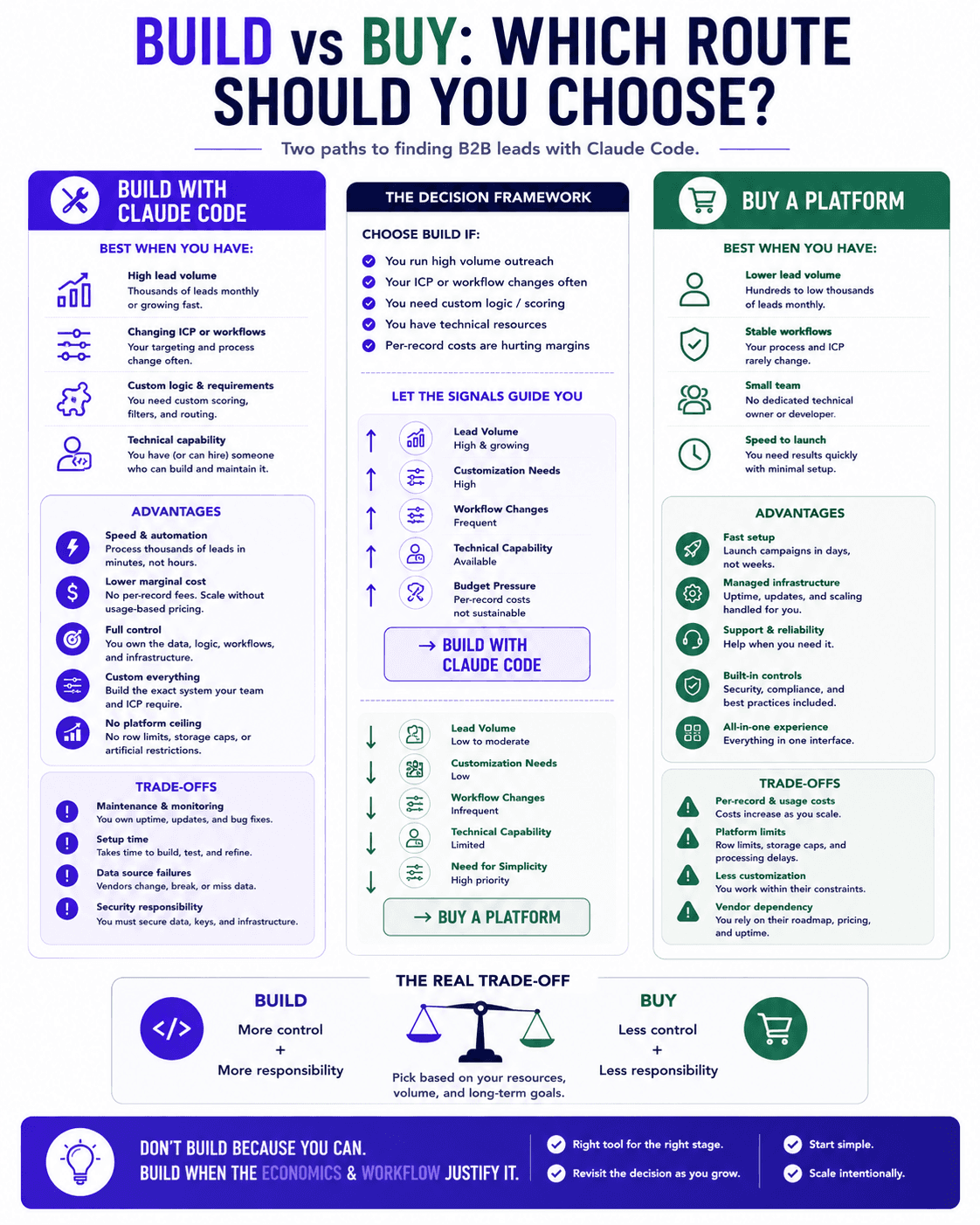
A self built system wins on three things. It is fast, since processing that used to take most of a day can run in a small window, which means you can reload a fresh list the moment a campaign stalls. It is cheap to run relative to the volume, because your ongoing cost is largely the tool itself plus modest hosting. And it gives you control, since the logic is yours to change whenever your targeting shifts.
The honest counterpoint is that a self built system is yours to maintain. A commercial platform hands you reliability, a support team, and no dependency on someone internal who understands the build. If you are running smaller volumes or you do not have anyone who can babysit the system when a data source changes its format, a good platform is often the better call. This is the same trade we walk through in our Apollo vs Clay comparison, and it applies just as much to the build versus buy question.
Security deserves a mention too. Tools you build for internal use are fine as internal tools, but they are not products, and they should not be exposed publicly without proper authentication and access controls. Treat them as private workflows, keep them behind a login, and be honest with yourself about what you can safely maintain.
Do I need to know how to code to find B2B leads with Claude Code?
No. The whole point of an agentic tool is that you describe what you want in plain language and it handles the implementation. People with no coding background have built working lead systems by starting with one problem, asking Claude Code good questions, and being willing to learn the shape of the workflow rather than the code itself. You need to know what you are trying to accomplish and how to check whether the output is right. The tool covers the rest, and it will explain any step you ask it to.
How is Claude Code different from Clay or Apollo?
Clay and Apollo are platforms with data and a fixed interface. You work inside the boundaries they set, which is fine until you outgrow them. Claude Code is an agent with no data of its own that you point at whatever sources you choose, and it builds the workflow around your logic rather than a preset one. Platforms are faster to start with and require no maintenance. Claude Code takes more setup and upkeep but removes the ceilings and gives you a system shaped entirely around your team. For most companies the realistic answer is a mix, using a platform for what it does well and Claude Code for the parts that need custom handling. Our guide on how to generate B2B leads with AI in 2026 lays out where each approach fits.
What does a Claude Code lead system cost to run?
The ongoing cost is lower than most people expect, because the expensive part of traditional stacks is usually per record data billing and storage, not the tool itself. With a self built system your main line item is the Claude Code subscription plus light hosting for any processing and databases. The larger investment is time on the front end to get the build working. That upfront cost is real, and it is the reason a lot of teams decide the maintenance is not worth it for their volume. If you want a sense of the full picture, our overview of the best prospecting tools for B2B sales teams breaks down what each layer of a stack tends to run.
Is a self built lead system safe to use?
For internal use, yes, as long as you treat it accordingly. Put authentication in front of anything with a web interface, keep your data access scoped, and do not repurpose an internal tool as a public product without a proper security review. The risk is not the concept but the assumption that something built quickly is production grade for outside users. Kept private and maintained sensibly, these systems are a reasonable way to run outbound at volume.
Which route should you actually take?
Here is the direct recommendation. If you have real volume, someone on the team who can maintain a build, and targeting that keeps shifting, Claude Code is worth it, and you should start with your single biggest bottleneck rather than the full system. If you are at smaller volume or you have nobody to own the system when a data source breaks, a good platform like the ones in our comparisons will serve you better and cost you less stress. And if you want the output of a fully built system without owning the build, engineering, and upkeep yourself, that is exactly the work we do for B2B companies every day.

We handle the sourcing, enrichment, qualification, and campaigns end to end, so your team gets booked calls instead of a maintenance project. If that is the route you want, book a call with us here and we will map out what your system would look like. For a deeper look at how we approach this internally, see how we built an AI lead generation engine with Claude Code and how we built an automated cold email workflow with Claude Code.