Article
Mar 16, 2026
Top 3 AI Transformation Frameworks for B2B Firms
Three AI transformation frameworks that help B2B firms move from stalled pilots to measurable business results.
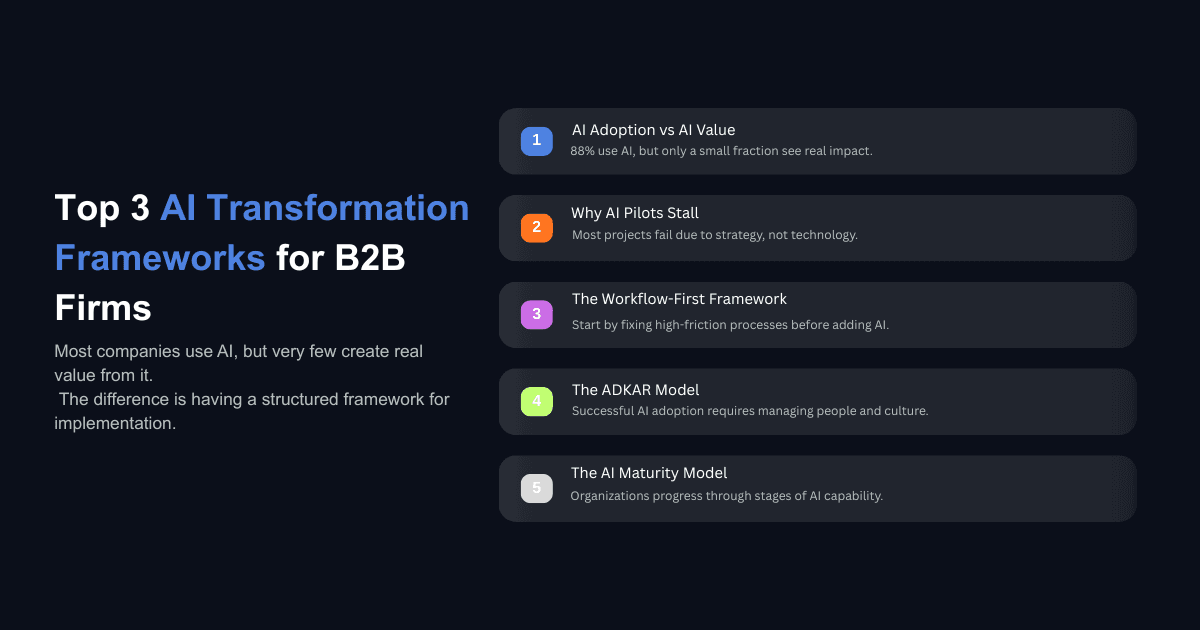
Most B2B firms have adopted AI in some capacity. According to McKinsey's 2025 State of AI report, 88% of organizations now use AI in at least one business function. But only 6% of those organizations are capturing meaningful value from it, and 67% remain stuck in what the report describes as pilot mode. The gap between using AI tools and transforming a business with AI continues to widen, and for B2B operations teams especially, the consequences of that gap are measured in wasted budget, stalled projects, and growing skepticism from leadership.
The issue is almost never the technology itself. It is the absence of a structured approach to deciding where AI fits, how it integrates into existing workflows, and what organizational changes need to happen alongside the technical work. That is where an ai transformation framework becomes essential. This post walks through three frameworks that address different dimensions of the problem: process redesign, people and culture, and staged maturity. Each one offers a different entry point depending on where your organization is today. For a broader look at what AI transformation means in practice, we have covered that in depth separately.
Why Most B2B Firms Get Stuck After the Pilot Phase
The Numbers Behind the Stall
The data on AI project outcomes is consistent across multiple research sources, and the picture is not encouraging. Enterprise AI failure research from Pertama Partners shows that over 80% of AI projects fail to deliver their intended business value, with the median sunk cost per abandoned initiative averaging $4.2 million. Large enterprises abandoned an average of 2.3 AI initiatives in 2025 alone. The most common reasons for abandonment were data quality issues that proved insurmountable (38%), a business case that no longer held up under scrutiny (29%), and loss of executive sponsorship before the project could mature (21%).
These numbers matter for B2B firms specifically because B2B operations tend to involve longer sales cycles, more complex approval chains, and deeper integration requirements than consumer-facing businesses. A failed AI pilot in a B2B context does not just waste money. It erodes internal trust in AI as a category, which makes the next attempt harder to fund and staff.
What Separates the 6% That Succeed
McKinsey's research identifies a small group of high performers, roughly 6% of organizations surveyed, that report 5% or more EBIT impact from AI. These organizations share a few characteristics that are worth understanding before evaluating any ai transformation framework. They start with business outcomes rather than technology selection. They redesign workflows around AI capabilities instead of layering AI onto existing processes. They maintain sustained executive sponsorship through the full lifecycle of implementation, not just the announcement phase. And they define clear metrics for success before approving a project, not after. Organizations with pre-defined success metrics achieved a 54% success rate compared to just 12% for those without them. These patterns point to a conclusion that should inform how any B2B firm approaches transformation: the reasons most AI transformations fail are strategic, not technical.
What Is an AI Transformation Framework and Why Does It Matter for B2B?
How a Framework Differs from a Strategy or Roadmap
An AI strategy defines what you want to achieve with AI and why. A roadmap sequences the steps and timelines. An ai transformation framework sits underneath both, providing the structure for how decisions get made, how work gets reorganized, and how the organization absorbs change at each stage. Without a framework, strategies tend to stay abstract and roadmaps tend to stall at the first unexpected obstacle. The framework is the operating logic that connects intention to execution.
Why B2B Operations Need a Different Approach
B2B firms operate with constraints that most AI marketing material ignores. There are legacy systems that cannot be replaced overnight. There are compliance requirements that limit how data moves between departments. There are approval chains involving multiple stakeholders who each have different priorities. A framework designed for consumer tech companies or greenfield startups will not account for these realities. B2B firms need an ai transformation framework that works within existing infrastructure and organizational dynamics rather than assuming a clean slate. This is also why many firms benefit from working with an AI transformation partner who understands enterprise operations rather than buying tools and hoping the pieces fit together.
Framework 1: The Workflow-First Framework
How It Works
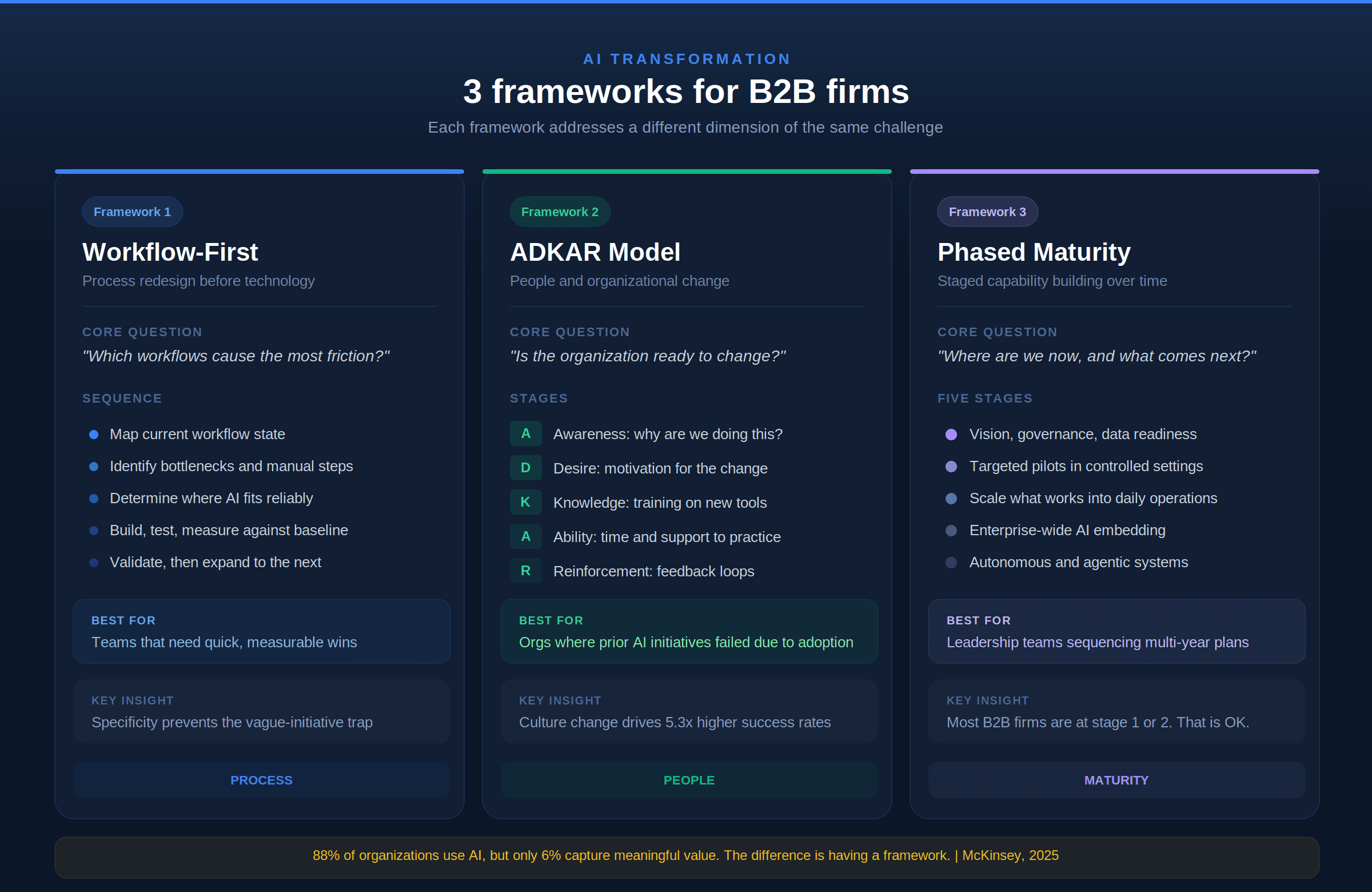
The Workflow-First Framework starts with the premise that AI should be applied to specific, well-understood processes before it is deployed broadly. Instead of asking "where can we use AI?", it asks "which workflows are creating the most friction, costing the most time, or producing the most errors?" The answer to that question becomes the starting point for implementation. The sequence is straightforward: map the current state of a workflow, identify bottlenecks and manual steps, determine which of those steps AI can handle reliably, build and test the AI-augmented version, and then measure the outcome against the original baseline. Only after validating results in one workflow does the organization expand to the next.
This framework is effective because it forces specificity. It prevents the common failure mode of launching a broad AI initiative with vague objectives and no measurable baseline. It also produces early wins that build internal credibility, which matters more than most leaders realize when it comes to sustaining long-term AI investment.
Where B2B Firms Apply It
In practice, B2B firms are using the Workflow-First approach to automate order processing, contract review, quoting, and internal reporting. One example frequently cited in the B2B transformation literature involves a mid-size manufacturer that reduced their quoting process from five days to four hours by digitizing and restructuring their approval workflow before introducing any AI tooling. The process redesign itself delivered most of the value, and AI then amplified it further. One enterprise client we worked with doubled their sales efficiency by applying AI-driven insights to their lead engagement workflow, enabling the team to act on data-backed timing rather than intuition. For more on AI workflow transformation strategies that are producing results, we have documented several approaches in detail. You can also explore real-world AI transformation examples across industries for a broader set of reference points.
Framework 2: The ADKAR Change Management Model
Why the People Side Breaks Before the Tech Does
Most AI projects that fail do not fail because the model was inaccurate or the tool was poorly built. They fail because the organization was not prepared to change how it works. McKinsey has consistently found that culture, not technology, is the largest obstacle to transformation, and that organizations investing in cultural change see 5.3 times higher success rates than those focused only on technology. The ADKAR change management framework, developed by Prosci, was designed to address exactly this gap. It has been adopted by organizations including Microsoft to manage large-scale shifts in how people work.
Applying ADKAR to AI Adoption in Operations Teams
ADKAR stands for Awareness, Desire, Knowledge, Ability, and Reinforcement. Each stage represents a prerequisite that must be met before the next one can succeed. In the context of an ai transformation framework for B2B, this looks like the following sequence. Awareness means making sure stakeholders across the organization understand why AI is being adopted and what problem it is solving, not just announcing that a new tool is being deployed. Desire means creating genuine motivation for the change, which usually comes from involving team leads early and showing them how AI reduces their workload rather than threatening their role. Knowledge means training people on the specific tools and workflows they will interact with. Ability means giving them time and support to practice and build confidence. Reinforcement means creating feedback loops and recognition systems that make the new way of working stick.
This framework is particularly relevant for B2B firms because enterprise operations teams tend to have deep institutional knowledge and established routines. Introducing AI without addressing the human side of adoption almost always leads to resistance, workarounds, or outright abandonment. The firms that succeed at AI transformation treat the people dimension as a first-order concern rather than an afterthought. For a CEO-level perspective on leading this kind of change, see our guide to leading AI transformation.
Framework 3: The Phased Maturity Model
The Five Stages of AI Maturity
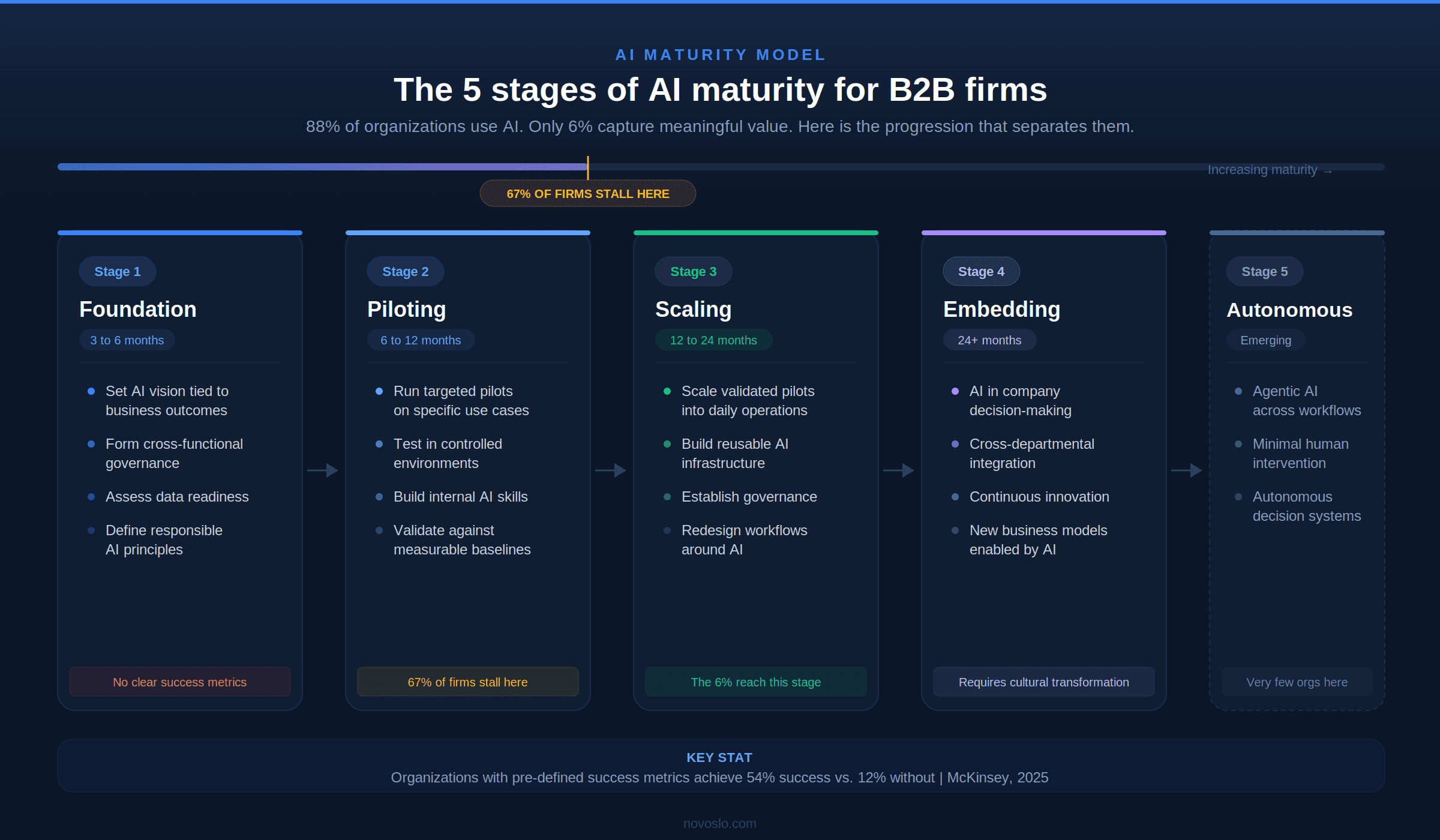
Microsoft Digital's AI maturity guide and IBM's AI transformation approach both describe enterprise AI maturity as a staged progression, and the stages are broadly consistent across frameworks. The first stage involves setting a vision anchored in business outcomes, forming cross-functional governance, and assessing data readiness. The second stage focuses on running targeted pilots that test specific use cases in controlled environments. The third stage involves scaling what works, building reusable infrastructure, and integrating AI into daily operations. The fourth stage is enterprise-wide embedding, where AI becomes part of how the company makes decisions and serves customers. The fifth stage, which very few organizations have reached, involves autonomous systems and agentic AI operating across workflows with minimal human intervention.
The value of this model is that it sets realistic expectations. Most B2B firms are in stage one or two, and that is not a failure. It is a starting position. The failure mode is pretending to be at stage four when you have not completed the foundational work of stages one and two.
How to Identify Where Your Organization Sits Today
The most practical way to assess your current maturity is to ask a few direct questions. Do you have a centralized view of what AI projects are running across the company, or are teams experimenting independently? Is your data clean, accessible, and governed, or is it scattered across silos with no consistent quality standards? Have you defined measurable success criteria for your AI initiatives, or are you still evaluating based on impressions? Are your leaders actively involved in AI decisions, or have they delegated it entirely to IT? Honest answers to these questions will place your organization on the maturity curve more accurately than any vendor assessment. From there, the AI transformation roadmap we have published provides a step-by-step sequence for moving from one stage to the next.
How Do You Choose the Right AI Transformation Framework?
The three frameworks described above are not mutually exclusive, and in most cases the right approach combines elements of all three. The Workflow-First Framework is the best starting point for organizations that need quick, measurable wins to build internal momentum and justify further investment. The ADKAR model is most relevant when the primary obstacle is organizational resistance or when prior AI initiatives have failed due to low adoption rather than poor technology. The Phased Maturity Model is most useful for leadership teams that need to sequence a multi-year transformation and want a shared reference point for where the organization is and where it is heading.
For most mid-market B2B firms, the practical path is to start with a workflow audit (Framework 1), layer in change management from the beginning (Framework 2), and use the maturity model (Framework 3) to set expectations with the board and executive team about what realistic progress looks like over 12 to 24 months. Databricks' strategy guide describes this combined approach as the intersection of process, people, and platform, and the framing holds up well in practice.
What Are the Most Common Mistakes When Implementing an AI Transformation Framework?
The most common mistake is starting with technology selection instead of problem definition. Organizations purchase AI platforms, hire consultants, and build roadmaps before they have clearly identified which business problems they are trying to solve and how they will measure success. This pattern accounts for a large share of the 80%+ failure rate in enterprise AI projects. The second most common mistake is treating AI as an IT initiative rather than a business transformation, which leads to implementations that are technically functional but organizationally disconnected from the teams that need to use them. The third is losing executive sponsorship mid-project, which research shows drops success rates from 68% to 11%. Understanding the real costs of AI implementation before committing budget is one of the most effective ways to avoid these patterns, because it forces realistic planning from the outset.
Another pattern we see frequently is organizations that try to skip the maturity stages entirely, jumping from stage one to stage four without building the data infrastructure, governance, or team capabilities required to operate at that level. The result is fragile systems that work in demos but break in production. For a deeper look at the structural reasons AI projects fail in practice, our analysis of why 70% of AI transformations fail covers the most common failure modes and how to mitigate them.
Where Should a B2B Firm Start?
Running a Workflow Audit Before Choosing a Framework
Before selecting or combining frameworks, the most productive first step is to audit your current workflows. Identify the processes that consume the most manual time, involve the most handoffs between teams, and produce the most errors or delays. These are your highest-value targets for AI, and they give you a concrete foundation for choosing which ai transformation framework to apply first. A workflow audit also surfaces data quality issues early, which prevents the most common reason AI pilots fail. If you are not sure where to start, our AI business audit tool can help identify the highest-impact opportunities specific to your operations. You can also use our AI ROI calculator to estimate the financial impact before committing resources.
When to Bring in an AI Transformation Partner
Many B2B firms have the internal talent to run AI experiments but lack the operational experience to scale them into production. This is where an external partner adds the most value: not in selecting tools, but in designing the implementation sequence, managing the organizational change process, and connecting AI projects to measurable business outcomes. If your team has run pilots that worked in isolation but stalled when it came time to integrate them into daily operations, that is usually a sign that the gap is in implementation structure rather than technical capability. You can read more about what an AI transformation partner actually does and how to evaluate whether you need one. For teams that want a practical guide to the implementation process itself, our workflow-first guide to implementing AI covers the step-by-step approach.
Conclusion
An ai transformation framework is not a luxury or an academic exercise. It is the structural difference between the 6% of organizations that capture real value from AI and the vast majority that spend millions and stall in pilot mode. The Workflow-First Framework gives you specificity and early wins. ADKAR gives you a method for getting your people through the change. The Phased Maturity Model gives you a realistic sequence for scaling over time. Most B2B firms will use a combination of all three, starting with the one that addresses their most immediate bottleneck.
The firms that succeed at this do not treat AI transformation as a technology project. They treat it as a business redesign that happens to involve AI. And they start with a clear understanding of where they are today before committing to where they want to go.
If you are ready to evaluate which ai transformation framework fits your organization, book a consultation with our team. We will help you identify where you sit on the maturity curve, which workflows to target first, and how to structure an implementation that delivers measurable results rather than another stalled pilot. Book a call with Novoslo →