Article
Feb 11, 2026
AI Workflow Transformation Strategies: What Actually Works in 2026 and Beyond
Explore AI workflow transformation strategies to streamline processes and boost business efficiency in 2026 and beyond.
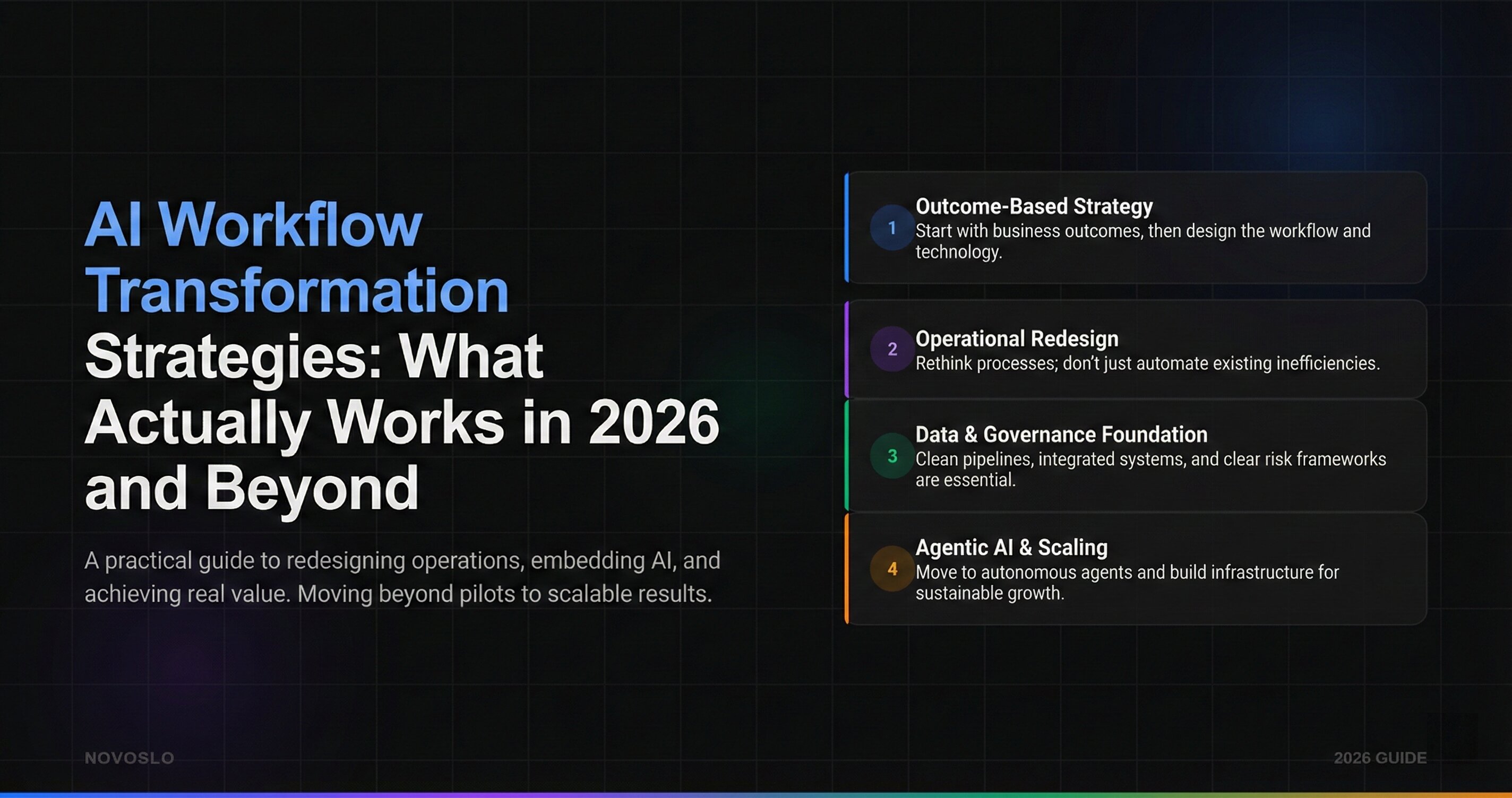
Most companies that say they are doing AI have purchased software and assigned someone to figure it out. The tools get demoed, a few teams run pilots, and leadership waits for results that rarely show up in the numbers. What is usually missing is not better technology. It is a structural change in how work actually moves through the organization. AI workflow transformation is the practice of redesigning those underlying processes so that AI is embedded in how decisions get made, how data travels between systems, and how people spend their time on work that requires judgment rather than repetition.
The gap between buying AI and getting value from it is almost entirely an operations problem. Companies that treat AI as an addition to existing workflows tend to automate tasks that probably should not exist in the first place. Companies that rethink the workflow itself, starting from the outcome they need and designing backward, tend to get compounding returns. This post walks through what that process looks like in practice: how to build a real AI workflow transformation strategy, where most companies get stuck, and what the organizations that are actually seeing results are doing differently.
What Is AI Workflow Transformation?
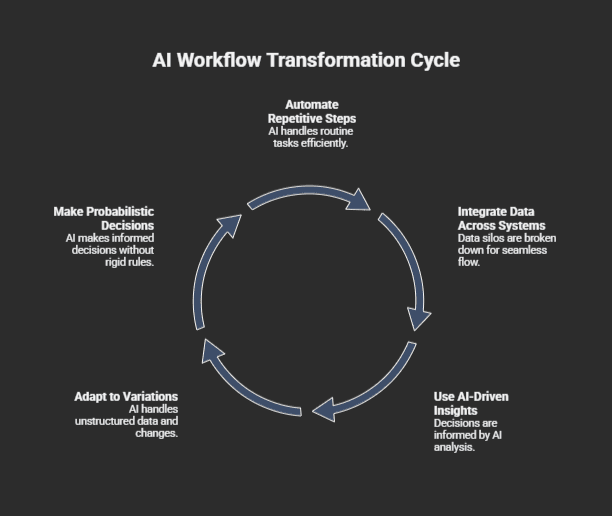
AI workflow transformation is the process of restructuring business operations so that artificial intelligence handles data processing, pattern recognition, and routine decision-making within the actual flow of work, rather than sitting alongside it as a separate tool. The core components are automation of repetitive steps, integration of data across systems that previously operated in silos, and the use of AI-driven insights to inform decisions at the point where those decisions are made, not in a report that gets reviewed days later.
This is different from traditional workflow automation in a meaningful way. Conventional automation follows rigid, predefined rules: if X happens, do Y. AI-driven workflows can interpret unstructured data, adapt to variations in input, and make probabilistic decisions without requiring someone to write a rule for every edge case. A traditional automation might route a support ticket based on keywords. An AI-driven workflow reads the ticket, understands the intent, checks the customer's history across multiple systems, and routes it to the right team with a recommended resolution attached.
Why Traditional Workflow Automation Hits a Ceiling?
Rule-based automation breaks when conditions change. It cannot process a PDF that is formatted differently from the template it was trained on. It cannot handle a procurement request that falls outside of three predefined categories. Organizations that spent years building RPA bots are discovering that those bots require constant maintenance because the business keeps evolving while the bots stay static. AI workflow transformation addresses this by building systems that learn from context, not just from rules. The shift is from automating what a human used to do, step by step, to defining the outcome you need and letting the system determine the best path to get there.
Where Most Companies Are Right Now With AI Adoption
The Current Adoption Landscape
AI adoption has moved past the experimental phase in most industries. Research from multiple sources shows that 78% of organizations now use AI in at least one business function, up from 55% in 2023. The AI agents market alone reached $7.6 billion in 2025 and is projected to hit $47.1 billion by 2030. But usage and outcomes are two different things. A company can have dozens of AI tools active across departments and still see no measurable impact on its P&L.
The pattern we see constantly is that adoption numbers look strong on paper while actual business impact stays flat. S&P Global data shows that 42% of companies abandoned most of their AI initiatives in 2025, up sharply from 17% the year prior. That is not a technology failure. It is a strategy failure. These companies often started with broad AI rollouts rather than focused investments in specific workflows where the payoff was clear and measurable.
Why Scaling AI Remains the Hard Part
The Informatica CDO Insights 2025 survey identifies the top obstacles to AI success as data quality and readiness (43%), lack of technical maturity (43%), and shortage of skills (35%). Notice that none of these are about the AI models themselves. The models work. What breaks is the infrastructure around them: fragmented data, systems that do not talk to each other, and teams that do not have the skills to design or maintain AI-driven processes. Scaling requires solving these operational problems first, and most companies skip straight to the technology.
How Do You Build an AI Workflow Transformation Strategy?
Start With Outcomes, Not Tools
PwC's 2026 AI business predictions make a point that is worth internalizing: most companies make the mistake of crowdsourcing AI initiatives from the ground up, then trying to shape them into a strategy afterward. The result is a collection of projects that do not match enterprise priorities, rarely get executed with precision, and almost never lead to real transformation.
What works instead is a top-down program where senior leadership identifies a small number of high-value workflows and applies concentrated resources, including their best people, to those areas. The question is not "how can we add AI to what we already do?" but "what outcome do we need, and what process would we design from scratch if we were starting today?" That reframe is where the real returns come from. If you want to implement AI using a workflow-first approach, the starting point is always the business outcome, not the technology.
A useful framework for thinking about this comes from breaking AI investment into three layers. The first is personal productivity, where individuals use AI tools to work faster. The second is workflow automation, where AI handles end-to-end processes across teams and systems. The third is core process transformation, where AI enables workflows that were not possible before. Most companies are stuck at layer one. The compounding value lives in layers two and three, and getting there requires a deliberate AI transformation roadmap that moves the organization through each stage with clear milestones.
Governance and Risk Management as Enablers
Governance is often positioned as the thing that slows AI down. In practice, it is the thing that allows AI to scale. Without clear policies on data access, model oversight, and decision authority, every AI deployment becomes a one-off project that requires bespoke approval processes. That is what creates the bottleneck.
Organizations that are moving fast with AI have governance frameworks that define, in advance, what an AI system is allowed to do independently and when it needs to escalate to a human. They have audit trails that show how decisions were made. They have the ability to course-correct when an AI system starts optimizing for the wrong outcome. The EU AI Act, which classifies workplace AI uses like recruitment and performance evaluation as high-risk, is making this kind of structured governance a legal requirement in many contexts. But even without regulatory pressure, governance is what turns one successful pilot into twenty.
Building a Team That Can Actually Work With AI
The Skills Gap Is Real and Widening
The World Economic Forum's Future of Jobs Report 2025 found that 86% of employers expect AI to transform their business by 2030, and 39% of workers' core skills are expected to change in that time. AI and big data now top the list of fastest-growing skills globally. But there is a perception gap that most leaders are not aware of. While 44% of employers say they offer formal AI upskilling programs, only 33% of employees confirm this. That gap means the training either is not reaching people, is not practical enough to stick, or does not feel relevant to their actual work.
The organizations that are handling this well treat AI literacy as a core business function, not an HR side project. They identify the specific workflows where AI will be deployed and train the people who work within those workflows on how to use, monitor, and improve the AI systems they will interact with daily. PwC's 2025 Global AI Jobs Barometer found that workers with AI skills command wage premiums up to 56% higher than peers in the same roles without those skills, which tells you where the labor market is heading.
Managing Cultural Resistance Without Corporate Theater
Cultural change management around AI usually gets reduced to town halls and internal newsletters. That does not work. The resistance is not about fear of technology in the abstract. It is about people worrying that their specific job will be eliminated, that they will be asked to use tools they do not understand, or that the company is making promises about AI that it will not follow through on.
The most effective approach we have seen is to start with the teams closest to the workflows being transformed and give them meaningful input into how AI gets integrated. When the people doing the work help design the new process, adoption is not something you have to manage. It happens because the solution actually fits how work gets done. The balance between central oversight and team-level autonomy matters here. Too much central control creates a bureaucracy that stalls every deployment. Too much autonomy creates disconnected tools that do not talk to each other. The sweet spot is a centralized platform with shared standards and a decentralized execution model where individual teams adapt within those standards.
What Does the Right Technology Foundation Look Like?
Infrastructure Decisions That Matter
AI workflow transformation requires infrastructure that most companies do not yet have. The critical components are clean, accessible data pipelines that can feed AI models in real time, APIs that connect your existing systems so AI can operate across them rather than within a single tool, and monitoring layers that track model performance, data drift, and output quality.
Data readiness alone accounts for the largest share of project failures. Organizations that succeed tend to spend 50--70% of their timeline and budget on data preparation: extraction, normalization, governance metadata, quality dashboards, and retention controls. This is not the exciting part of AI. It is the part that determines whether anything else works.
Build vs. Buy, and When Each Makes Sense
MIT research found that purchasing AI tools from specialized vendors and building partnerships succeeds about 67% of the time, while internal builds succeed only about a third as often. This is especially relevant in regulated industries where companies are inclined to build proprietary systems for compliance reasons but often underestimate the cost and complexity of maintaining those systems over time.
Understanding the difference between AI agents and AI tools matters here. Off-the-shelf tools handle defined tasks within a single application. AI agents operate across systems, make decisions within defined boundaries, and can manage multi-step workflows autonomously. Choosing the wrong type for your use case is one of the most common reasons companies spend money without seeing results. The general principle is to buy for well-understood processes where speed of deployment matters, and build only for core processes where the AI creates genuine competitive differentiation.
What Are Companies Getting Right? Industry Examples
Where Workflow Transformation Is Landing
AI workflow transformation is producing measurable outcomes in several areas, though the results are concentrated in specific use cases rather than spread evenly across entire organizations. Financial services firms are using AI to automate fraud detection, compliance monitoring, and loan processing, where the combination of structured data and high transaction volumes makes AI particularly effective. Healthcare organizations are applying AI to patient eligibility verification, claims processing, and clinical documentation, though adoption in healthcare remains slower than other industries due to regulatory complexity.
In sales operations, the results are tangible. One enterprise client doubled their sales efficiency after implementing AI-driven insights that identified the right leads and the right timing for engagement, replacing manual prospecting processes that consumed the majority of the team's week. For a broader view of where these patterns are showing up, Novoslo has documented over 30 real-world AI transformation examples across industries.
Patterns From Early Successes
The companies that are getting results share a few common characteristics. They started with a specific, high-value workflow rather than a broad AI initiative. They assigned their best people to the project, not a side team. They measured success in business terms like revenue, cost reduction, or time-to-completion rather than in technical metrics like model accuracy. And they treated the first deployment as a foundation for scaling, not as a standalone project.
Deloitte's research on agentic AI strategy reinforces this: leading enterprises do not layer AI agents onto existing workflows. They redesign the process to take advantage of what agents can do, which often means eliminating steps that existed only because a human was doing the work manually. The companies that skip this redesign step tend to get incremental improvement at best.
How Do You Measure and Sustain AI Workflow Success?
Defining Metrics That Reflect Actual Business Value
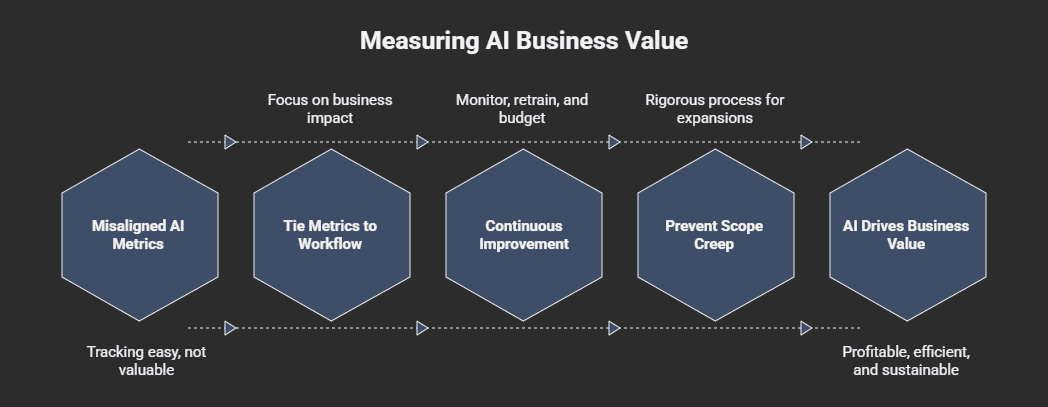
The measurement problem in AI is that teams often track what is easy to measure rather than what matters. Model accuracy, number of AI tools deployed, and employee adoption rates are all useful signals, but none of them tell you whether AI is actually making the business more profitable or efficient.
The metrics that matter are tied directly to the workflow being transformed. If AI is handling invoice processing, the relevant metric is processing time per invoice, error rate, and cost per transaction compared to the manual baseline. If AI is supporting sales outreach, the metric is pipeline velocity, conversion rate, and revenue per rep. Every AI deployment should have a clearly defined financial outcome before it starts, and that outcome should be tracked through the same reporting infrastructure the business already uses. For a structured approach to this, Novoslo's guide on how to measure AI transformation success provides a practical framework.
Continuous Improvement Without Scope Creep
AI systems are not set-and-forget. Data distributions shift, business requirements change, and models degrade over time if they are not monitored and retrained. The organizations sustaining results treat AI deployments like products: they assign ownership, define service-level objectives, budget for ongoing maintenance, and plan quarterly improvement cycles.
The risk to watch for is scope creep, where a successful deployment gets expanded into adjacent use cases without the same rigor that made the original deployment work. Each expansion should go through the same process: define the outcome, assess the data readiness, confirm the business case, and staff it properly. Calculating total AI implementation costs upfront, including ongoing operational costs, prevents the common pattern where initial savings get consumed by maintenance and expansion expenses that were never budgeted.
What Is Coming Next in AI Workflow Automation?
Agentic AI and Multi-Agent Systems
The most significant shift happening right now is the move from AI as a tool that responds to prompts to AI as an agent that executes multi-step workflows autonomously. IBM's technology outlook for 2026 describes this as AI moving from individual usage to team and workflow orchestration, where systems coordinate entire workflows, connect data across departments, and move projects from start to completion. The models themselves are becoming commoditized. The competitive advantage is shifting to how companies orchestrate models, tools, and workflows into systems that deliver business outcomes.
Agentic AI also changes the governance conversation. When AI agents can act autonomously within defined boundaries, organizations need frameworks that specify when agents can make decisions independently, when they need to escalate, and how their work gets audited. Gartner has predicted that over 40% of agentic AI projects will be canceled by 2027 due to escalating costs, unclear business value, or inadequate risk controls. The organizations that invest in governance infrastructure now will be the ones that can deploy agentic AI at scale when the technology is ready.
Preparing for 2026 and Beyond
Several trends are converging. Multi-agent systems, where specialized AI agents collaborate on complex tasks, are moving from research into production. Edge AI is making it possible to run models on local devices rather than relying entirely on cloud infrastructure, which matters for latency-sensitive and compliance-heavy applications. The democratization of AI agent creation is putting the ability to build and deploy agents in the hands of business users who are closest to the actual problems.
Preparing for this does not mean buying new technology today. It means building the foundations that will allow you to adopt new capabilities as they mature. Clean data pipelines, API-connected systems, a workforce that understands how to work with AI, and governance frameworks that can accommodate increasing autonomy. These are the investments that compound over time, regardless of which specific AI capabilities emerge next.
Where to Start
AI workflow transformation is not a technology project. It is an operations project that uses technology. The companies seeing real results are the ones that start with a specific, high-value workflow, invest in data readiness and people before they invest in models, measure success in business terms from day one, and treat every deployment as a foundation for the next one.
If your organization is stuck in pilot mode or struggling to scale AI beyond a few teams, the problem is almost certainly not the AI itself. It is the gap between the tool and the workflow, the data and the system, or the strategy and the execution. Closing those gaps is what an AI transformation partner does, working with your team to identify where AI can create measurable business value and building the infrastructure to make it sustainable.
The window for deliberate, well-planned AI transformation is open, but it is narrowing as early movers build advantages that compound each quarter. The best time to start was last year. The second best time is to pick one workflow, define the outcome, and begin.