Article
Dec 22, 2025
What Is AI Transformation? Definition, Examples, and Roadmap
Learn what AI transformation means for businesses, how it differs from digital transformation, and how to build a practical roadmap to scale AI.
For many business leaders, the surge of Artificial Intelligence (AI) feels like a mandate to "do something" immediately. This often leads to scattered experiments, a marketing team using generative AI for copy here, a customer service team deploying a chatbot there. While these are positive steps, they often fall into the trap of "random acts of digital."
Adding AI tools to an existing process isn’t the same as transforming the business. True AI transformation is not just about adopting new software; it is a fundamental shift in how an organization operates, decides, and creates value.
In this guide, we will move beyond the hype to provide a clear definition of AI transformation, explore how it differs from digital transformation, and outline a realistic, 6-step roadmap to implementation. Whether you are a CIO, a strategy lead, or a functional head, this is your blueprint for moving from isolated pilots to scalable enterprise intelligence.
AI transformation definition (and what it is not)
AI transformation is a strategic, enterprise initiative that integrates artificial intelligence into the core of an organization's operations, products, and services. Unlike simple adoption, transformation leverages AI to drive innovation, radically improve efficiency, and unlock new growth avenues. It changes how work gets done, moving from human-only workflows to hybrid human-AI systems.
AI transformation vs. AI adoption
It is crucial to distinguish between adoption and transformation:
AI Adoption: Focuses on isolated use cases or surface-level improvements. Example: A sales team uses an AI tool to transcribe calls.
AI Transformation: Focuses on re-imagining operating models and creating new value.
Example: The entire sales cycle, from lead scoring to outreach and contract generation is automated and optimized by AI, allowing humans to focus solely on high-value relationship building.
What AI transformation is not
It is not just a chatbot: Deploying a customer service bot is a tactic, not a transformation.
It is not purely an IT project: If AI lives solely within the IT department, it will fail. Successful enterprise AI transformation requires executive leadership, cultural buy-in, rigorous governance, and cross-functional ownership.
Eager to learn more about AI Transformation, we have over 30 examples for you to check out, click here.
AI transformation vs. digital transformation
A common point of confusion is the relationship between digital transformation and AI transformation. While they are deeply linked, they serve different functions in the evolution of a business.
Key difference
Digital transformation focuses on digitizing and modernizing processes. It moves analog data to digital formats (cloud migration, ERP implementation) to increase connectivity and access.
AI transformation focuses on embedding intelligence into those digital systems. It introduces learning, reasoning, autonomy, and real-time decision-making capabilities that can reshape business models entirely.
Why digital transformation is a prerequisite
You cannot implement AI effectively on top of paper records or siloed, on-premise servers that don't talk to each other. Digital transformation builds the "pipes" (data infrastructure and integration), while AI transformation determines what flows through them (insights and automated decisions). Without a solid digital foundation, AI pilots often stall because they lack accessible, clean data.
What AI transformation looks like inside a business (the pillars)
To move from theory to practice, successful organizations often use a "pillars" model to structure their approach.
The 4 Pillars of Enterprise AI
Leadership & Strategy: Transformation must be top-down. This pillar involves setting a clear vision, defining the "why" (urgency), allocating investment, and establishing success metrics.
Culture & Capability: Technology moves faster than people. This pillar focuses on upskilling employees, fostering AI fluency, and creating a culture that encourages safe experimentation rather than fear of replacement.
Tools, Data, and Orchestration: This is the technical backbone. It requires reliable models, robust data infrastructure, and the ability to integrate AI into existing workflows (orchestration) so that insights lead immediately to action.
Governance & Risk Management: To scale safely, you need guardrails. This includes policies on data privacy, ethical AI use, and checkpoints to manage risk as models scale.

Core technologies behind AI transformation
While the strategy is paramount, understanding the toolkit is essential. Here are the core technologies driving AI transformation strategy:
Machine Learning (ML) & Deep Learning: The engines of prediction and classification. Used for forecasting sales, detecting fraud, or recommending products.
Natural Language Processing (NLP): Enables machines to understand and generate human language. Critical for search, summarization, sentiment analysis, and customer support.
Computer Vision / OCR: Allows systems to "see" and digitize the physical world. Used for quality inspection in manufacturing or digitizing paper invoices (OCR).
Generative AI: The creator. Used to generate code, marketing content, internal knowledge base answers, and assist employees in drafting communications.
Automation & AI Ops: The closers. These technologies take the insight generated by AI and trigger an action, closing the loop between "knowing" and "doing."
Note: Tech doesn’t transform, workflows do. The most powerful technology is useless if it isn't integrated into the daily flow of work.
Business outcomes and examples of “transformative AI”
Outcomes to highlight
Efficiency & Cycle Time: Drastic reduction in the time required for repetitive tasks (e.g., document review).
Better Decisions: moving from gut-feeling to data-driven forecasting and real-time insights.
Experience Improvements: Offering hyper-personalization and 24/7 support that resolves issues rather than just deflecting them.
Innovation: Creating entirely new revenue streams or service delivery models.
“Transformative AI” examples
Supply Chain: A global retailer moving from historical inventory tracking to predictive demand and automated replenishment, reducing waste and stockouts simultaneously.
IT Modernization: A legacy bank using Generative AI to assist in translating millions of lines of COBOL code into modern languages, accelerating modernization by years.
Employee Support: An enterprise deploying an internal "copilot" that resolves IT and HR tickets end-to-end (e.g., granting software access or answering benefits questions) without human intervention.
How to do AI transformation (a practical roadmap)
Developing an AI transformation roadmap is a multi-step process. It requires balancing quick wins with long-term infrastructure building.
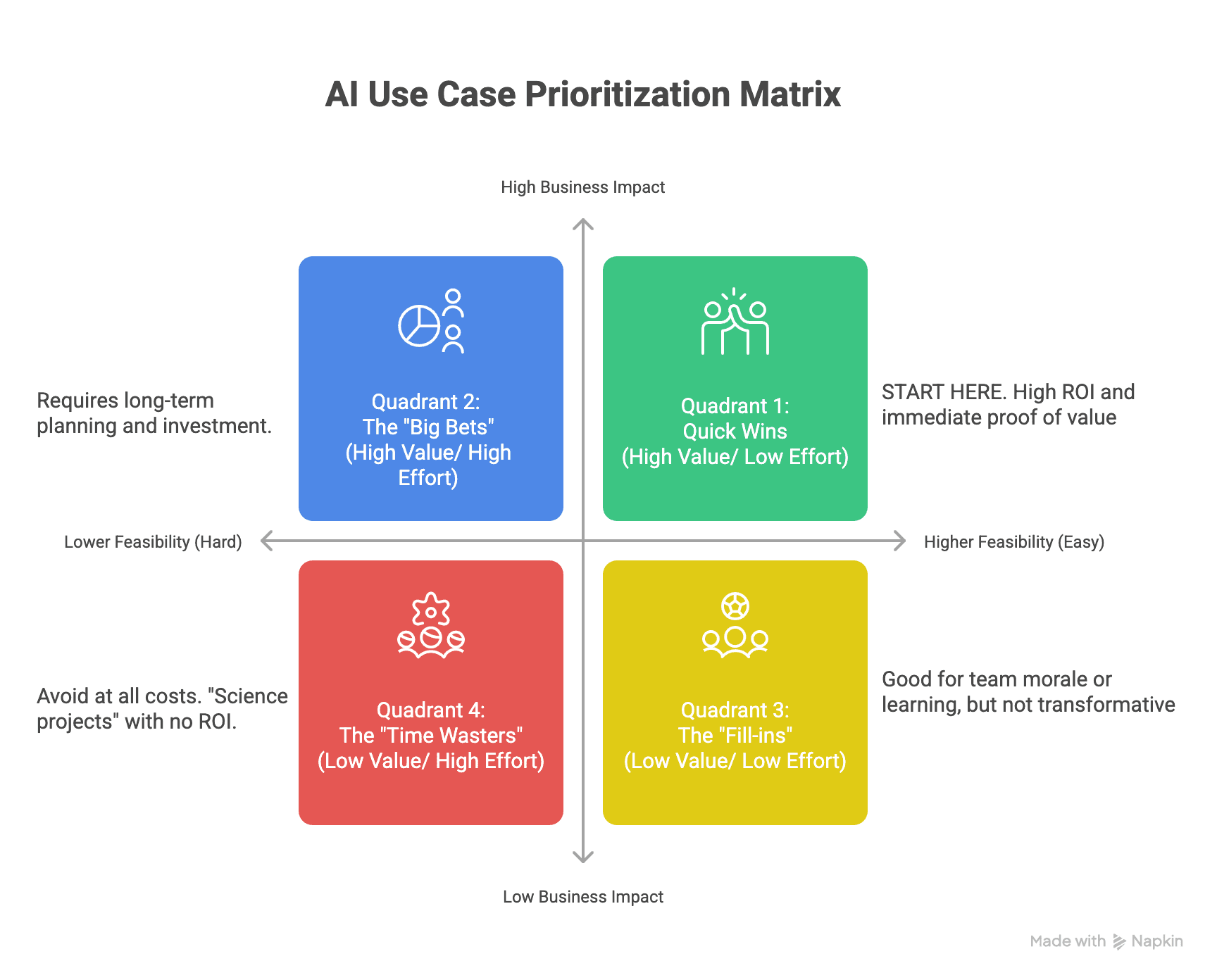
Step 1: Identify value & select use cases
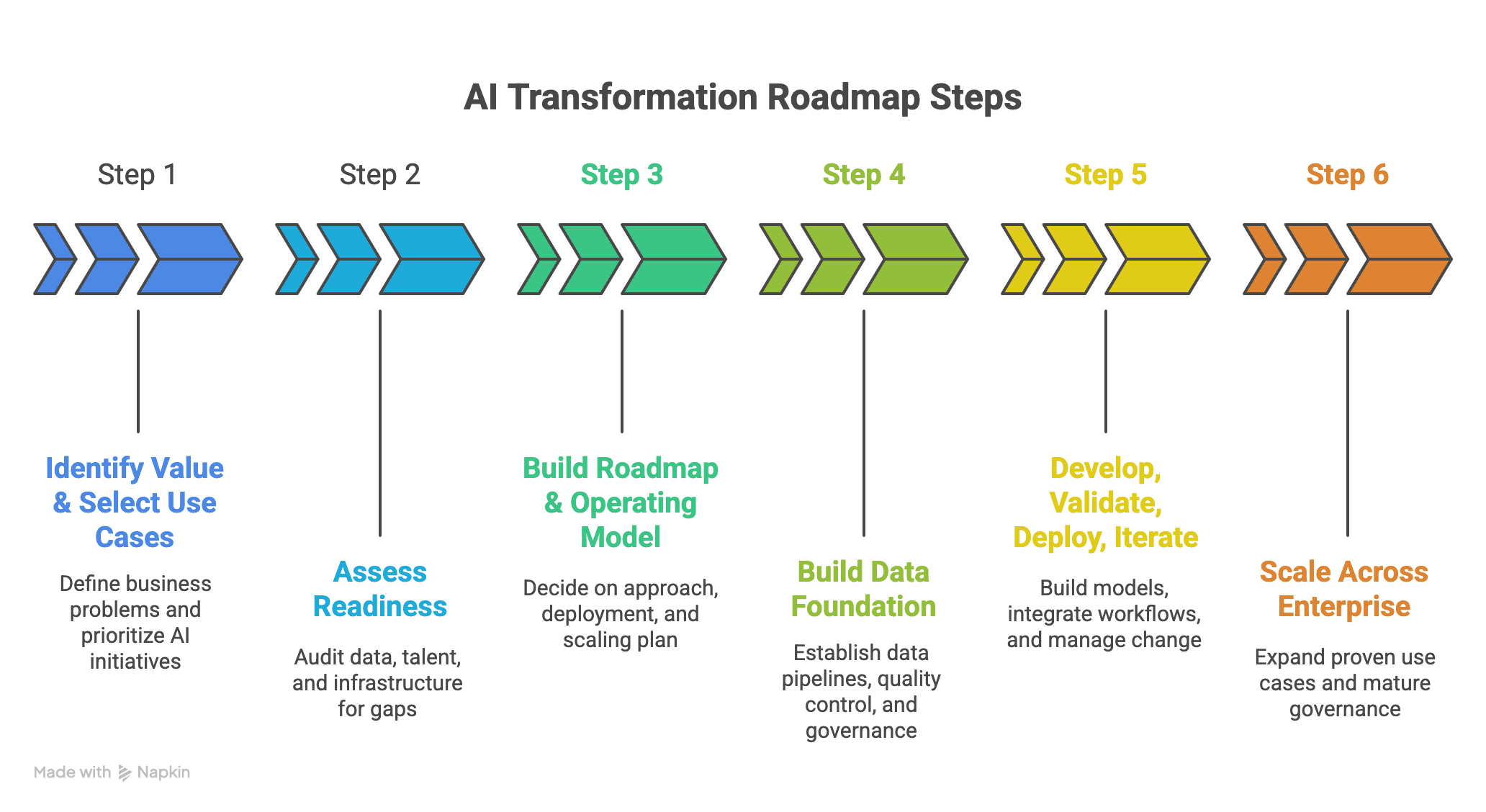
Don't start with "what can this tech do?" Start with "what business problem must we solve?" Tie initiatives to key objectives (e.g., reducing churn). Prioritize use cases by high impact and high feasibility, and assign specific owners to each.
Step 2: Assess readiness
Conduct an audit of your current resources. Do you have the right data? Is it accessible? Do you have the talent in-house to build or manage these systems? Identifying gaps early prevents stalled pilots.
Step 3: Build the roadmap and operating model
Decide on your approach: Will you buy, build, or partner? Define your deployment approach (cloud vs. on-prem) and your scaling plan.
Step 4: Build the data foundation
AI eats data. You must establish pipelines for data collection, ensure quality control, and set up governance and security protocols. Without this, your models will hallucinate or fail.
Step 5: Develop, validate, deploy, and iterate
Begin building or configuring your models. Crucially, integrate them into workflows and focus on Change Management. As roles change, employees need support to adapt to new ways of working.
Step 6: Scale across the enterprise
Once a use case is proven, "infuse" it across other functions. Expand from a sales pilot to a marketing rollout. As you scale, mature your governance models to handle the increased complexity.
Common challenges (and how to avoid them)
Talent/Skills Gaps:
Challenge: Finding data scientists and AI engineers is difficult and expensive.
Mitigation: Focus on upskilling existing staff and partnering with external vendors or platforms that offer "low-code" AI solutions.
Data Quality and Access:
Challenge: "Garbage in, garbage out." Siloed data prevents models from learning effectively.
Mitigation: Invest in a modern data stack and data cleaning before attempting complex ML projects.
Trouble Finding the Right Use Cases:
Challenge: Pick use cases that are too small (no impact) or too big (never finish).
Mitigation: Use a prioritization matrix to find the "Goldilocks" projects—manageable scope with measurable ROI.
Culture and Change Resistance:
Challenge: Employees fear AI will replace them.
Mitigation: Position AI as an "augmenter" or "copilot" and involve staff in the design process so they feel ownership.
How to measure AI transformation success
To prove the value of your AI transformation framework, you must measure it across different layers.
Metrics by layer
Adoption/Usage: Active users, percentage of workflow automated, user satisfaction scores.
Operational: Cycle time reduction, increased throughput, error rate reduction, cost-to-serve.
Business: Revenue lift, churn reduction, conversion rate improvement, Net Promoter Score (NPS), time-to-market.
Risk: Number of compliance incidents, model quality drift (tracking if the model gets worse over time).
Measurement principles
Start with a baseline. You cannot measure improvement if you don't know where you started. Measure continuously, not just at the end of a project, and always tie technical metrics back to business outcomes (e.g., "model accuracy" matters less to the CEO than "revenue saved").
Take the Next Step with Novoslo
Don’t let your AI strategy get stuck in the pilot phase. Join the leaders who are reimagining what’s possible.
If you’re a business owner and want to see how these systems would actually be implemented inside your business.