Article
Dec 28, 2025
30+ Real-World AI Business Transformation Examples (And How to Copy Them)
Discover 30+ real-world AI business transformation examples across retail, finance & tech. Get a step-by-step guide to implement these strategies.
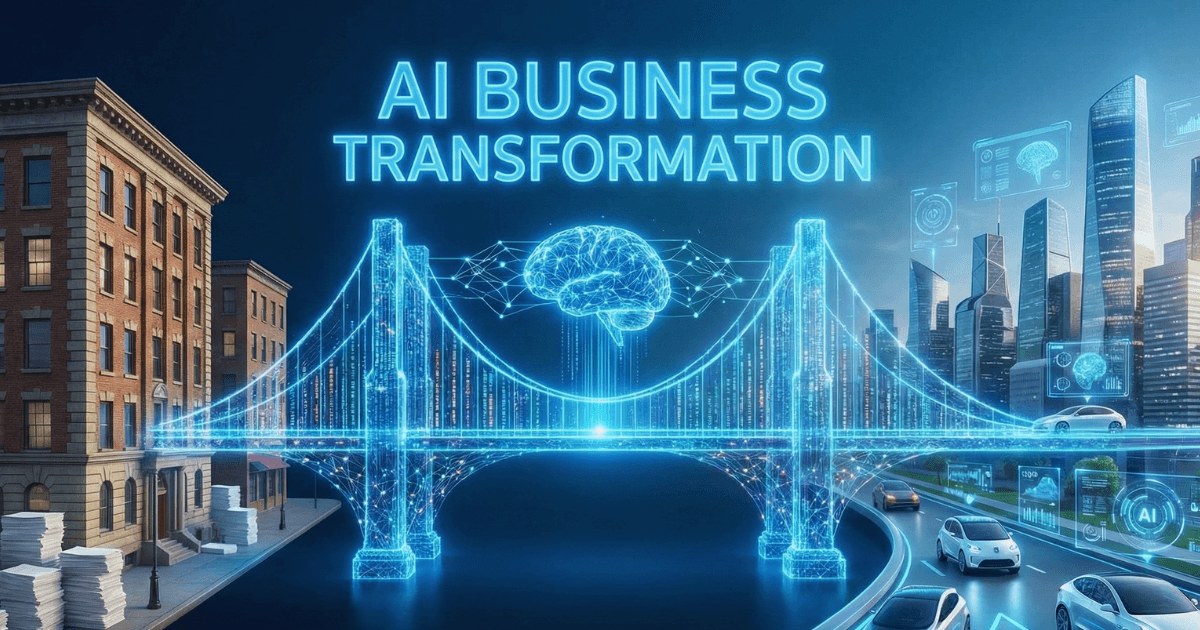
For the better part of a decade, "Digital Transformation" was the corporate buzzword of choice. It usually meant moving from paper to PDFs, or from on-premise servers to the cloud. But that era is ending. We are now entering the age of AI Business Transformation.
The difference is critical: Digital transformation was about digitizing data. AI transformation is about reasoning over that data. It is the shift from simply storing information to using artificial intelligence to make decisions, predict outcomes, and autonomously execute complex workflows.
AI business transformation is defined as the strategic integration of artificial intelligence into all areas of a business, fundamentally changing how you operate and deliver value to customers. It is not just about adding a chatbot to your website; it is about rethinking your core business model to be AI-first.
This article analyzes over 30 real-world AI business transformation examples. We will dissect the specific strategies behind these AI transformation case studies and, most importantly, provide you with a "How to Copy Them" blueprint to apply these innovations to your own organization.
Digital Transformation vs. AI Transformation
To understand the leap we are taking, consider this comparison:
Feature | Digital Transformation (2010–2020) | AI Transformation (2024 & Beyond) |
|---|---|---|
Core Goal | Digitize processes (Paper to Digital) | Intelligent automation (Data to Decision) |
Primary Output | Efficiency and connectivity | Prediction and personalization |
Data Role | Data is stored and retrieved | Data is analyzed and reasoned over |
Human Role | Humans operate the software | Humans supervise the AI agents |
Retail & E-Commerce: Mastering Hyper-Personalization
The retail sector is perhaps the most aggressive adopter of AI, primarily because the feedback loop is immediate: you either make the sale or you don't. While traditional digital methods relied on broad customer segmentation (e.g., "Males, 18-35"), leading companies are now achieving 1:1 hyper-personalization.
The following real-world AI examples demonstrate how the industry giants are using algorithms not just to sell more, but to fundamentally understand the human intent behind every click.
Amazon: The "Flywheel" of Recommendation Engines
Amazon set the gold standard for AI business transformation by integrating machine learning into the very fabric of its store. Their "item-to-item collaborative filtering" doesn't just look at what you bought; it analyzes what items are frequently purchased together in the same cart across millions of users.
The Impact: It is estimated that 35% of Amazon's total revenue is generated by its recommendation engine.
The Strategy: By serving "Frequently bought together" prompts, they reduce customer decision fatigue and increase average order value (AOV) without human intervention.
Sephora: Visual AI and Augmented Reality (AR)
For years, the biggest barrier to buying cosmetics online was the inability to test the product. Sephora bridged this gap with the "Virtual Artist" app.
The Tech: Using facial recognition and Augmented Reality (AR), the app maps facial features to overlay makeup products digitally in real-time.
The Result: This isn't just a gimmick; it’s a conversion tool. By allowing users to "try on" thousands of shades instantly, Sephora significantly reduced return rates and increased user engagement time, proving that AI transformation case studies can be as visual as they are analytical.
Zara: Supply Chain Agility & Inventory Management
Zara is famous for its "fast fashion" model, but its speed is powered by AI, not just fast manufacturing.
The Integration: Zara uses RFID tags on every clothing item, feeding location data into an AI system that tracks inventory in real-time.
Predictive Power: The AI analyzes sales data to predict exactly which styles are trending in specific locations. If a jacket sells out in London but sits stagnant in Paris, the system optimizes distribution centers to reroute stock, drastically reducing waste and markdowns.
Walmart: Demand Forecasting & GenAI Search
Walmart is currently redefining the search bar. Traditionally, e-commerce search was keyword-based (e.g., searching for "chips," "salsa," and "balloons").
GenAI Implementation: Walmart has integrated Generative AI to understand semantic intent. Now, a user can search for a use case, such as "football watch party."
The Outcome: The AI infers the necessary items, snacks, drinks, decorations, and presents a curated collection. This shifts the burden of list-building from the customer to the AI, shortening the path to purchase.
Booking.com: Predicting Travel Intent
Booking.com uses machine learning to solve the "paradox of choice" in travel.
The Model: Their models analyze previous trips, current location, and even the speed of scrolling to predict where a user might want to go next.
The Experience: Often, the app suggests the correct destination or hotel type before the user finishes typing the query. This predictive capability reduces friction in the mobile experience, where typing is cumbersome, thereby increasing conversion rates.
Actionable Takeaway: How to Copy Them
You do not need an Amazon-sized budget to implement these strategies, but you do need organized data.
Start with Data Unification: You cannot personalize if your data is siloed. Implement a Customer Data Platform (CDP) to create a "single view" of the customer.
Crawl, Walk, Run: Don't start with complex AR apps like Sephora. Begin with simple recommendation algorithms on your checkout page (e.g., "Customers who bought X also bought Y").
Search Intent: Review your site search logs. Are users searching for problems ("how to fix leak") or products ("wrench")? optimizing your site search to handle natural language queries is a high-value, low-effort step toward AI business transformation.
Manufacturing & Logistics: The Era of Predictive Operations
In heavy industry and logistics, the cost of failure is measured in millions of dollars per hour. Consequently, AI business transformation in this sector isn't about flashy chatbots; it is about rigorous efficiency and safety. The industry is undergoing a massive shift from "reactive" maintenance (fixing things after they break) to "predictive" operations (fixing things before they break).
These real-world AI examples illustrate how data is becoming the most valuable raw material on the factory floor.
BMW: AI in Quality Control & Manufacturing
BMW has redefined the assembly line by integrating AI-powered computer vision into its quality control processes.
The Tech: At their pressing plants, automated image recognition systems compare metal parts against a perfect digital dataset in milliseconds.
The Impact: These systems can detect micro-cracks and deviations invisible to the human eye. By catching defects at the source, BMW avoids expensive downstream rework and recalls, showcasing how AI transformation case studies often revolve around precision rather than just speed.
DHL: The "OptiCarton" Solution
One of the logistics industry's most expensive inefficiencies is "shipping air" sending small items in unnecessarily large boxes.
The Solution: DHL implemented "OptiCarton," an AI algorithm that analyzes the dimensions and weight of a shipment to recommend the exact optimal box size and pallet layout.
The Result: This simple yet powerful application of AI has helped customers reduce shipping cardboard waste by up to 50% and significantly lower carbon footprints by maximizing truck utilization.
Siemens: The Industrial Metaverse & Digital Twins
Siemens is pioneering the concept of the "Industrial Metaverse" through the use of Digital Twins.
The Strategy: Before pouring a single cubic foot of concrete, Siemens creates a photorealistic, physics-based digital replica of an entire factory.
The Value: They use AI to simulate production workflows, test new machinery configurations, and stress-test supply chains in the virtual world. This allows them to solve bottlenecks digitally before they become expensive physical problems.
Tesla: Autonomous Data Loops
Tesla’s advantage isn't just in battery tech; it is in their "Data Engine."
The Loop: Unlike traditional automakers who rely on test drivers, every Tesla on the road acts as an edge device collecting data. When a driver intervenes (e.g., grabbing the wheel to avoid a pothole), that data is uploaded to train the central AI model.
The Scale: This creates a continuous feedback loop where the fleet teaches the AI, and the AI updates the fleet. It is a prime example of a self-reinforcing AI business model that becomes smarter with scale.
Actionable Takeaway: How to Copy Them
You don't need to build a self-driving car to benefit from this logic.
Sensorize Critical Assets: Identify the "heart" of your operation (e.g., a specific server, a printing press, a delivery truck). Install IoT sensors to track temperature, vibration, or throughput.
Establish Baselines: Use simple anomaly detection algorithms to establish what "normal" looks like.
Predictive Alerts: Set up alerts for deviations. If a machine vibrates 5% more than usual, send a technician now, during a planned break, rather than waiting for the machine to seize up during a rush order.
Unsure what is AI Transformation? We have a whole article on it. Click here to check it out.
Financial Services: Fraud Detection & Risk Management
In the financial sector, trust and speed are the currency. With the sheer volume of global transactions making manual review impossible, banks and insurers have turned to AI business transformation to manage risk at scale. Here, the goal isn't just efficiency; it's about processing millions of data points per second to prevent fraud and capitalize on fleeting market opportunities.
These real-world AI examples demonstrate how machine learning is actively protecting assets and rewriting the rules of engagement in finance.
JPMorgan Chase: Contract Analysis (COIN)
JPMorgan Chase revolutionized its back-office operations with a program called COIN (Contract Intelligence).
The Challenge: Reviewing commercial loan agreements was a massive drain on resources, consuming 360,000 lawyer-hours annually.
The Transformation: They deployed an NLP (Natural Language Processing) system that interprets commercial loan agreements. What took humans thousands of hours, the AI now completes in mere seconds. This massive efficiency gain allows their legal teams to focus on high-value strategy rather than repetitive document review.
Lemonade: Disrupting Insurance Claims
Lemonade has built its entire business model around AI, challenging legacy insurers who rely on slow, paper-heavy processes.
The Experience: When a user files a claim for something simple (like a stolen bike), they chat with "AI Jim," a conversational bot.
The Speed: AI Jim runs 18 anti-fraud algorithms instantly. If the claim is legitimate and simple, the payout is wired in as little as 3 seconds. This sets a new benchmark for AI transformation case studies, proving that insurance doesn't have to be adversarial or slow.
Goldman Sachs: Algorithmic Trading & Risk
For investment giants, milliseconds matter. Goldman Sachs utilizes complex machine learning models to navigate volatile markets.
The Application: Their algorithms ingest vast amounts of alternative data from news sentiment to satellite imagery to identify market signals invisible to human traders.
The Result: This allows them to execute trades at speeds humans cannot match and, crucially, to model risk scenarios dynamically, adjusting portfolios in real-time to protect client capital.
KPMG: Auditing with Generative AI
KPMG is modernizing the centuries-old profession of auditing by integrating Generative AI into its smart audit platform, "Clara."
The Innovation: Clara helps auditors analyze financial data and identify high-risk areas by reasoning over vast datasets.
The Benefit: Instead of sampling a small percentage of transactions, the AI allows auditors to analyze 100% of the data, providing a far more comprehensive view of a company's financial health and freeing up auditors to focus on complex anomalies.
HotelTonight: Preventing Chargeback Fraud
For on-demand booking platforms, last-minute transactions are high-risk for credit card fraud.
The Strategy: HotelTonight implemented predictive models to score every transaction in real-time.
The Outcome: By analyzing booking patterns (e.g., location, device used, time to check-in), the system flags suspicious activity before the charge goes through. This proactive approach reduced credit card chargebacks by 50%, directly impacting the bottom line.
Actionable Takeaway: How to Copy Them
The lesson here is to separate "judgment" from "verification."
Map Your Decision Tree: Identify processes that are high-volume but low-complexity (e.g., verifying a receipt, checking a signature, flagging a transaction over $5,000).
Automate the "Easy" 80%: Deploy AI models to handle these clear-cut cases automatically.
Route the Edge Cases: Configure your system so that anything with a low confidence score (the "ambiguous" 20%) is instantly routed to a human expert. This "human-in-the-loop" approach is the safest path to AI business transformation.
Healthcare & Pharma: Accelerating Discovery
In healthcare, AI business transformation is not merely about optimizing profits; it is about compressing the timeline between "diagnosis" and "cure." Drug discovery historically takes over a decade and costs billions. By leveraging real-world AI examples, leaders in pharma are slashing these timelines, proving that algorithms can save lives just as effectively as they save money.
Pfizer: Speeding up Clinical Trials
The development of the COVID-19 vaccine is one of the most famous AI transformation case studies in history. Speed was the primary variable.
The Strategy: Pfizer used machine learning to analyze vast amounts of demographic and disease data to identify the optimal locations for clinical trials.
The Impact: Instead of waiting months to find suitable patient populations, the AI predicted where outbreaks would occur next. This allowed Pfizer to set up trial sites in high-infection zones before the waves hit, shaving months off the development timeline and bringing the vaccine to market in record time.
PathAI: AI-Assisted Pathology
Pathology, diagnosing disease by examining tissue samples is notoriously subjective and prone to human fatigue.
The Innovation: PathAI uses computer vision models trained on millions of pathology slides to identify cancer cells.
The Benefit: The AI doesn't get tired. It highlights suspicious regions on a slide for the pathologist to review. Research shows that while human error rates in identifying metastatic breast cancer can be around 3.5%, adding AI assistance reduces that error rate to near zero (0.6%). This is a perfect example of AI augmenting, not replacing, human expertise.
Exscientia: AI-Designed Drugs
Traditional drug discovery involves manually testing thousands of molecules to find one that works. Exscientia flipped this model.
The Breakthrough: They became the first company to bring an AI-designed drug molecule to human clinical trials.
The Process: Their AI platform doesn't just screen libraries of existing molecules; it "imagines" and generates entirely new molecular structures optimized for specific targets. This generative approach reduced the exploratory phase from the industry standard of 4-5 years to just 12 months.
Actionable Takeaway: How to Copy Them
Most businesses aren't developing vaccines, but every business makes high-stakes decisions based on complex data.
Adopt "Human-in-the-Loop" (HITL): Do not view AI as a replacement for your experts. Position it as a "second opinion" or a "pre-screener."
reduce False Negatives: If you are in audit, security, or quality control, use AI to flag potential issues. Let the AI be hyper-sensitive (flagging anything suspicious), and let your human experts make the final judgment call on whether it’s a true positive. This leverages the AI's speed and the human's context.

Marketing & Content: Scaling Creativity
In the creative industries, the fear has often been that AI will kill creativity. However, the most successful real-world AI examples in media prove the opposite: AI is scaling creativity, allowing brands to produce personalized content at a volume humanly impossible to match. AI business transformation here is about moving from a "one-size-fits-all" broadcast model to a "one-size-fits-one" engagement model.
Netflix: Artwork Personalization
Netflix has turned the simple movie thumbnail into a data science experiment.
The Strategy: Netflix realized that a single image doesn't appeal to everyone. Their AI analyzes your viewing history to select the specific artwork most likely to get you to click play.
The Execution: If you watch a lot of romance movies, the thumbnail for Good Will Hunting might show Matt Damon and Minnie Driver kissing. If you watch comedies, the thumbnail might show Robin Williams laughing.
The Result: By treating artwork as a dynamic variable rather than a static asset, Netflix significantly increased their click-through rates, proving that AI transformation case studies can be built on granular A/B testing.
The Washington Post: Heliograf Bot
Journalism faces a constant struggle between quality and volume. The Washington Post solved this with "Heliograf," their in-house storytelling bot.
The Application: Heliograf connects to structured data sources, like election results or high school football scores—and automatically generates short narratives.
The Value: During the Rio Olympics and US elections, Heliograf published thousands of articles. This didn't replace reporters; it freed them. While the bot handled the repetitive data reporting, human journalists were free to write the deep-dive investigative pieces that drive subscriptions.
Facebook (Meta): Ad Performance Optimization
Meta’s "Advantage+" suite is a prime example of AI taking the wheel in advertising.
The Automation: Instead of a marketer manually testing five different headlines and three images, they upload the raw assets. Meta's AI mixes and matches these assets dynamically to find the winning combination for each specific user.
The Optimization: The system adjusts budget allocation in real-time, shifting spend toward the highest-performing creative variations. This level of automated optimization has become a cornerstone of modern digital marketing, delivering lower costs per acquisition (CPA) with less manual oversight.
Actionable Takeaway: How to Copy Them
You don't need a Netflix-level algorithm to personalize your content.
Use GenAI for Variations, Not Creation: Don't just ask ChatGPT to "write a blog post." Write the core post yourself (the "Human" element), then use AI to generate 10 different headline variations or 5 different LinkedIn hooks.
Test the Angles: Use these AI-generated variations in your email subject lines or ad copy.
Let Data Decide: Stop guessing which creative is "best." Run the A/B test and let your audience's behavior dictate the winner. This moves your marketing from "opinion-based" to "data-driven."
Internal Operations: Transforming HR, IT, and Admin
While marketing and sales grab the headlines, some of the most impactful AI business transformation examples are happening quietly in the back office. The "invisible" transformation of internal operations is where margins are saved and employee burnout is prevented. Companies are moving away from sluggish ticket-based systems to instant, conversational resolution.
Moveworks: The Agentic AI Service Desk
Moveworks has pioneered the use of "Agentic AI" in IT support, fundamentally changing the traditional helpdesk model.
The Problem: The average IT ticket takes days to resolve, often involving a human agent simply resetting a password or looking up a software license.
The Transformation: Moveworks doesn't just "chat"; it executes. Using advanced Natural Language Processing (NLP), the AI understands the user's intent (e.g., "I can't access Zoom").
The Resolution: It autonomously interacts with backend systems (like Okta or Active Directory) to fix the permission issue instantly. This reduces the ticket volume for human IT staff by over 50%, allowing them to focus on complex infrastructure projects rather than password resets.
Palo Alto Networks: Employee Onboarding
For a cybersecurity giant like Palo Alto Networks, speed and security are paramount, even in HR.
The Strategy: They streamlined the "hire-to-retire" lifecycle using AI agents. When a new employee starts, they aren't handed a static PDF manual.
The Execution: AI agents handle the provisioning of software access and answer the hundreds of "Where do I find...?" questions new hires have. This reduces the "time-to-productivity" for new employees, ensuring they are contributing value in days rather than weeks. This internal efficiency is a crucial, often overlooked aspect of AI business transformation.
Unilever: AI in Recruitment
Unilever receives millions of applications annually. Screening them manually is not only slow but prone to unconscious bias.
The Innovation: Unilever implemented a digital selection process using AI to screen entry-level candidates.
The Process: Candidates play neuroscience-based games that measure inherent traits like risk tolerance and focus, rather than just relying on keywords in a resume.
The Impact: This data-driven approach removed pedigree bias (hiring only from top universities) and increased the diversity of hires. It demonstrates how AI transformation case studies can solve deep-rooted cultural issues while improving operational efficiency.
Actionable Takeaway: How to Copy Them
The "Internal FAQ" is the low-hanging fruit of AI adoption.
Audit Your Tickets: Look at your IT and HR helpdesk logs. What are the top 10 questions? (Usually: "Reset password," "Guest Wi-Fi," "Holiday policy").
Build a Knowledge Base: Ensure the answers to these questions are documented clearly in your internal wiki (e.g., Notion, SharePoint).
Deploy an Internal LLM: Use a secure, internal chatbot (using RAG - Retrieval-Augmented Generation) that connects to your wiki. Let the bot answer the Tier-1 questions instantly. This frees your human HR and IT teams to handle complex Tier-2 issues that actually require empathy and judgment.
The Blueprint – How to Execute Your Own AI Transformation
Reading through real-world AI examples is inspiring, but the gap between "reading" and "doing" is where most companies fail. Competitor analysis shows that while many articles list what companies are doing, few explain how to structure that journey.
To replicate the success of these AI transformation case studies, you need a structured roadmap. Based on the patterns seen in successful organizations, here is a 4-Stage Adoption Framework to guide your AI business transformation.
The 4-Stage Adoption Framework
Most leaders try to jump straight to stage 4. This is a mistake. Successful transformation is iterative.
Augmented Intelligence (The "Co-pilot" Phase)
What it is: AI acts as a sidekick, helping humans perform their existing tasks faster and better. The human is still fully in the driver's seat.
Example: A software engineer using GitHub Copilot to write boilerplate code, or a marketer using ChatGPT to brainstorm blog titles.
Goal: Increase individual productivity.
Process Automation (The "Hands-off" Phase)
What it is: AI takes over a specific, repetitive task entirely. The human reviews the output but does not do the work.
Example: An AI system that automatically extracts data from PDF invoices and enters it into the ERP system.
Goal: Increase operational efficiency and reduce error rates.
Agentic AI (The "Manager" Phase)
What it is: AI moves from doing a task to executing a workflow. It can reason, make decisions, and use tools to complete a multi-step objective without constant supervision.
Example: An AI agent that detects a server outage, diagnoses the root cause, spins up a backup server, and notifies the engineering team—all autonomously.
Goal: Autonomy and speed of response.
Business Model Innovation (The "Transformation" Phase)
What it is: The AI enables a product or service that was previously impossible. This is where you stop optimizing the old business and start building a new one.
Example: John Deere moving from selling tractors to selling "precision agriculture as a service" using AI-driven insights.
Goal: New revenue streams and market disruption.
Measuring Success: KPIs that Matter
One common pitfall in AI business transformation is measuring the wrong things. If you only measure "Hours Saved," you are treating AI as a cost-cutting tool rather than a growth engine.
Time to Value: Instead of "how long did the task take," measure "how fast did the customer get their solution?" (e.g., Lemonade paying claims in 3 seconds).
Prediction Accuracy: For supply chain or finance, the ROI comes from being right. A 1% improvement in demand forecasting accuracy can save millions in inventory costs.
NPS & CSAT: Does the AI make the customer happier? If your chatbot saves money but annoys customers (lowering NPS), it is a failed transformation.
Leadership & Change Management
The World Economic Forum estimates that 50% of all employees will need reskilling by 2025. This is the human cost of transformation.
Reskilling vs. Replacing: The most successful companies (like AT&T and Amazon) invest heavily in internal academies to teach their workforce how to work with AI.
Shift in Leadership Style: In an AI-first organization, the leader's role shifts from "Command and Control" (telling people what to do) to "Inspire and Enable" (giving people the tools and data to solve problems themselves).
Critical Pitfalls to Avoid in AI Transformation
Analyzing successful AI transformation case studies often leads to survivorship bias—we see the winners but miss the hundreds of failed initiatives. The path to AI business transformation is littered with stalled projects and expensive failures. Understanding these common pitfalls is just as important as knowing the success stories.
The Data Readiness Trap
There is a saying in the industry: "There is no AI strategy without a data strategy."
The Reality: Many executives view AI as a magic wand that can be waved over messy, siloed spreadsheets to produce insights.
The Consequence: If your data is unstructured, labeled incorrectly, or trapped in legacy on-premise servers, your AI models will fail. This is the classic "Garbage In, Garbage Out" principle.
The Fix: Before buying expensive AI tools, invest in a "Data Fabric" or modern cloud data warehouse (like Snowflake or Databricks). Ensure your data is clean, accessible, and governed. As seen in many real-world AI examples, the companies that succeed are those that spent years cleaning their data before training their models.
Ethical Bias and "Black Box" Problems
Speed should never come at the cost of fairness.
The Risk: Early AI implementations in hiring and lending faced severe backlash for perpetuating historical biases. For example, if an algorithm is trained on 10 years of hiring data where men were predominantly selected, the AI will "learn" to penalize female resumes.
The "Black Box": Deep learning models are often opaque they give an answer, but can't explain why. In regulated industries like finance or healthcare, this is unacceptable.
The Fix: Prioritize "Explainable AI" (XAI). Ensure you can audit the decision-making path of your models. Leaders must establish an AI Ethics Board to review high-impact algorithms before deployment.
The "Pilot Purgatory"
McKinsey estimates that nearly 70% of companies are stuck in "Pilot Purgatory" running endless Proof of Concepts (PoCs) that never scale to production.
The Cause: Pilots are often launched in a vacuum by innovation labs without integration into the core business workflow. They work in a sandbox but fail when exposed to the messy reality of daily operations.
The Fix: Don't design for the lab; design for scale from Day 1. Define clear "Exit Criteria" for every pilot: If we hit X metric by Y date, we commit Z budget to roll this out globally. If the pilot doesn't solve a burning business problem, kill it fast and move on.
Conclusion
The era of theoretical AI is over. As these 30+ real-world AI examples demonstrate, the technology is no longer just a futuristic concept, it is the current engine of competitive advantage. From Sephora’s augmented reality to Siemens’ industrial digital twins, the winners of this decade are not necessarily the ones with the biggest budgets, but the ones with the best data strategies.
Success in AI business transformation does not come from blindly adopting the latest tools. It comes from identifying specific, high-friction business problems and applying "intelligent" solutions to solve them.
Take the Next Step with Novoslo
Don’t let your AI strategy get stuck in the pilot phase. Join the leaders who are reimagining what’s possible.
If you’re a business owner and want to see how these systems would actually be implemented inside your business.
Book a strategy call here.
Frequently Asked Questions
What are some real-world AI business transformation examples?
Leading real-world AI examples include Amazon’s recommendation engine (driving 35% of revenue), DHL’s "OptiCarton" for logistics efficiency, and Pfizer’s use of machine learning to accelerate vaccine clinical trials. These companies didn't just add AI tools; they fundamentally reshaped their operations around data-driven decision-making.How is AI business transformation different from digital transformation?
Digital transformation is about converting analog information into digital formats (digitization). AI business transformation takes the next step: using that digital data to reason, predict, and automate decisions. While digital transformation connects systems, AI transformation enables those systems to act autonomously.What is the biggest risk in AI transformation?
The "Data Readiness Trap" is the most common pitfall. Many AI transformation case studies fail because companies attempt to build advanced models on top of unstructured, "dirty" data. Without a unified data strategy and clear governance, AI initiatives often stall in the "pilot purgatory" phase without delivering ROI.How do I start an AI pilot in my company?
Begin with the "Augmented Intelligence" stage. Identify a high-volume, repetitive task like IT ticket sorting or invoice entry and deploy an AI tool to assist your human experts. Measure the "Time to Value" and accuracy. Once the pilot proves successful and the data flow is stable, you can move toward full automation.