Article
Jan 21, 2026
How to Calculate Total AI Implementation Costs
This guide reveals the hidden expenses that cause failures and provides a framework for calculating total costs upfront.

MIT research on AI implementation failures shows 95% of enterprise AI implementations deliver zero measurable return despite $30 billion in annual investment. The problem isn't the technology. Organizations budget for software licenses and ignore everything else. Infrastructure costs, data preparation work, and ongoing maintenance quietly triple initial estimates. By the time teams realize the real AI implementation costs, they're committed to projects that won't deliver.
Why Most AI Cost Estimates Are Wrong From Day One
The $200,000 Project That Actually Costs $600,000
A vendor quotes $200,000 for an AI pilot that includes software, basic integration, and training, so leadership approves the project with confidence. At that moment, the budget feels complete and the scope seems clear. However, as the work begins and time passes, hidden gaps start to appear.
First, the team realizes that customer data is scattered and inconsistent across systems, which makes the AI unusable without cleanup. Because of this, data preparation alone adds $80,000 to the original budget. Once the data is fixed, another problem shows up. The existing cloud setup cannot handle the new processing load, so infrastructure upgrades add $120,000 more.
As the system grows, the company also needs people who know how to run and maintain it. This leads to an additional $150,000 per year for specialized talent. At the same time, employees need help learning new workflows, which brings in change management costs of $50,000.
By the end of the first year, the original $200,000 pilot has quietly turned into a $600,000 project. Research on enterprise AI projects shows that 85% of organizations misjudge AI costs by more than 10%, often from the very beginning.
What Makes AI Projects Fail at Twice the Rate of Traditional IT?
Recent analysis of enterprise AI abandonment found 42% of companies abandoned most AI initiatives in 2025, up from 17% in 2024. Gartner predicts over 40% of agentic AI projects will be canceled by 2027 due to escalating costs.
AI projects fail at twice the rate of traditional IT for a simple reason. Traditional software does what you tell it. AI systems learn from data. If data is incomplete or inconsistent, the system produces unreliable outputs regardless of algorithm sophistication. Most organizations discover data problems after committing significant budget.
The Five Hidden Cost Categories Vendors Won't Mention
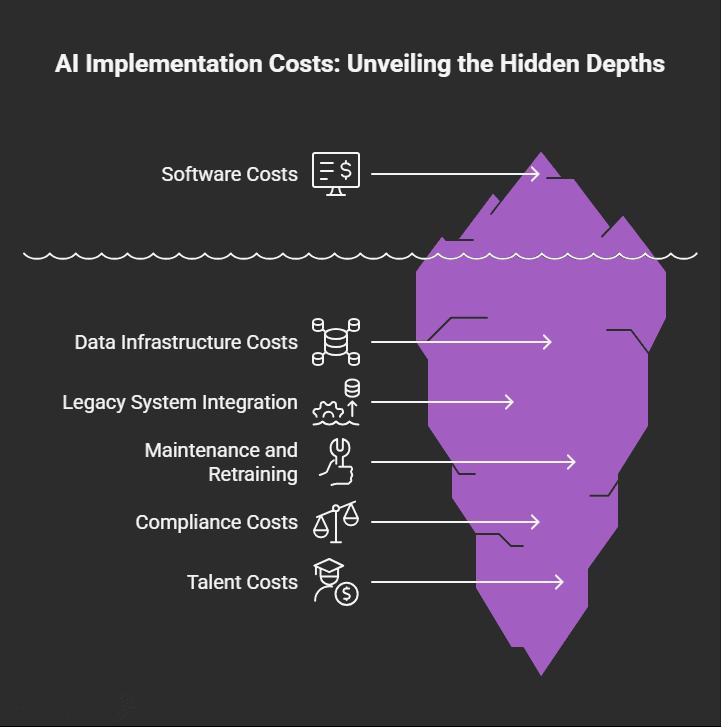
Vendors sell AI implementation costs based on their software. But software is usually the smallest part of total cost.
Data Infrastructure Costs Add 30% to 50% to Initial Estimates
AI needs consolidated data. Customer information in CRMs, transaction history in ERPs, behavioral data in analytics platforms must be in one place, cleaned and standardized. Detailed breakdown of integration expenses shows these costs add 30% to 50% to initial estimates. A $300,000 project becomes $450,000 before AI work begins.
Research on AI infrastructure optimization found 30% to 50% of AI cloud spend evaporates into idle resources. Organizations with mature data governance reduce AI implementation costs by 20% to 35%.
Legacy System Integration Can Double Your Timeline and Budget
Legacy integration costs $50,000 to $150,000 for performance optimization alone, according to detailed breakdown of integration expenses. Data transformation adds $30,000 to $100,000. Technical debt in legacy systems becomes apparent when organizations layer AI capabilities on top. Many need to modernize critical systems first.
Maintenance and Retraining Consume 15% to 30% Annually
Models trained on 2024 data become less accurate as conditions change. This model drift requires continuous monitoring and retraining. Enterprise AI total cost of ownership research shows annual maintenance accounts for 15% to 30% of total infrastructure cost.
Compliance Adds 23% in Regulated Industries
Healthcare needs HIPAA compliance. Financial services face SEC oversight. European customer data requires GDPR satisfaction. Regulatory compliance adds 23% to AI implementation costs in highly regulated industries, according to detailed breakdown of integration expenses.
Talent Costs Exceed $150,000 Per Year
Data scientists command $150,000 to $200,000 annually. Senior machine learning engineers can exceed $250,000. Smaller companies face particular challenges competing for limited talent. 40% of smaller organizations struggle to find qualified candidates versus 29% of larger firms.
What Are the Real Risk Costs of AI Implementation Failure?
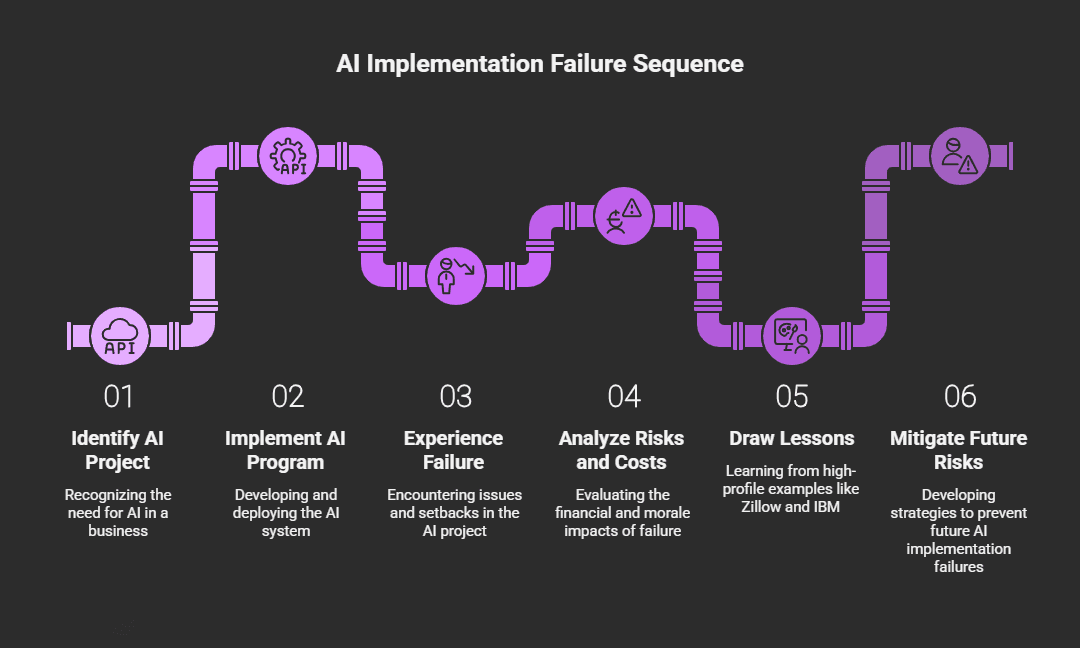
The $304 Million Lesson: How Zillow's AI Bet Destroyed Value
Analysis of high profile AI failures documents Zillow's algorithmic home buying program collapsing with a $304 million inventory writedown in one quarter. The company laid off 25% of its workforce.
The AI wasn't broken. The problem was data completeness. Models relied on structured data but couldn't account for neighborhood dynamics, school quality changes, or property condition details. IBM burned through $5 billion on Watson Health before selling it at a massive loss.
How Do Failed Implementations Impact Team Morale?
McKinsey research on AI risk management shows 51% of organizations using AI experienced negative consequences. When projects fail, teams become cynical. The best people leave. Remaining staff approaches new initiatives with defensive pessimism. Rebuilding confidence takes years.
How Can You Calculate Total AI Implementation Costs Before Committing?
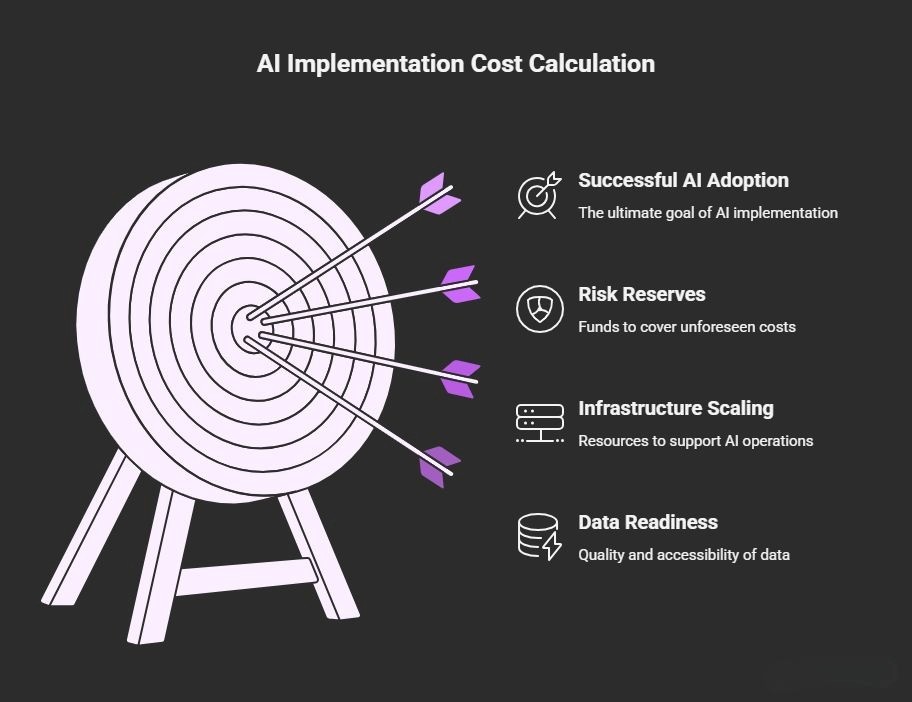
Start With Data Readiness Assessment Before Any Technology Decisions
Analysis of high profile AI failures found 73% of enterprise data leaders identify data quality as the primary barrier to AI success. That ranks above model accuracy and computing costs. A proper assessment examines data volume, consistency, accuracy, and accessibility. It identifies gaps and estimates consolidation work.
Organizations with mature data governance face lower costs. Research on AI infrastructure optimization shows they reduce total costs by 20% to 35% and accelerate time to value by 40% to 60%.
Add Infrastructure Scaling Costs to Your Three Year Projection
Infrastructure needs grow as adoption expands. Enterprise AI total cost of ownership research notes planning for scalability adds 15% to 25% to initial costs but reduces future expansion expenses by 40% to 60%.
Include compute resources, storage costs, network capacity, and redundancy in three year projections. Organizations investing in scalable architecture upfront spend 15% to 20% more initially but save 30% to 50% on total ownership costs.
What Should Your Risk Reserve Be for Enterprise AI Projects?
Traditional IT projects hold 10% to 15% contingency reserves. AI projects need 20% to 30% reserves reflecting higher uncertainty and failure rates. This covers data quality issues, integration complexity, performance problems, and emerging regulatory requirements.
Build explicit decision points into project plans. At each milestone, evaluate whether projects deliver expected value. These checkpoints provide natural exit points if economics stop working.
Which Implementation Approach Reduces Cost Risk Most Effectively?
Why Professional Services Increase Success Rates by 650%
Comprehensive study on DIY versus professional implementation reveals DIY routes face 80% failure rates. Organizations with structured professional support succeed at 26% versus 4% for pure DIY approaches. Professional services increase success odds by 650% while reducing total costs.
Experienced partners know failure patterns. They prevent expensive mistakes during planning phases. Once systems run, organizations shift to internal maintenance with foundations properly established.
Incremental Deployment in Non Critical Systems First
Enterprise AI security guidelines recommend deploying AI in non critical systems first. Starting with lower risk use cases like document processing or meeting transcription allows teams to learn without betting the business.
The workflow first implementation framework provides structure for phased approaches. Phase one proves value in constrained scope. Phase two expands successful pilots into production with validated business cases.
What Questions Should You Ask Before Signing Any AI Contract?
Can the Vendor Show Proof of Measurable Business Outcomes?
Ask vendors for specific examples delivering documented financial returns. Credible partners share customer success metrics with context. They acknowledge where implementations struggled. Vendors deflecting or providing vague assurances lack strong track records.
The AI transformation roadmap provides context for reasonable expectations. Realistic implementations show initial value within three to six months but achieve full potential over 12 to 18 months.
How Will This Integrate With Our Existing Systems and Data?
Vendors should demonstrate specific understanding of your technology environment. Ask them to map integration architecture. Which systems need connections? Where does data flow? What transformation happens where?
Understand vendor approaches to choosing between AI agents and tools. Architecture decisions impact long term costs and flexibility.
What Happens When the Model Drifts or Performance Degrades?
Model drift isn't if but when. Vendors should have clear answers about monitoring, alerting, and remediation. Ask about drift detection capabilities, alerting systems, and retraining costs. Sophisticated vendors build observability into solutions from day one.
Who Owns the Risk If This Project Fails to Deliver ROI?
Most AI contracts shift implementation risk to customers. Ask vendors to propose risk sharing mechanisms. Performance based pricing, guaranteed cost caps, cancellation clauses. Vendors confident in their approach accept reasonable risk sharing.
Working with AI transformation partners who share implementation risk creates better alignment than vendors focused purely on software sales.
The Real Cost of Getting AI Implementation Wrong
AI implementation costs exceed initial projections because organizations focus on software licensing and ignore data preparation, infrastructure scaling, legacy integration, maintenance, and specialized talent. These hidden costs typically double or triple estimates.
MIT research on AI implementation failures shows 95% of implementations fail because organizations underestimate what deployment requires. But the pattern isn't inevitable.
Organizations that calculate total costs upfront, implement incrementally starting with non critical systems, invest in professional services for planning, and build explicit risk reserves succeed at dramatically higher rates. Comprehensive study on DIY versus professional implementation found these organizations achieve 6x better success rates and 30% lower total costs despite higher upfront investment.
AI implementation costs what it costs. Organizations that face real numbers early make better decisions about scope, timing, and approach. Those discovering costs midstream usually pay more for worse outcomes.