Article
Jan 3, 2026
What does an AI Transformation Partner Do?
Learn what an AI Transformation Partner does, how they differ from vendors, when you need one, and what a phased AI engagement looks like, plus ROI math.
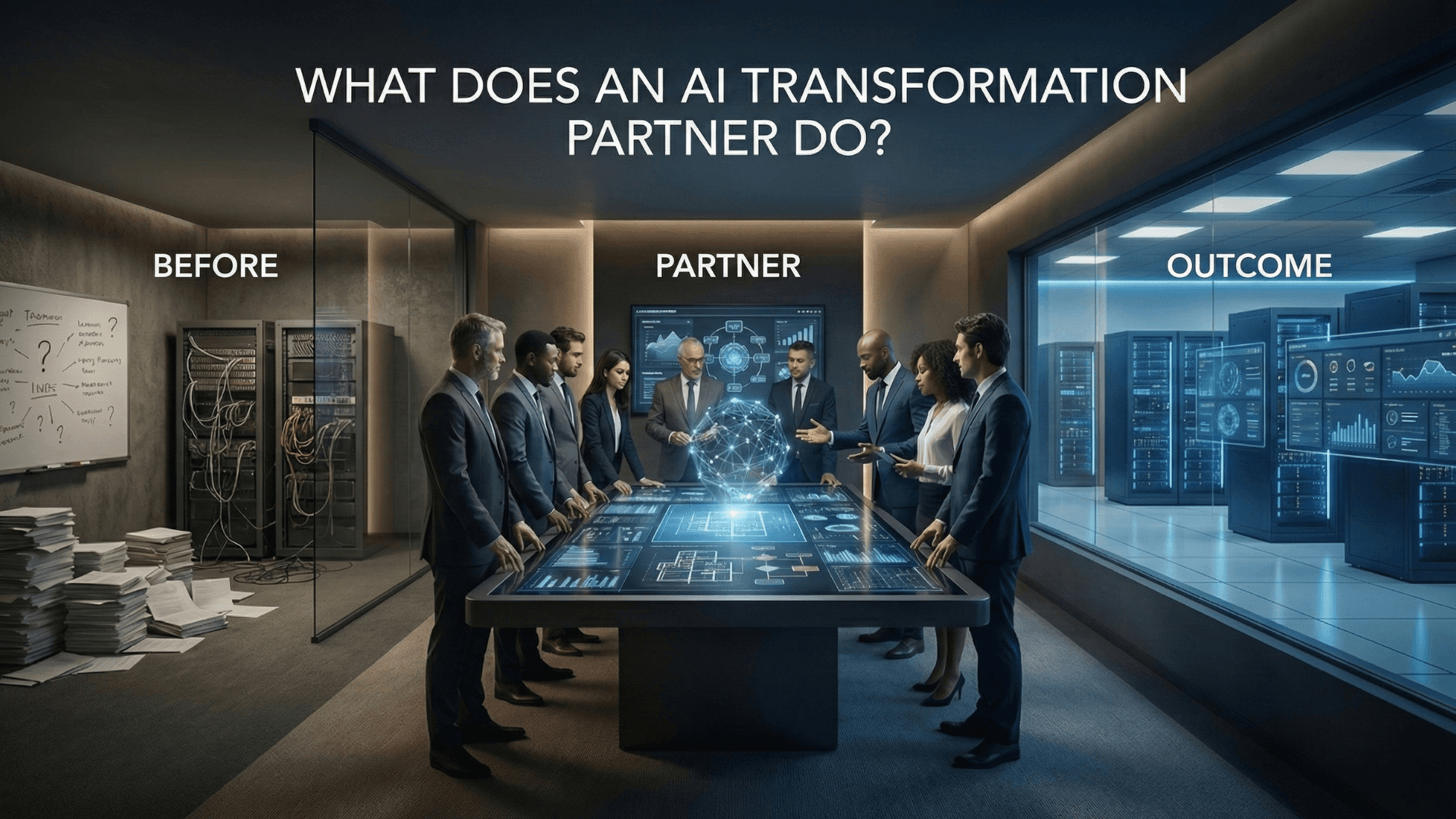
An AI transformation partner is a specialized firm or consultant that guides organizations through the complete journey of adopting artificial intelligence from identifying high-value opportunities to deploying production systems and optimizing them over time. Unlike traditional software vendors who deliver tools, or consultants who deliver strategy decks, an AI transformation partner combines both: they diagnose where AI will create the most value, build and deploy the solutions, and stay engaged to ensure those solutions continue delivering results.
In practice, an AI transformation partner does the following:
Conducts operational audits to map processes and identify automation opportunities
Scores and prioritizes use cases by ROI, complexity, and strategic alignment
Designs and runs pilots with clear success metrics before scaling
Builds production-grade systems with proper integration, monitoring, and documentation
Establishes governance frameworks for responsible AI deployment
Trains your team and manages the organizational change AI adoption requires
Provides ongoing optimization as models drift, APIs evolve, and business needs change
This guide explains each of these responsibilities in detail, shows you what a typical engagement looks like, and provides the financial frameworks to evaluate whether an AI transformation partner makes sense for your organization.
Core Responsibilities of an AI Transformation Partner
Understanding what an AI transformation partner does requires looking beyond surface-level descriptions. Here are the specific responsibilities that define the role.
Strategy and Opportunity Mapping
The partner's first job is diagnosis, not prescription. They examine your operations to understand where time disappears, where errors originate, and where automation would produce the highest return. This involves process mapping at a granular level—documenting how work actually flows through your organization, including the workarounds and exceptions that procedure manuals never capture. They conduct stakeholder interviews with the people who do the work daily, not just managers describing it from above. The output is a prioritized list of opportunities scored by potential value, implementation complexity, and strategic fit.
Data Readiness and Architecture Alignment
AI solutions require data. A credible partner assesses whether your data infrastructure can support the proposed use cases. This includes evaluating data quality, accessibility, and governance. They identify gaps that need addressing before implementation begins and help you understand what architectural changes, if any, are required to enable AI at scale.
Pilot Design and Measurement
Before committing to large investments, a partner designs bounded pilots that prove concepts work in your specific environment. This means selecting high-value, lower-complexity opportunities, agreeing on specific success metrics tied to business outcomes, and running against real data to surface edge cases that synthetic testing would miss. The pilot validates whether the proposed solution delivers value before you commit to production scale.
Production Integration and Reliability
Moving from pilot to production is where many AI initiatives fail. The partner handles integration hardening—connecting solutions to production systems with proper error handling, logging, and recovery mechanisms. They conduct load testing under realistic conditions and ensure the system behaves correctly when upstream systems slow down or inputs fall outside expected parameters. This phase includes comprehensive documentation: system architecture, configuration details, operating procedures, and troubleshooting guides.
AI Governance, Risk, and Compliance
Responsible AI deployment requires governance frameworks that most organizations lack. The partner establishes policies for model ownership, approval workflows, bias monitoring, and risk mitigation. In regulated industries, they ensure solutions meet compliance requirements. This is not an afterthought—it is built into the engagement from the beginning.
Change Management and Enablement
Technology alone does not create transformation. The partner trains your team on new tools and workflows, manages the cultural shift AI adoption requires, and builds internal capability so your organization becomes progressively more self-sufficient. This includes onboarding new staff and providing advanced training as your team becomes more sophisticated.
Ongoing Optimization
AI systems require continuous attention. Models degrade. APIs change. Business processes evolve. The partner monitors performance over time, updates solutions to maintain effectiveness, incorporates user feedback into incremental improvements, and helps identify the next opportunities for expansion. This ongoing relationship distinguishes AI transformation partners from vendors who deliver and disappear.
What You Should Receive: AI Transformation Partner Deliverables
A legitimate AI transformation partner produces tangible deliverables at each stage. Here is what you should expect:
Phase | Deliverables |
|---|---|
Operational Audit | Process maps, opportunity scorecard with ROI estimates, prioritized recommendation list, baseline metrics definition |
Pilot | Scope document, success metrics agreement, working solution in controlled environment, measured results report, go/no-go recommendation |
Production | Production runbook (logging, monitoring, fallback procedures), system architecture documentation, operating procedures, troubleshooting guides |
Governance | AI governance policy (ownership, approvals, model risk), compliance documentation, bias monitoring framework |
Enablement | Training plan, enablement materials, onboarding documentation for new staff |
Ongoing | Performance reports, optimization recommendations, model update logs, expansion roadmap |
AI Transformation Partner vs. Consultant vs. Vendor
The term "AI transformation partner" can be confusing because it overlaps with consultants and vendors. Here is how these roles differ:
Aspect | Traditional Consultant | Software Vendor | AI Transformation Partner |
|---|---|---|---|
Primary output | Strategy decks, recommendations | Software product | Working systems + ongoing value |
Implementation | Advises but does not build | Sells existing product | Builds custom solutions |
Engagement length | Project-based (weeks/months) | License term | Long-term partnership |
Post-delivery involvement | Minimal | Support tickets | Continuous optimization |
Risk sharing | Limited | None (you buy, you own) | Phased approach reduces risk |
The key distinction: a transformation partner is accountable for outcomes, not just activities. They have skin in the game because their success depends on your AI initiatives actually working.
When Do You Need an AI Transformation Partner?
Not every organization needs an AI transformation partner. Here are the signals that indicate you might:
Your pilots have stalled or failed due to gaps between strategy and execution
Your internal teams lack bandwidth or expertise for full-scale AI initiatives
Leadership sees AI as a core growth driver but needs a roadmap to get there
You have tried tools but they have not delivered the promised value
You need governance and compliance frameworks that do not exist internally
You want transformation, not just tools
Conversely, you probably do not need a transformation partner for one-off automations, simple tool implementations, or if you already have strong internal AI capabilities and just need supplemental engineering resources.
The AI Transformation Partner Engagement Model
Understanding what an AI transformation partner does becomes clearer when you see how a typical engagement unfolds. Every partner operates slightly differently, but the fundamental phases remain consistent across legitimate engagements.
Phase 1: Operational Audit: What the Partner Does and What You Get
The engagement begins with understanding, not building. This phase exists because solutions designed without diagnosis fail.
What happens during this phase:
Process mapping at a granular level. The partner documents how work actually flows through your organization—including workarounds, exceptions, and unofficial steps everyone knows but nobody writes down.
Stakeholder interviews. The partner talks to the people who do the work. Not just managers describing work from above, but individuals who handle transactions, manage approvals, and solve problems daily. This is where tribal knowledge surfaces.
Bottleneck identification. Once processes are mapped, the partner identifies where delays accumulate. Sometimes the bottleneck is a single approval step. Sometimes it is a data handoff between systems. Sometimes it requires one specific person's attention.
Opportunity scoring. Not every bottleneck is worth solving with AI. The partner scores opportunities based on potential return, implementation complexity, and strategic alignment to produce a prioritized list.
What you should receive:
Clear report documenting current state operations
Identified bottlenecks with root cause analysis
Recommended interventions ranked by expected value
Baseline metrics for measuring future improvement
Typical duration: Two to four weeks depending on operational complexity.
Your involvement: Moderate to high. The partner needs access to your people, systems, and data. Executive sponsorship ensures cooperation across departments.
Phase 2: Pilot Deployment: What the Partner Does and What You Get
The audit identifies where to focus. The pilot proves the concept works. This phase is deliberately bounded—narrow scope, limited investment, with the goal of validating that the proposed solution delivers value in your specific environment.
What happens during this phase:
Scope definition. The partner selects one high-value, lower-complexity opportunity from the audit recommendations. The scope is intentionally constrained to reduce risk and accelerate learning.
Success metrics agreement. Before building anything, both parties agree on how success will be measured. Metrics must be specific, measurable, and tied to business value.
Development and configuration. The partner builds the solution, typically involving workflow automation, integration with existing systems, and implementation of AI models tailored to your use case.
Testing with real data. The pilot runs against your actual data in a controlled environment. This surfaces edge cases and integration issues that synthetic testing would miss.
Results measurement. Outcomes are measured against agreed metrics. Did the solution deliver expected value? What worked? What requires adjustment?
What you should receive:
Working solution deployed in controlled environment
Measured results compared against success criteria
Clear recommendation for whether and how to proceed
Typical duration: Four to eight weeks depending on complexity.
Your involvement: Moderate. You need to provide data access, identify edge cases, and participate in results review.
Phase 3: Production Scale: What the Partner Does and What You Get
A successful pilot proves the concept. Production scale proves the solution can operate reliably at full volume. This is where many AI initiatives fail—the pilot worked, but the transition to production introduced unexpected problems.
What happens during this phase:
Integration hardening. The solution is connected to production systems with proper error handling, logging, and recovery mechanisms.
Load testing. The solution is tested under realistic production conditions. Can it handle peak volumes? How does it behave when upstream systems slow down?
User acceptance testing. People who will use the solution daily test it in realistic scenarios. Their feedback identifies usability issues and training needs.
Documentation. System architecture, configuration details, operating procedures, and troubleshooting guides are all documented.
Deployment. The solution goes live, either all at once or in a staged rollout depending on risk tolerance.
What you should receive:
Production-grade solution operating with real data and users
Comprehensive documentation
Confirmation that results match pilot expectations at scale
Typical duration: Six to twelve weeks depending on integration complexity.
Your involvement: High during testing phases, moderate during deployment. Key stakeholders must validate the solution meets operational needs.
Phase 4: Continuous Optimization: What the Partner Does and What You Get
Deployment is not the finish line. AI systems require ongoing attention. This phase distinguishes AI transformation partners from vendors who deliver and disappear.
What happens during this phase:
Performance monitoring. The partner tracks key metrics over time. Is accuracy holding steady? Are processing times consistent? Drift is detected early.
Model updates. As AI models improve and APIs evolve, the solution is updated to take advantage of new capabilities or maintain compatibility.
Iteration based on feedback. User feedback is incorporated into incremental improvements. Features are refined, workflows adjusted, edge cases addressed.
Training and enablement. As your team becomes more sophisticated, they receive advanced training. New staff are onboarded.
Expansion planning. Once the initial deployment is stable, the partner helps identify next opportunities from the original audit.
What you should receive:
Regular performance reports
Proactive updates to maintain system health
Responsive support for issues
Structured process for continuous improvement
Typical duration: Ongoing. The specific engagement model varies—retainer arrangements, support packages—but the commitment to long-term value remains consistent.
How This Phased Structure Reduces Risk
Notice that each phase contains natural exit points. After the audit, you can decide not to proceed—you have a valuable document but no commitment to implementation. After the pilot, you can decide not to scale—your exposure is limited to pilot scope. After production deployment, you can decide not to continue with the same partner for optimization—you have a working system and documentation sufficient for another party to maintain.
This structure protects you. Each phase proves value before the next phase begins. You are never locked into a large commitment without evidence that the engagement is working.
A partner who proposes this phased approach demonstrates confidence in their ability to deliver. A vendor who pushes for large upfront commitments without phased validation is asking you to absorb risk that should be shared.
The ROI Conversation: How an AI Transformation Partner Quantifies Value
A credible AI transformation partner does not sell "AI"—they quantify outcomes, define baselines, and tie metrics to your P&L. This section provides the frameworks they should use.
How to Calculate Time Savings in Labor Costs
Time savings are the most common benefit claimed by AI solutions. They are also the most commonly miscalculated. The error most people make is using gross time saved without converting to financial impact.
Start with the process you intend to automate. Measure current labor investment precisely. How many people touch this process? How many hours per week does each person spend? What is the fully loaded cost per hour? Fully loaded cost includes benefits, payroll taxes, equipment, and overhead—typically 1.25 to 1.4 times base salary.
Example:
Invoice processing currently requires one full-time employee at $55,000 salary. Fully loaded cost is approximately $71,500 annually ($34/hour). The employee spends thirty hours weekly on invoice processing—monthly cost: $4,420. After automation, invoice processing requires five hours weekly for exception handling—monthly cost: $737. Monthly savings: $3,683. Annual savings: $44,196.
How to Measure Error Reduction
Errors have costs that most organizations do not track systematically. This makes error reduction harder to quantify but often more valuable than time savings.
Categories of error cost:
Direct correction cost: Labor consumed fixing errors
Downstream impact cost: Errors propagate and affect vendor relationships, pricing negotiations, etc.
Compliance and penalty cost: In regulated industries, errors trigger penalties
Customer impact cost: Errors affecting customers damage retention and lifetime value
Example:
A company processes 2,000 orders monthly with a 4% error rate (80 errors). Average cost per error: $45. Monthly error cost: $3,600 ($43,200 annually). After automated validation, error rate drops to 0.5% (10 errors). Monthly error cost: $450. Annual savings from error reduction: $37,800.
How to Frame AI Investment Against Headcount Costs
The most clarifying comparison is the headcount frame. When you invest in AI automation, you are buying a capability that performs work. The relevant comparison is not "does this cost seem reasonable" but "what would it cost to accomplish the same output with human labor."
Example:
An AI solution will automate lead qualification—currently 60 hours monthly of SDR time. Fully loaded SDR cost: $32/hour. Monthly human cost: $1,920 ($23,040 annually). The AI solution costs $15,000 to implement and $500/month to maintain. Year one total: $21,000. Year one ROI: positive by $2,040. Year two onward: saving $17,040 annually.
The Hidden Interest You Pay Every Month You Delay
Every month you continue operating with inefficient manual processes, you are paying a premium. For every month you delay implementation, you forgo savings. If your projected monthly savings are $5,000 and you delay six months, you have paid $30,000 in hidden interest—money you will never recover.
This reframes the decision. The question is not just "should we invest" but "what does it cost to wait." An AI transformation partner who can accelerate your decision process is delivering value before implementation begins.
Building the Business Case
For leaders presenting to financial stakeholders, the ROI conversation requires structure:
Establish current state costs. Document labor hours, error rates, and their financial impact precisely.
Project future state costs. Estimate costs after automation. Be conservative.
Calculate the investment. Include implementation, maintenance, internal resources, and transition costs.
Compute payback period. Viable periods are typically 6-18 months.
Quantify hidden interest. Show what each month of delay costs.
See If We Are the Right Fit
If you are evaluating AI transformation partners and want a conversation grounded in diagnosis rather than demos, we should talk.
Novoslo operates as an AI Transformation Partner for businesses. We start with an audit, not a pitch. We build systems that reduce your dependence on us over time. We measure success in outcomes, not outputs.
Book a discovery call to discuss your situation and see if there is a good fit. On the call we will determine whether your challenges align with what we do.
If we are not the right fit, we will be the first to tell you. If we are, you will know exactly what working together looks like.
[Schedule a Discovery Call]
Frequently Asked Questions About AI Transformation Partners
What is an AI transformation partner?
An AI transformation partner is a specialized firm that guides organizations through complete AI adoption—from identifying opportunities through deployment and ongoing optimization. Unlike consultants who advise or vendors who sell products, they combine strategy and implementation into a single accountable relationship.
What does an AI transformation partner do day-to-day?
Day-to-day activities vary by engagement phase. During audits, they interview stakeholders and map processes. During pilots, they build and test solutions. During production, they handle integration and documentation. During optimization, they monitor performance and implement improvements.
How is an AI transformation partner different from an AI consultant or vendor?
Consultants typically deliver recommendations without implementation. Vendors sell existing products without customization. Transformation partners do both: they diagnose opportunities, build custom solutions, and remain engaged for ongoing optimization. They are accountable for outcomes, not just activities.
What deliverables should you expect from an AI transformation partner?
Expect process documentation, opportunity scorecards, pilot results reports, production runbooks, governance policies, training materials, and ongoing performance reports. Each engagement phase should produce tangible deliverables that have value even if you do not proceed to the next phase.
How do you measure the success of an AI transformation engagement?
Success should be measured against specific metrics agreed before work begins. Common metrics include time savings (converted to labor cost reduction), error rate reduction, throughput increase, and payback period. A credible partner will help you establish baselines and track outcomes.
How long does an AI transformation engagement take?
Timelines vary by scope. A typical audit takes 2-4 weeks. Pilots take 4-8 weeks. Production deployment takes 6-12 weeks. Optimization is ongoing. A complete initial engagement from audit through production typically takes 3-6 months, with the relationship continuing for optimization.
What does an AI transformation partner cost?
Costs vary significantly based on scope and complexity. The relevant question is not absolute cost but return on investment. Frame the investment against the headcount cost of accomplishing the same work manually. Most viable engagements achieve payback within 6-18 months.