Article
Jan 16, 2026
5 Ways to Use Claude Cowork for Business AI Transformation
Claude Cowork turns AI from a chatbot into an agent. Here are 5 workflows that save executives 20+ hours a week on reports, audits, and analysis.
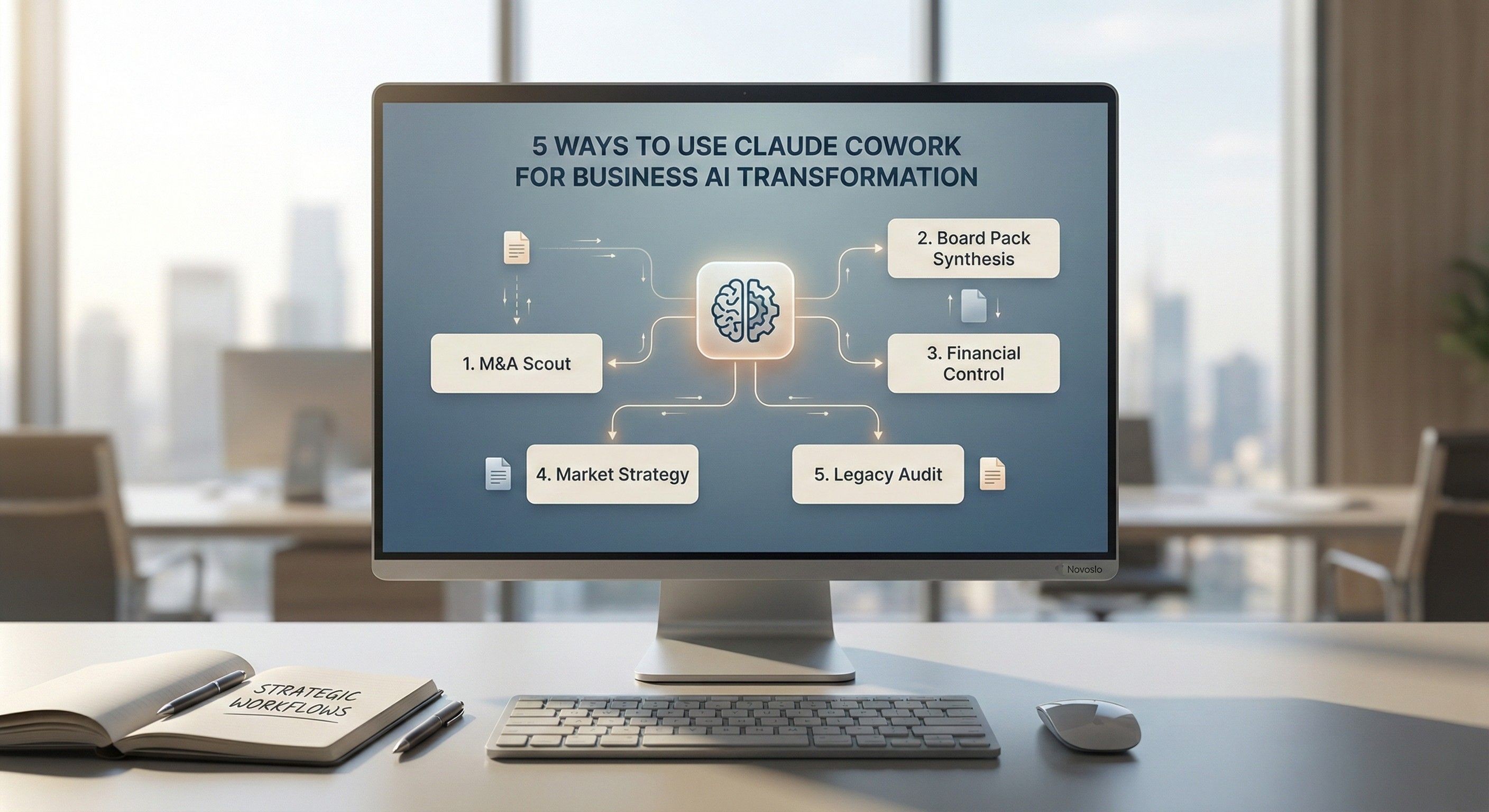
If you haven’t heard yet, Anthropic has just released Claude Cowork which changes the way you use Artificial Intelligence due to its Agentic capabilities on its Desktop Application.
For executives, this distinction is critical. A chatbot waits for you to type. An agent helps you do the work.
Claude Cowork allows the AI to access a specific local environment on your computer. It can read files, draft documents, edit spreadsheets, and execute complex instructions without constant supervision.
This capability changes how leadership teams approach AI transformation. It shifts the focus from generating text to completing tasks.
What Makes Claude Cowork Different from Regular LLM Chat?
To understand the value of Cowork, you must understand the limitation of the standard "Chat" interface.
The Old Way: The Reactive Loop
In a standard ChatGPT or Claude session, the human is the engine.
Human: Writes a prompt.
AI: Generates text.
Human: Reads text, copies it, pastes it into a Word doc, formats it, saves it, and emails it.
The AI does the thinking, but the human does the doing. The friction of copy-pasting and formatting often negates the time saved by the AI.
The New Way: The Agentic Loop
Claude Cowork operates as an agent. You give it a goal and an environment.
Human: "Read the data in this folder and create a formatted report."
AI (Agent):
Step 1: Scans the folder.
Step 2: Reads the files.
Step 3: Creates a new file (e.g.,
Report_v1.docx).Step 4: Writes the content into that file.
Step 5: Reviews its own work against the instructions.
Human: Reviews the final file.
Use Case Deep Dives: 5 Strategic Workflows
Theory is useful, but execution is what matters. Below are five specific, high-leverage workflows where agentic AI provides immediate ROI. We have selected these because they represent the "heavy lifting" tasks that typically slow down executive decision-making.
1. Strategic Due Diligence (The "M&A Scout")
The Problem
Mergers and acquisitions run on information, but they are bottled-necked by human bandwidth. When a target company opens their data room, your team receives hundreds of disorganized files, financials, org charts, legal contracts, and IP documentation.
Your highly paid analysts and legal counsel often spend the first week just indexing these files. They burn valuable billable hours on organization rather than analysis. (This is why AI is rapidly transforming the legal industry.) This slows down decision-making and increases deal costs.
The Cowork Workflow
You can treat Claude Cowork as a "Level 1 Scout." It does not replace your legal team, but it prepares the battlefield for them.
Implementation Steps:
Sanitize: Ensure the target company data is in a secure, local folder (not a cloud share).
Ingest: Point Claude Cowork to this specific folder.
Direct: Issue a structured command to review the assets against your investment thesis.
The Prompt Strategy
"You are acting as an M&A analyst. Review every document in this folder. Your goal is to create a 'Risk Assessment Matrix' in a CSV file.
Columns should include: Document Name, Risk Level (High/Med/Low), Summary of Issue, and Page Reference.
Specifically look for:
Any 'Change of Control' clauses in vendor contracts.
Declining revenue trends in the quarterly P&L sheets.
Discrepancies between the Org Chart and the Payroll data.
If a file is irrelevant, note it as 'Skipped' in the logs."
The Transformation Result
Speed to Insight: You get a synthesized view of the data in hours, not weeks.
Triage: Your expensive external counsel only looks at the "High Risk" items flagged by the AI, significantly reducing legal fees.
Deal Velocity: You can screen three times as many potential deals because the initial "filter" phase is automated.
2. Operational Reporting (The Board Pack Synthesizer)
The Problem
The "Monthly Business Review" (MBR) or Board Pack is a massive drain on executive time. The Chief of Staff or COO acts as a glorified editor.
Department heads send their updates in different formats. Sales sends a Salesforce export; Marketing sends a PDF; Product sends a bulleted list in Slack. The COO spends two days copy-pasting these disparate pieces into a single slide deck or memo, checking for grammar, and trying to make the tone consistent.
The Cowork Workflow
Instead of manually compiling, you use the agent to synthesize.
Implementation Steps:
Collect: Drop every raw update (regardless of format) into a folder named
Jan_2026_Updates.Template: Include a PDF of last month’s Board Pack so the AI knows the expected format and tone.
Synthesize: Task the agent with writing the new report.
The Prompt Strategy
"Read the files in this folder. Using 'Dec_2025_Board_Pack.pdf' as a style guide, draft the 'Jan_2026_Executive_Summary.docx'.
Requirements:
Consolidate the Sales and Marketing numbers into a single table.
Identify any conflicts. (Example: If Sales says 'strong lead flow' but Marketing reports 'low conversion', flag this contradiction).
Highlight any OKRs that are currently marked 'At Risk'.
Do not use buzzwords. Keep the tone clinical and objective."
The Transformation Result
Consistency: The AI enforces a single "Novoslo Voice" across all departments, removing the jarring shift between different writing styles.
Objectivity: It highlights numerical conflicts that a human peer might gloss over to avoid internal politics.
High-Value Focus: The COO spends their time refining the narrative and strategy of the board meeting, rather than formatting text boxes.
3. Financial Control (Automated Variance Analysis)
The Problem
The CFO’s job is to ensure capital allocation aligns with strategy. However, the reality is often "chasing numbers."
When the books close at the end of the month, the Finance team sees that the "Travel & Entertainment" budget is over by 15%. Finding out why requires drilling down into hundreds of individual line items in the General Ledger (GL). It is tedious, manual detective work.
The Cowork Workflow
Claude Cowork excels at pattern matching across structured data files.
Implementation Steps:
Export: Download the raw General Ledger export for the month (CSV/Excel).
Context: Provide the original Budget PDF.
Analyze: Ask the agent to perform a variance analysis.
The Prompt Strategy
"Compare the 'Actuals' in the GL_Export.csv against the 'Budgeted' amounts in Budget.pdf.
Create a new Excel file named 'Variance_Report.xlsx'.
Isolate every line item where the variance exceeds 10%.
For each high-variance item, read the 'Invoice Description' column and group them by vendor.
Write a brief summary explaining where the money went (e.g., 'Overage driven by 3 unplanned offsite events at [Venue Name]')."
The Transformation Result
Granularity: A human analyst might only spot-check the top 5 largest expenses. The AI checks every single line item.
Narrative Connection: It connects the raw data (numbers) to the context (invoice descriptions) automatically.
Rapid Correction: You catch overspending immediately, allowing you to freeze budgets or adjust guidance before the quarter ends.
4. Market Strategy (Competitive Intelligence Mapping)
The Problem
Most companies have a weak grasp of their competition. Executives rely on hearsay, outdated beliefs ("They are expensive," "Their tech is old"), or surface-level website browsing.
True competitive intelligence requires deep reading. You need to analyze their 10-K filings, their whitepapers, their API documentation, and their patent applications. No CEO has time to read 5,000 pages of technical documentation for five different competitors.
The Cowork Workflow
You can turn Claude Cowork into a dedicated Market Research Analyst.
Implementation Steps:
Curate: Create a folder for each major competitor. Fill it with their public PDFs (Annual Reports, Technical Specs, Case Studies).
Map: Use the agent to extract specific strategic pillars.
The Prompt Strategy
"Analyze the documents in the 'Competitor_A' and 'Competitor_B' folders.
I need a 'Feature Velocity Map'.
Identify every new product feature or service they released in the last 12 months.
Based on their 'Forward-Looking Statements' in the 10-K, what are their top 3 investment priorities for next year?
Compare their stated R&D focus against our own product roadmap (attached).
Output this as a comparative matrix."
The Transformation Result
Fact-Based Strategy: You stop making decisions based on assumptions and start using hard data.
Pattern Recognition: The AI can spot subtle shifts in language for example, if a competitor stops mentioning a specific product line, it may signal a sunsetting strategy.
Blind Spot Detection: It highlights areas where competitors are investing heavily that you may have ignored.
5. Legal and Compliance (The "Legacy Audit")
The Problem
Enterprise organizations accumulate "contract debt." You have hundreds of vendor agreements, software licenses, and service partnerships.
These documents usually sit in a digital drawer. The company loses money on unwanted auto-renewals because no one tracks the dates. Or worse, you are paying for three different software tools that do the same thing because different departments signed different contracts.
The Cowork Workflow
This is a perfect "audit" use case for an agentic workflow.
Implementation Steps:
Archive: Place your folder of legacy contracts (PDFs/Scans) into the sandbox.
Audit: Instruct the agent to build a master tracking database.
The Prompt Strategy
"Audit the 45 contracts in this folder.
Create a 'Master_Contract_Tracker.csv' with the following columns:
Vendor Name
Annual Cost
Renewal Date
Notice Period (How many days in advance must we cancel?)
Auto-Renew Clause (Yes/No)
Service Description (Summarize what they do in 1 sentence)
Highlight in RED any contract that renews in the next 60 days."
The Transformation Result
Immediate ROI: You will almost certainly find a subscription you intended to cancel but forgot about.
Consolidation: By seeing the "Service Descriptions" side-by-side, you can identify redundancy (e.g., "Why do we have contracts with both Zoom and WebEx?").
Risk Mitigation: You ensure you never miss a cancellation window again.
How to Roll This Out Without Breaking Things: Implementation Roadmap
While the potential of Claude Cowork is immense, it requires a "Safety First" approach. You are giving an AI access to internal files. This demands governance. (For a broader framework, see our guide on how to implement AI in your business.)
We recommend a three-phase rollout for any agentic workflow.
Phase 1: The Sandbox (Weeks 1-2)
Do not connect the agent to your live corporate server or Google Drive.
Local Only: Run Cowork on a local machine with a dedicated "Air-Gapped" folder.
Dummy Data: Test the prompts using non-sensitive or publicly available data first to verify the output quality.
Human Verification: Read every word the AI writes. Treat it like a new intern on their first day.
Phase 2: The Pilot (Weeks 3-4)
Select one low-risk use case (e.g., Competitive Intelligence or Legacy Audit).
Live Data: Use real company data, but keep it contained.
SOP Creation: Document the exact prompts that produce the best results. Standardize the process so it is repeatable.
Phase 3: Deployment (Month 2+)
Once the workflow is proven, roll it out to specific departments.
Training: Teach your teams how to "manage" the agent. They need to learn how to write clear instructions (as shown in the examples above).
Access Control: Ensure strict permissions on who can run these agents and on which folders.
Final Thoughts: The Operator’s Advantage
The companies that win in the next decade won't be the ones with the best AI models everyone has access to the same models. The winners will be the companies with the best workflows. That's exactly what an AI transformation partner helps you build.
Claude Cowork is more than a feature; it is a tool for turning static, trapped data into active insights. It allows your leadership team to move faster, see clearer, and focus on the decisions that actually move the needle.
Stop guessing. Start building.
At Novoslo, we don't just talk about AI strategy; we engineer the workflows that run your business.
[Contact Novoslo for an Agentic Audit]
Frequently Asked Questions
Q: What is the main difference between Claude and Claude Cowork?
A: Claude is the LLM (Large Language Model) you chat with. Claude Cowork is the interface feature that gives the model "agency" the ability to access a local folder, read multiple files, and create/edit documents autonomously.
Q: Is this secure for confidential company data?
A: Cowork operates locally on the machine in the folder you specify. It does not upload your files to a public training set (assuming you have the correct Enterprise or Team settings enabled). However, standard data governance applies. Do not put PII (Personally Identifiable Information) or sensitive HR records into the system without strict protocols.
Q: Does this replace the need for junior analysts?
A: No, but it changes their job description. Instead of spending 80% of their time compiling data and 20% analyzing it, they will spend 10% managing the AI and 90% interpreting the results. It creates "Super Analysts," not unemployed ones.
Q: How accurate is the "Agentic" work?
A: AI agents can still "hallucinate." They might misread a date or confuse two similar filenames. Human-in-the-loop is mandatory. You must review the work. Never auto-send AI output directly to a client or the Board without verification.
Q: What hardware is required?
A: Currently, this feature is optimized for desktop environments (Mac/Windows) with the Claude desktop app. It requires a stable internet connection as the "reasoning" still happens via the API, even though the file manipulation is local.