Article
Mar 6, 2026
Real Estate Marketing Automation
Learn which real estate marketing workflows to automate first and how to build a system that actually converts leads.
Most real estate teams know they need to follow up faster, post more consistently, and keep their pipeline warm. They also know they are not doing it well enough. The problem is rarely effort. It is capacity. There are only so many hours in the day, and most of those hours are already spent on showings, negotiations, and coordination.
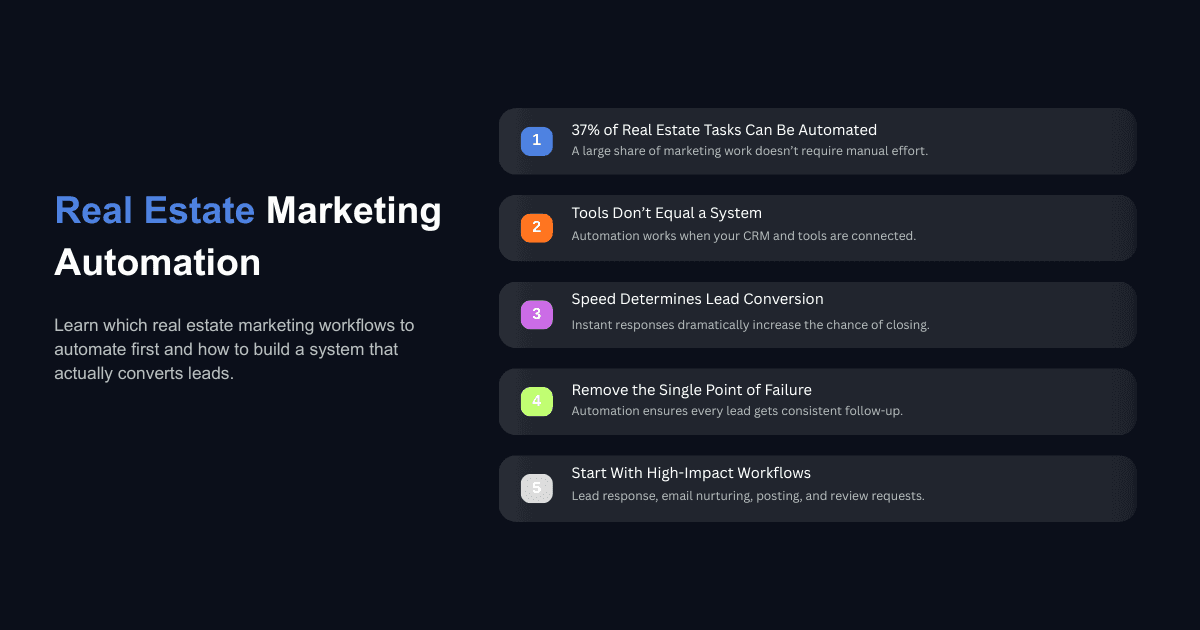
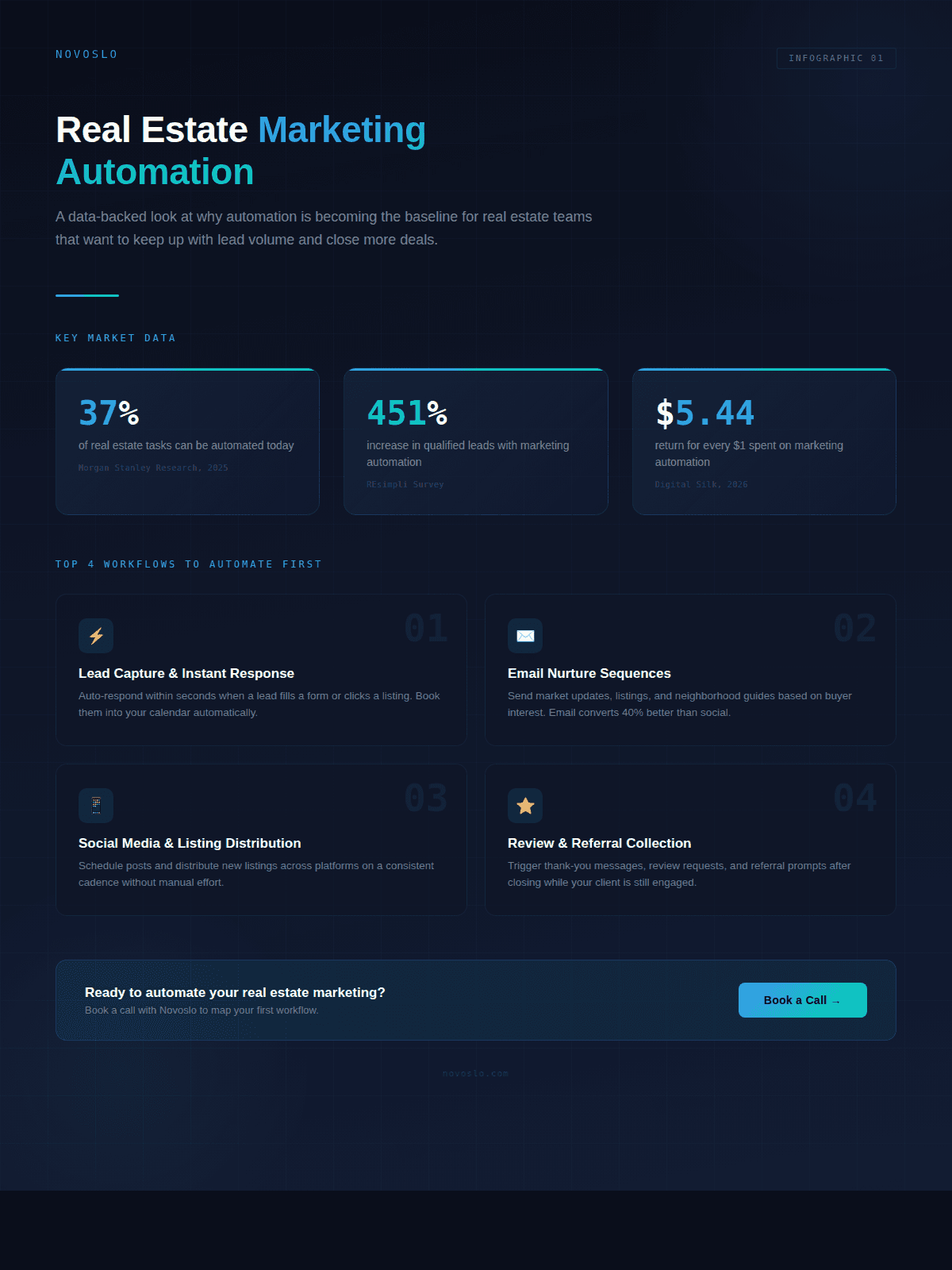
According to Morgan Stanley Research, roughly 37% of tasks in real estate can be automated. That is a significant share of your working week spent on things that a system could handle while you are out meeting buyers. This guide breaks down what real estate marketing automation actually looks like in practice, which workflows to start with, and how to build a system that runs without needing your constant attention.
If you are a real estate developer, team lead, or brokerage operator, this is written for you.
What Real Estate Marketing Automation Actually Means
Real estate marketing automation is not a single product you buy. It is a set of connected workflows that handle repetitive marketing tasks on your behalf, such as sending emails, responding to new leads, posting to social media, and tracking buyer behavior. Understanding why automation matters for business at a structural level makes it easier to see where the real gains come from.
The market for this category of software was valued at over $1 billion in 2024 and is growing at a rate of about 14% per year. That growth is not driven by hype. It is driven by teams realizing they cannot manually manage the volume of leads and touchpoints that modern real estate demands.
The Difference Between Having Tools and Having a System
Most teams already have tools. A CRM here, an email platform there, maybe a scheduling tool for social posts. The problem is that these tools are not connected to each other, and nobody has mapped out what should happen when a new lead enters the pipeline.
A system means your tools talk to each other. When someone fills out a form on your website, the CRM captures the lead, an email sequence starts within minutes, and your team gets notified with context about what the lead is interested in. That is the difference between owning software and running a system.
Understanding the difference between AI agents and AI tools helps here. Tools require you to push buttons. Agents and automated workflows act on triggers and conditions you set in advance.
What Gets Automated and What Should Not
Good candidates for automation include lead capture responses, email drip sequences, social media scheduling, review requests after closing, and listing distribution across platforms.
What should stay manual: personal check-ins with serious buyers, negotiation conversations, relationship-building with referral partners, and any communication where the buyer expects a human on the other end. Automation handles the volume. Your team handles the moments that matter.
Why Most Real Estate Teams Lose Leads Before They Respond
This is the part most teams do not want to hear. Speed is the single biggest factor in converting real estate leads, and most teams are too slow. Data consistently shows that responding to a new inquiry within five minutes dramatically increases the chance of conversion. Most teams take hours. Some take days.
The reason is not laziness. It is that the person responsible for follow-up is also showing a property, or sitting in a meeting, or managing ten other things at once. The lead comes in, the notification gets buried, and by the time someone calls back, the buyer has already spoken to another agent.
This is exactly where AI can streamline your operations. Automated responses do not replace the human conversation. They buy you time. A well-built automation sends an instant acknowledgment, provides relevant information about the property or service, and books the lead into your calendar for a real conversation.
What Happens When Follow-Up Depends on One Person
If your lead follow-up process depends on one person remembering to check a spreadsheet, you will lose leads. It is that simple. Automation removes the single point of failure. Leads get acknowledged, nurtured, and routed to the right person regardless of who is available at that moment.
Industry data shows that marketing automation software can produce a 451% increase in qualified leads. That number is not about magic. It is about consistency. Automated systems do the same thing every time, for every lead, without forgetting.
Which Marketing Workflows Should You Automate First?
You do not need to automate everything at once. Start with the workflows that have the highest impact on revenue and the most repetitive steps. Here are four to prioritize, informed by AI workflow transformation strategies that work across industries.
Lead Capture and Instant Response
When someone fills out a form, clicks on a listing, or sends a message through your website, they should get a response within seconds. Set up an automated flow that sends a personalized text or email immediately, includes relevant property details, and offers a way to book a call or showing. This is the foundation.
The same principle applies to AI automation in customer support across other industries. The logic is identical: capture the lead, acknowledge them immediately, and keep the conversation moving.
Email Sequences for Nurturing Buyers
Not every lead is ready to buy today. Some are three months out, some are six months out, and some are just browsing. Automated email sequences let you stay in front of those leads without manually sending messages every week.
Email marketing in real estate converts about 40% better than social media. Set up sequences that deliver market updates, neighborhood guides, and new listing alerts based on what the lead has shown interest in. The content should be relevant and specific, not generic newsletters that feel like they were written for everyone and no one.
Social Media Posting and Listing Distribution
Consistency on social media is important for brand visibility, but it is also one of the first things to fall off when the team gets busy. Automate your posting schedule so that new listings, market updates, and educational content go out on a regular cadence. The content still needs to be good, but the publishing part should not require someone to manually log into three platforms every morning.
Review and Referral Collection After Closing
The period right after closing is when your client is most likely to leave a positive review or refer someone. Set up an automated sequence that sends a thank-you message, followed by a review request a few days later, followed by a referral prompt. Most teams know they should do this. Almost none do it consistently. Automation fixes that.
How Does AI Fit Into Real Estate Marketing Automation?
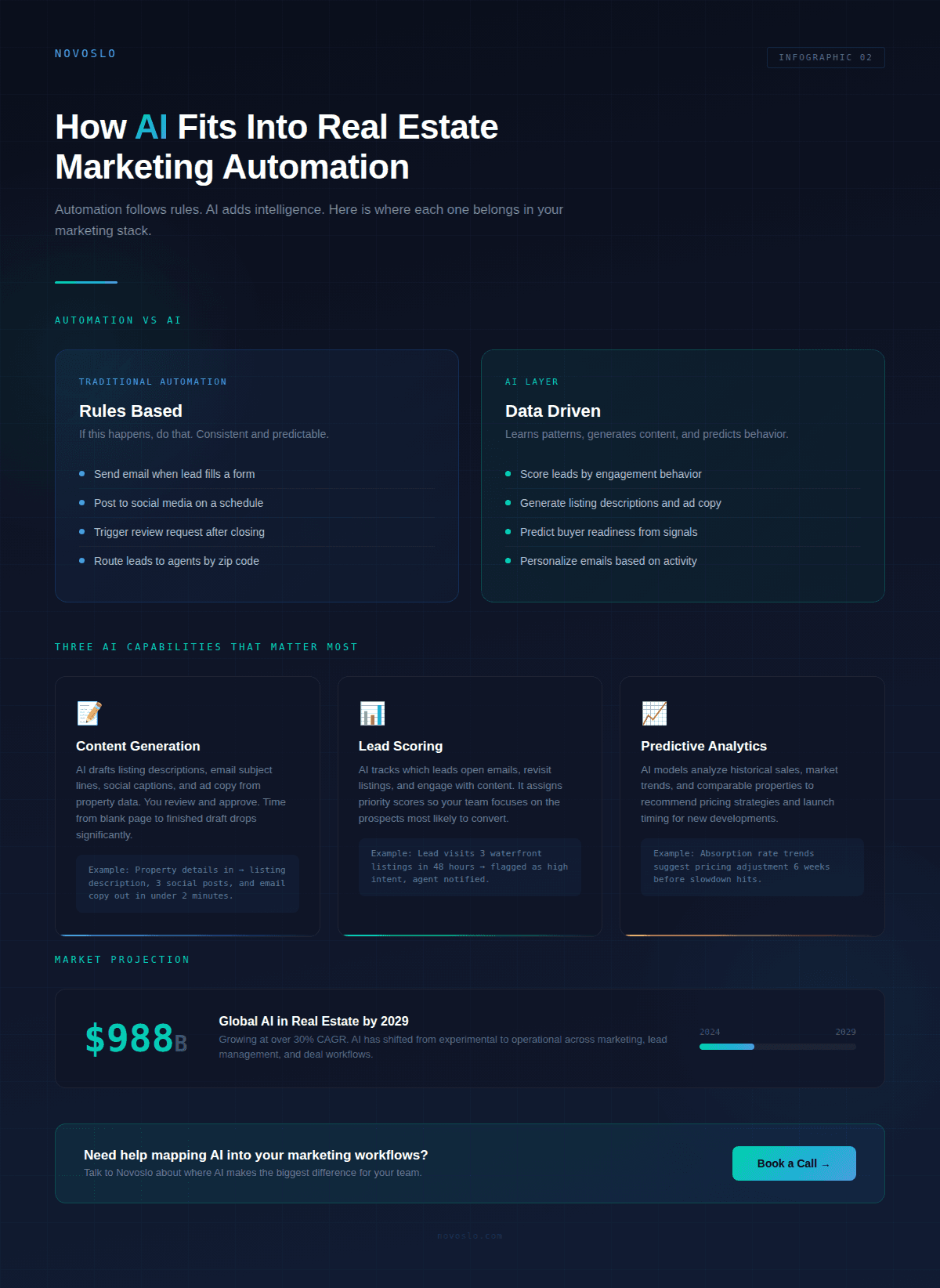
AI is a layer on top of automation. Traditional automation follows rules you set: if this happens, do that. AI adds the ability to generate content, predict behavior, and adapt based on data. Understanding how AI differs from traditional automation will help you figure out where each one belongs in your stack.
Content Generation for Listings and Campaigns
Writing listing descriptions, social captions, email subject lines, and ad copy takes time. AI tools can generate first drafts based on property details, neighborhood data, and your brand voice. You still review and approve everything, but the time from blank page to finished copy drops significantly.
This is one of the most common entry points for AI in real estate marketing, and it is a good one because the risk is low and the time savings are immediate.
Lead Scoring and Behavior Tracking
Not all leads are equal. AI can track which leads are opening your emails, clicking on listings, visiting your website repeatedly, and engaging with your content. Based on that behavior, it assigns a score that tells your team who to prioritize.
This replaces the old method of treating every lead the same or relying on gut feel to decide who is ready to buy. Behavior-based lead scoring means your team spends time where it is most likely to result in a transaction.
Predictive Analytics for Pricing and Timing
AI models can analyze historical sales data, market trends, and comparable properties to help with pricing recommendations and timing decisions. For developers, this is particularly useful when planning launch timelines or adjusting pricing strategies based on absorption rates and buyer activity.
For a broader view of how AI is being applied in real-world business contexts, look at these real-world AI transformation examples.
How to Build a Real Estate Marketing Automation System That Works
Start With One Workflow, Not Ten Tools
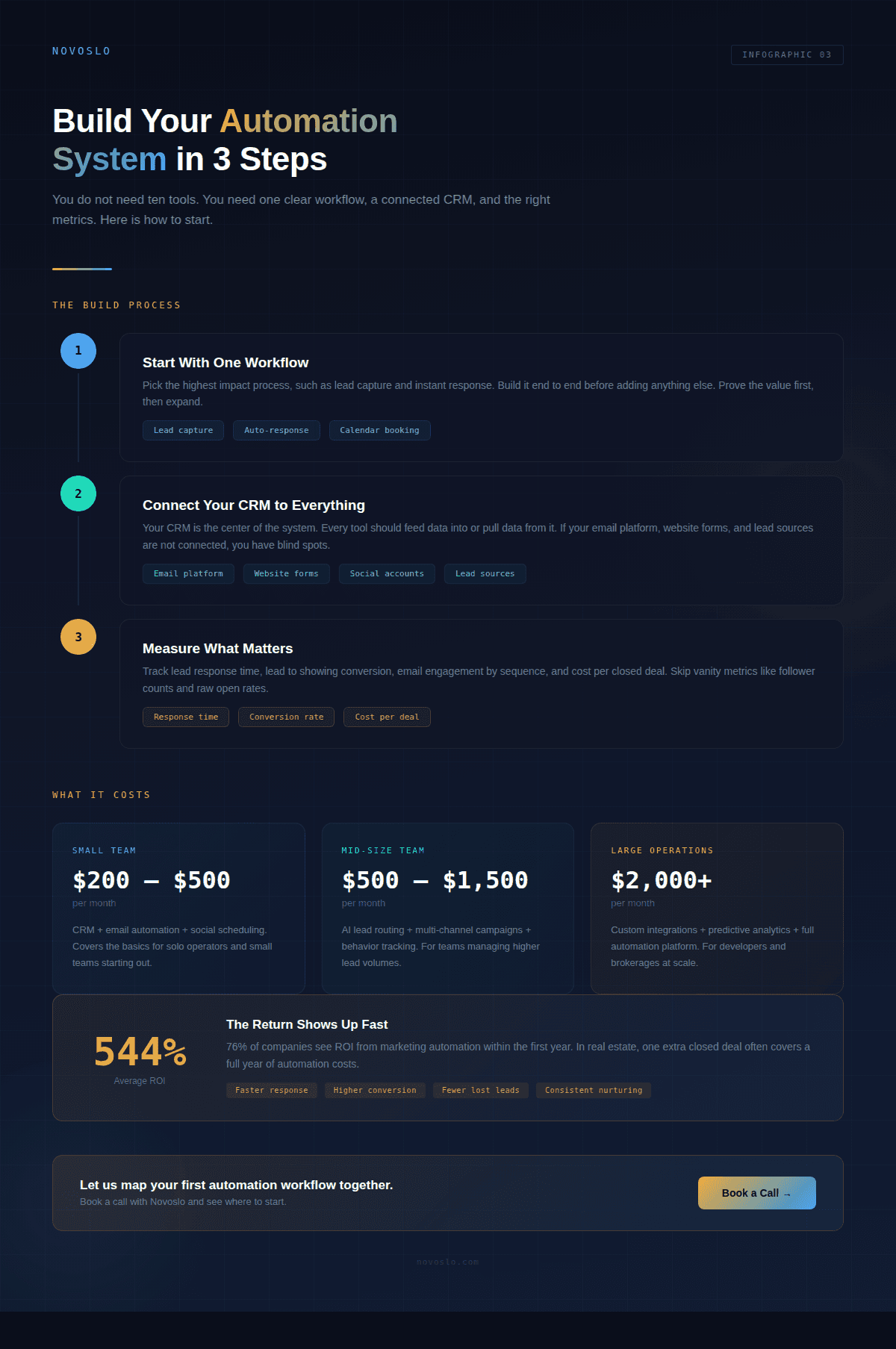
The most common mistake is buying multiple tools before defining a single workflow. Pick one high-impact process, such as lead capture and response, and build it out completely. Get it running, measure the results, and then move to the next workflow.
If you want a structured approach to implementing AI into your business, the same principle applies: start narrow, prove the value, then expand.
Connect Your CRM to Everything
Your CRM is the center of the system. Every tool you add should feed data into or pull data from the CRM. If your email platform, website forms, social accounts, and lead sources are not connected to the CRM, you are operating with blind spots. Integration is not a technical luxury. It is a requirement for automation to work.
Measure What Matters and Ignore Vanity Metrics
Track lead response time, lead-to-showing conversion rate, email engagement by sequence, and cost per closed deal. Do not get distracted by follower counts, open rates in isolation, or the number of emails sent. The point of automation is to move leads closer to a transaction, and your metrics should reflect that.
What Does Real Estate Marketing Automation Cost?
Budget Ranges for Small, Mid, and Large Teams
For a small team or solo operator, a basic stack consisting of a CRM, email automation, and a social scheduling tool typically runs between $200 and $500 per month. Mid-size teams with more complex workflows, AI-powered lead routing, and multi-channel campaigns are looking at $500 to $1,500 per month. Larger operations with custom integrations, predictive analytics, and full-service automation platforms can spend $2,000 or more per month depending on the scope.
The key is that these costs are marginal compared to the revenue impact. On average, companies see a return of $5.44 for every $1 spent on marketing automation. In real estate, where a single closed transaction can generate $10,000 to $50,000 or more in commission or profit, the math is straightforward.
You can calculate your potential AI ROI to see how the numbers look for your specific situation.
Where the ROI Actually Shows Up
The return is not always in direct lead generation. It shows up in faster response times, higher conversion rates on leads you already have, more consistent nurturing that keeps your pipeline warm, and fewer leads lost to competitors who simply responded first.
One enterprise client doubled their sales efficiency after implementing AI-driven lead engagement, reaching prospects at the right time with data-backed decisions. That result came from connecting the systems, not from any single tool.
Where to Start
Real estate marketing automation is not complicated once you break it down. Start with lead capture and response. Connect your CRM. Add email nurturing. Automate your social posting and review collection. Layer in AI where it saves time and improves decisions.
The teams that are closing more deals in 2026 are not necessarily working harder. They have built systems that handle the repetitive work so their people can focus on relationships and transactions.
If you want help mapping out which workflows to automate first and how to connect your existing tools into a system that actually works, book a call with the Novoslo team. We will walk through your current setup and show you where automation can have the biggest impact on your business.