Article
Feb 25, 2026
Why Is Automation Important in Business?
Why automation matters in 2026: cut costs, reduce errors, scale faster, and build AI-driven workflows that drive sustainable growth.
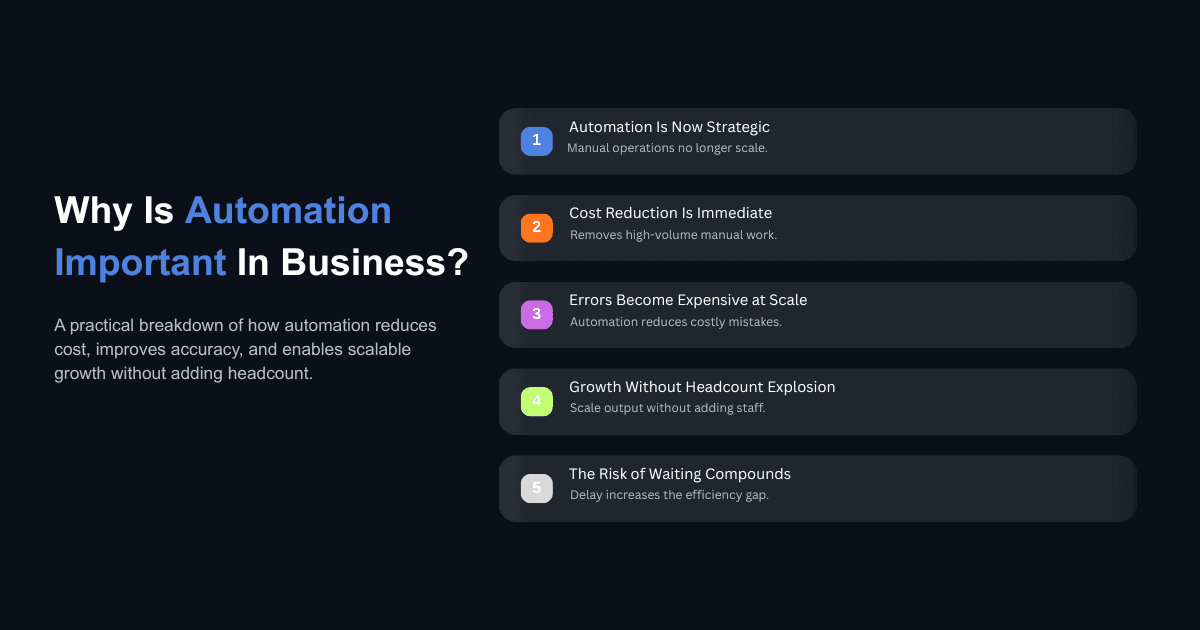
Two out of three businesses now invest in some form of automation technology, and the global business process automation market is on track to double by 2030. Those numbers are not surprising if you have spent any time inside an operationally complex company. The manual work that holds most organizations together — data entry, approvals routing, invoice processing, report generation — is expensive, slow, and prone to error. Automation addresses all three problems at once, which is why it has moved from a back-office IT initiative to a strategic priority for leadership teams.
This post covers what business automation actually means today, why it matters for operational performance and growth, and where companies should focus their efforts first. If you are an operations leader, CFO, or founder evaluating automation for your organization, the goal here is to give you a practical framework rather than a vendor pitch.
What Business Automation Actually Means in 2026
Beyond RPA: How Automation Has Evolved
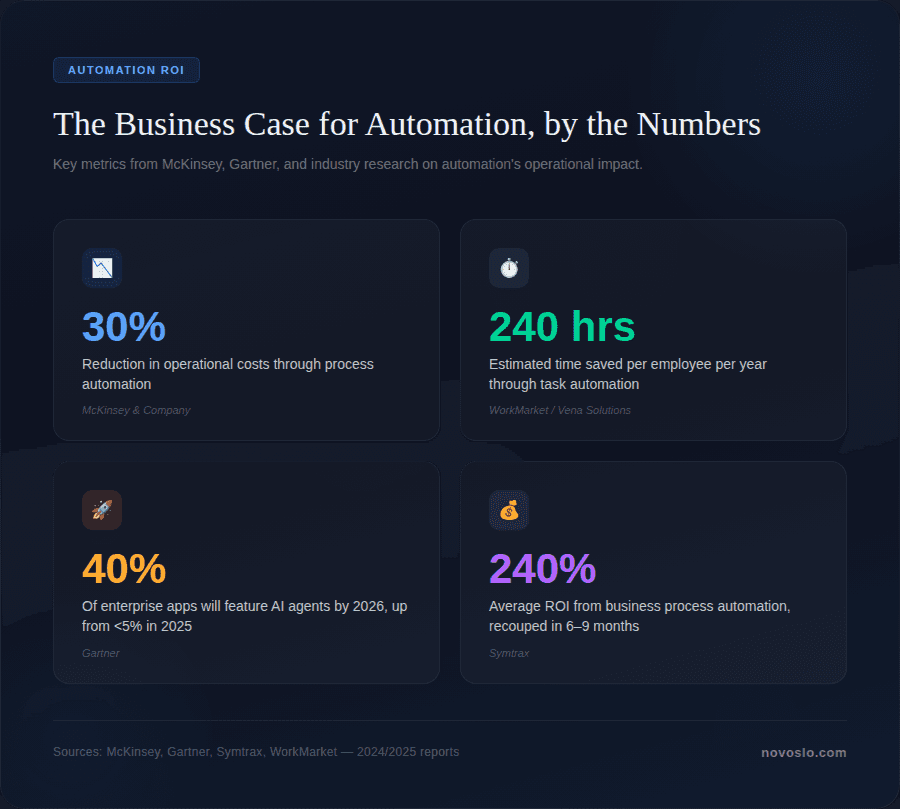
When most people hear "automation," they think of robotic process automation — bots that click through screens and move data between systems. RPA still has a role, especially for rules-based, repetitive tasks. But automation in 2026 covers a much wider range of capability. AI-powered systems can now analyze business goals, coordinate data across platforms, execute multi-step tasks, and flag exceptions for human review. Gartner projects that 40% of enterprise applications will include task-specific AI agents by 2026, compared to less than 5% in 2025. That is a meaningful shift in how work gets distributed between people and software.
Understanding the difference between AI agents and AI tools matters here, because the distinction determines what you can actually automate. A tool helps a person do a task faster; an agent can handle the task independently within defined boundaries.
The Three Types of Business Automation
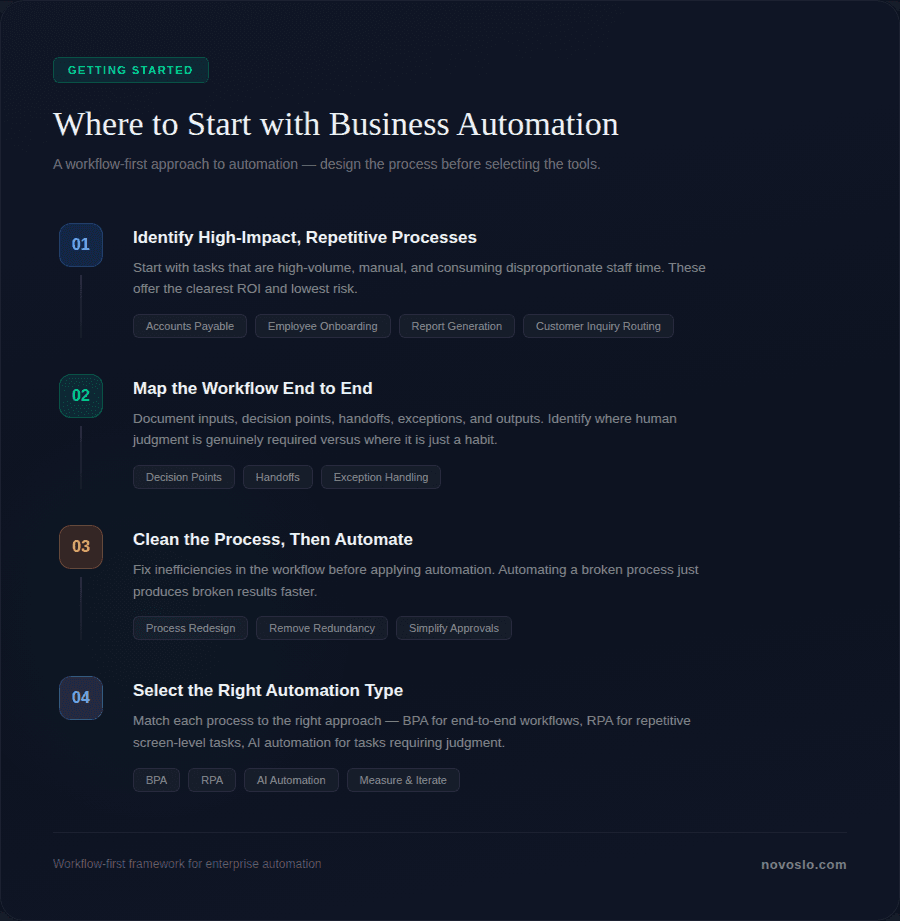
Business process automation (BPA) covers end-to-end workflows like employee onboarding, purchase order approvals, and customer intake. RPA handles specific, repetitive screen-level tasks such as copying data between systems or generating standardized reports. AI automation adds a layer of judgment — interpreting unstructured data, making recommendations, and adapting to exceptions that would normally require a person. Most organizations that get real value from automation use all three in combination, applying each where it fits best rather than forcing one approach across the board.
Why Is Automation Important in Business?
Reducing Operational Costs at Scale
The cost case for automation is well-documented at this point. McKinsey research shows that automation can reduce operational costs by up to 30%, and organizations that implement business process automation report an average cost reduction of 22% within three years. Those numbers come from removing manual labor from high-volume, low-complexity tasks — the kind of work that consumes a disproportionate share of operational budgets in finance, HR, procurement, and customer service.
The savings compound as automation expands across departments. A company that automates invoice processing, for example, does not just reduce the cost of that single function — it also reduces error correction time, speeds up payment cycles, and frees finance staff to work on analysis and forecasting. You can use Novoslo's AI ROI calculator to estimate what these savings look like for your specific operations.
Eliminating Manual Errors Across Workflows
Manual data entry and handoff processes introduce errors that are expensive to fix and hard to detect until they cause downstream problems. Bad data costs U.S. businesses an estimated $600 billion annually, and analysts spend roughly 40% of their time cleaning and correcting data rather than doing actual analysis. Automated systems follow predefined rules consistently, which means they handle data entry, validation, and routing without the variability that comes with human fatigue and distraction. In compliance-heavy industries like financial services and healthcare, this consistency is not just an efficiency gain — it is a risk management requirement.
Freeing Teams for Higher-Value Work
One of the clearest findings from workforce studies is that employees estimate they could save 240 hours per year if their repetitive tasks were automated, while business leaders estimate the figure is closer to 360 hours. That is the equivalent of six to nine working weeks spent on tasks that do not require human judgment. When you automate those tasks, teams can redirect their time toward work that actually moves the business forward — relationship management, strategic planning, problem-solving, and creative output.
One enterprise sales team saw this firsthand after implementing AI-driven workflow automation: they doubled their sales efficiency by engaging leads at the right time with data-backed decisions, rather than spending hours on manual prospecting and CRM updates. The pattern holds across departments. AI automation in customer support, for instance, handles routine inquiries so that human agents can focus on complex cases that require empathy and judgment.
How Does Automation Affect Business Growth?
Scaling Without Proportionally Scaling Headcount
Growth traditionally required adding people — more customer service reps as ticket volume increased, more finance staff as transaction volume grew, more operations coordinators as complexity expanded. Automation changes that equation by allowing throughput to scale without a proportional increase in headcount. This is particularly relevant for mid-market companies that need to grow efficiently and for enterprise organizations managing costs under pressure from investors or board expectations.
McKinsey's research on sales automation shows that early adopters report efficiency improvements of 10 to 15% and sales uplift potential of up to 10%, without adding additional staff. The same principle applies to operations, finance, and support functions. When processes are automated, you can handle more volume with the same team, which directly improves margins and creates room for reinvestment. If you want to explore how this applies to your company, Novoslo's guide on how to streamline operations with AI walks through the practical steps.
Faster Decision-Making Through Real-Time Data
Manual reporting introduces lag. By the time someone pulls data from three systems, reconciles it in a spreadsheet, and presents it to a decision-maker, the information may already be stale. Automated data pipelines eliminate that lag by collecting, processing, and surfacing information in real time. Leaders get dashboards and alerts that reflect the current state of operations, not last week's snapshot. In industries where conditions change quickly — supply chain, retail, financial services — this speed difference translates directly into better decisions and faster response times. Knowing how to measure the success of AI transformation helps ensure that these faster decisions are actually producing better outcomes.
Where Should Companies Start With Automation?
Identifying High-Impact, Repetitive Processes
The most common mistake companies make with automation is starting with the technology rather than the problem. The right approach is to identify processes that are high-volume, repetitive, and currently consuming significant staff time — then evaluate which automation approach fits best. Common starting points include accounts payable and receivable processing, employee onboarding workflows, customer inquiry routing, data migration between systems, and report generation. These are areas where the ROI is clear, the risk is low, and the results build organizational confidence in automation as a capability. Over 40% of finance professionals and a third of accounting professionals say automating purchasing and procurement is a top priority, which reflects where the pain is most acute in many organizations.
Why Workflow Design Matters More Than Tool Selection
We see this pattern consistently: a company buys an automation platform, runs a few pilots, and then struggles to scale because the underlying workflows were never designed for automation. The tool is rarely the bottleneck. The process underneath it is. Before selecting software, map the workflow end to end — inputs, decision points, handoffs, exceptions, and outputs. Identify where human judgment is genuinely required and where it is just a habit. Clean up the process first, then automate the clean version. Companies that skip this step end up automating broken workflows, which just produces broken results faster.
Novoslo's overview of AI workflow transformation strategies covers this design-first approach in detail, including how to prioritize which workflows to automate and how to structure them for long-term scalability.
What Are the Risks of Not Automating?
Compounding Inefficiency Over Time
Manual processes do not just stay the same cost over time — they get more expensive. As transaction volume grows, as compliance requirements increase, and as data complexity expands, the cost of doing things manually scales linearly while automated processes scale at a fraction of that rate. A finance team that manually reconciles 500 transactions per month will need to add headcount when volume hits 1,000. An automated system handles that increase with the same infrastructure. The organizations that delay automation are not holding steady; they are falling further behind on a compounding cost curve.
Falling Behind Competitors Who Have Already Started
According to UiPath's 2026 trends report, 78% of executives say they will need to reinvent their operating models to capture the full value of AI-driven automation. Nearly two-thirds of global businesses are already embedding automation into daily workflows, according to McKinsey Digital. The competitive gap between companies that have automated and those that have not is widening, and it becomes harder to close with each passing quarter. Companies that invest now benefit from learning effects — their teams build internal capability, their processes improve iteratively, and their data infrastructure matures in ways that support more advanced automation over time. If you are ready to start that process, Novoslo's guide on how to implement AI in your business provides a workflow-first framework designed for 2026.
Making Automation Work for Your Business
Automation is important in business because it directly addresses the three biggest operational constraints most companies face: cost, speed, and accuracy. Organizations that implement it thoughtfully — starting with workflow design, targeting high-impact processes, and scaling based on measured results — consistently see cost reductions of 20 to 30%, meaningful time savings for their teams, and the capacity to grow without proportionally growing headcount.
The companies that benefit most are the ones that treat automation as an infrastructure decision rather than a technology experiment. That means investing in process design, governance, and internal capability alongside the software itself. If you are evaluating where automation fits in your organization, start with your workflows, not your tooling.
Ready to identify the highest-value automation opportunities in your business? Book a call with the Novoslo team to discuss where automation can create the most impact for your operations.