Article
Oct 19, 2026
How to Enter a New B2B Market Without Building a Full Sales Team
You don't need a sales team to enter a new B2B market, you need proof it exists. How to test and enter a market with lean outbound before you hire.

The usual way companies enter a new market is to hire for it: bring on a few reps, give them a target, and hope the pipeline follows. It is also the most expensive and riskiest way, because you commit a large fixed cost to a market you have not yet proven wants what you sell. If the market does not respond, you are left unwinding salaries and explaining a quarter of burn with nothing to show for it, and if it does respond, you often find you hired for the wrong profile because you did not yet know who actually buys.
There is a leaner path that inverts the order. Instead of hiring a team and then looking for demand, you use targeted outbound to find the demand first, and only build the team once the market has proven it exists. This treats market entry as an experiment to run rather than a bet to place, and outbound is the cheapest instrument for running it. This guide covers how to enter a new B2B market without building a full sales team: why outbound is the right test, what it tells you before you commit, and how to run the entry lean and scale the team only once the numbers justify it.
Hiring first gets the order backwards
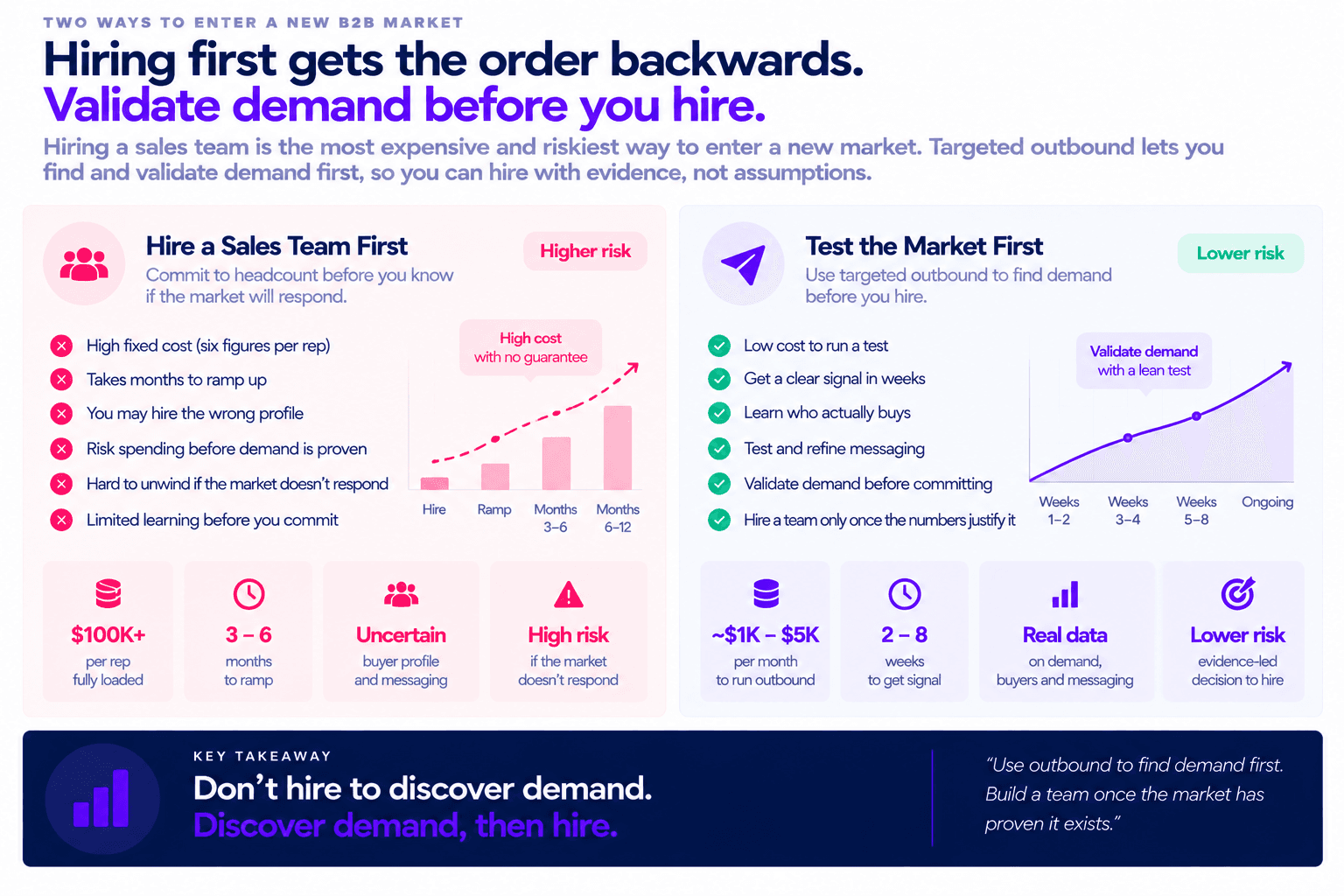
The problem with leading with headcount is that it front-loads your biggest commitment against your smallest amount of knowledge. At the moment you hire, you know the least you will ever know about the new market, yet you are locking in its largest fixed cost, which is a fully loaded sales rep that runs well into six figures a year before they book anything. You are betting a large sum on assumptions about who buys, why, and whether they will respond at all.
Worse, a new hire takes months to ramp before they produce signal, so you wait a full quarter or two just to learn whether the market responds, and by then the cost has compounded. Hiring first also locks in a profile prematurely, since the kind of rep you need for a market depends on who turns out to buy and how they buy, which is exactly what you do not yet know. The leaner path reverses this, gathering the knowledge cheaply first so that any hiring you do later is informed rather than speculative, which is the same discipline behind landing your first customers in any market before scaling the motion.
Outbound is the cheapest market test you have
Targeted outbound is the right instrument for entering a new market because it is the only channel that lets you reach your exact intended buyer, on purpose, at low cost, and get a direct read on whether they respond. A content or ads strategy takes months to produce signal and tells you little about a specific segment, while a focused outbound campaign to a precise list gives you a clear answer in weeks about whether this market has the problem you solve and will engage on it.
The economics are what make it a test rather than a commitment. A lean outbound setup, meaning sound sending infrastructure and a sharp list, costs a fraction of a single hire and can be running in weeks, which means you can learn whether a market is real for the price of a rounding error against a sales team's payroll. Running outbound as a deliberate lead generation system rather than a one-off blast is what turns it from noise into a clean experiment, and it is far cheaper per unit of learning than any other way of probing a new segment, which matters when you are deciding how much to spend on lead generation in an unproven market.

What the test actually tells you
A well-run outbound entry answers the three questions that decide whether a market is worth committing to, and it answers them with real responses rather than guesses. The first is whether the demand exists at all, which the reply rate and the content of those replies reveal, since a market with the problem you solve engages while a market without it stays silent regardless of how good your copy is.
The second is who actually buys, because the entry almost always teaches you that your assumed ideal customer profile was slightly or badly wrong, and the segments that reply and convert redraw it for you. The third is what messaging lands, since the angle that earns replies in a new market is frequently not the one you expected, and outbound tests several angles cheaply and tells you which resonates. Learning these three things before you hire is the entire point, because a team built on a validated profile and a proven message is a very different investment from one built on assumptions, and the testing itself is just a disciplined version of turning cold prospects into real opportunities while you watch which ones convert.
How to run the entry lean
Running a lean market entry follows a clear sequence that one capable operator, or a founder, can execute without a team. Start by defining the new market precisely as a small target list rather than a broad segment, drawing on your best guess at the companies worth pursuing so the test is aimed at accounts that would actually matter if the market proves out. A tight list of a few hundred well-chosen accounts tells you more than a blast to thousands, because you can read the responses clearly.
From there, build and verify the data so the test is clean, reach the real decision-makers rather than generic inboxes, and run a genuine sequence with enough follow-up that a quiet first email does not get mistaken for a dead market. Lead with value rather than a hard pitch, since a value-first approach gets a truer read on interest than a meeting demand, and handle the replies yourself or with one person so you hear the market's objections and language directly. Automating the repetitive parts of this, the sourcing, enrichment, and sending, is what lets a single person run a real entry, which is the logic behind founders using AI to scale outbound without a team behind them.
Read the results before you commit a dollar to headcount
The discipline that makes this work is treating the entry as an experiment with a decision at the end rather than a campaign you hope succeeds. Measure the conversion chain from the test, meaning how many of the right accounts replied, how many became qualified conversations, and how many look like real opportunities, and read those numbers against what a viable market would need to look like. A strong response says the market is real and tells you the profile and message to build on, a weak one says to adjust the target or the angle and test again, and a flat one across several tries says this market is not it, which is a cheap and valuable thing to learn before you hired for it.
This is where the lean approach pays off most, because a disappointing result costs you weeks and a small spend rather than a team and a quarter, and a promising result hands you a validated profile, a proven message, and early pipeline to build on. Reading the results properly is the same skill as diagnosing why any outbound effort is or is not working, applied to the question of whether a whole market is worth entering. The decision to commit headcount becomes evidence-based rather than a leap of faith.
When to actually build the team
The point of entering without a team is not to avoid building one forever, it is to build it at the right time with the right information. Once the test has proven the market responds, confirmed who buys, and shown which message works, you have what you never have when hiring first: a repeatable motion to hand a new rep rather than a blank page and a hope. That is the moment to scale, because now the hire is backed by evidence and inherits a working process.
Even then, the sequence matters, since you expand the proven motion first and add people to run more of it rather than to figure it out, which is how you avoid the trap of scaling a motion you have not yet proven. Many companies also find that the lean, largely automated setup that entered the market keeps carrying much of the load after the team arrives, so the first hires focus on conversations and closing while the system keeps feeding pipeline, the same division that makes a modern outbound operation efficient. You build the team to pour fuel on a fire that is already lit, not to light it.
Can you enter a new B2B market without a sales team?
Yes, and for the test phase it is usually the smarter approach. A lean, targeted outbound effort run by a founder or a single operator can reach your exact intended buyers and get a direct read on whether the market responds, who buys, and what messaging works, all for a fraction of the cost of a sales hire and in weeks rather than quarters. You are not avoiding a sales team permanently, you are gathering the evidence to build the right one later. The team gets built once the market has proven it exists, so the hire is informed rather than speculative.
How do you test demand in a new market before hiring?
Run a focused outbound campaign to a small, precise list of your intended buyers and measure the response. A tight list of a few hundred well-chosen accounts, reached through verified data and a genuine follow-up sequence, tells you within weeks whether the demand is real, since a market with the problem you solve engages while one without it stays quiet. Track the conversion chain from reply to qualified conversation to opportunity, and read it against what a viable market would need. A strong response validates the market and the profile, a flat one tells you to adjust or move on before you have spent anything on headcount.
When should you hire a sales team for a new market?
Hire once the market has proven three things: that demand exists, who actually buys, and which message lands. At that point you have a repeatable motion to hand a new rep rather than a set of assumptions, so the hire inherits a working process and is backed by evidence. Build the team to scale a proven motion rather than to discover one, and expand the working approach first before adding people to run more of it. Hiring before the market is validated front-loads your largest cost against your least knowledge, which is the mistake the lean entry is designed to avoid.
Bringing it together

Entering a new B2B market without building a full sales team means reversing the usual order: find the demand first with lean outbound, then build the team once the market has proven it exists. Hiring first commits your largest fixed cost against your smallest amount of knowledge, while a targeted outbound test reaches your exact buyers cheaply and answers the three questions that matter, whether demand is real, who buys, and what message works, in weeks rather than quarters. Run the entry as an experiment with a decision at the end, read the results honestly, and scale the team only when the evidence justifies it. Done this way, market entry stops being a bet and becomes a test you can afford to run.
If you want help entering a new market with a lean outbound test before you commit to headcount, book a call with the Novoslo team and we will show you exactly how it works.