Article
Jan 3, 2026
What Is an AI Transformation Partner? A Complete Guide for Business Leaders
Learn what an AI transformation partner is, why the role exists now, and how to evaluate if your business needs one to move from pilot to production.
You have heard the pitch before.
An AI vendor walks into your office. They show you a demo. Everything works perfectly. The numbers look impressive. The slides are polished. They promise transformation.
Six months later, the pilot is stalled. The integration never happened. The tool sits unused. Your team is back to spreadsheets. And you are left explaining to the board why the "AI initiative" produced nothing but invoices.
This is not a failure of AI. This is a failure of partnership.
The market is flooded with consultants who deliver roadmaps but never touch a keyboard. Dev shops that build features but cannot explain why they matter. Automation agencies that install templates and disappear. None of them own the outcome. They deliver outputs and move on.
An AI Transformation Partner operates differently.
This role exists because the gap between AI strategy and AI execution has become a graveyard for corporate budgets. Companies do not need more tools. They do not need more slide decks. They need someone who can diagnose the actual problem, build the actual solution, and stay accountable until the numbers move.
This guide is for the founder who feels pressure to "do something with AI" but does not know where to start. For the COO drowning in manual processes. For the CFO who has seen too many failed technology investments to sign another check without proof.
If you are evaluating AI partners, this will help you separate the real from the performative.
Why the Term AI Transformation Partner Exists Now
The AI Transformation Partner did not exist five years ago because the market did not need it.
Between 2020 and 2022, executives operated in FOMO mode. FEAR OF MISSING OUT.
Every board meeting included a question about AI strategy. Every competitor seemed to be announcing a machine learning initiative. The pressure was to move fast, experiment, and figure it out later.
That era is over.
The 2024 to 2025 market operates on a different fear. Call it FOLS: Fear of Looking Stupid.
Executives are no longer worried about missing the AI wave. They watched colleagues chase that wave and crash. They saw the pilots that went nowhere. They approved budgets that produced nothing but demos.
Now they are worried about one thing: looking foolish in front of the board for signing another check that delivers vaporware.
This shift explains why the AI transformation partner model emerged. The old vendor categories could not solve the new problem.
Before evaluating partners, it helps to have a clear definition of AI transformation and what a realistic roadmap looks like.
Why Most AI Pilots Fail (And How to Structure Yours Differently)
95% of AI pilots never reach production. MIT documented this pattern across enterprise adoption.
Most pilots fail for one of four reasons:
No production owner. The pilot gets built by an innovation team. When it's time to integrate with live systems, no one in operations has ownership. It sits in limbo.
Clean data, dirty reality. The pilot runs on curated sample data. Production data is messy, inconsistent, full of edge cases. The system that worked perfectly in the demo breaks on day one.
No integration scope. The pilot proves the AI works. But no one scoped the work required to connect it to your CRM, your ERP, your approval workflows. That integration work often costs more than the pilot itself.
Success criteria defined after the fact. Without clear metrics upfront, "success" becomes subjective. Stakeholders disagree. The pilot gets labeled inconclusive and shelved.
If you're planning a pilot, pressure-test it against these four failure modes before you start.
For organizations already using Google Workspace, there are specific opportunities to leverage that ecosystem for AI transformation.
The Four Pillars of a True AI Transformation Partner
Most vendors describe themselves with vague characteristics. "Strategic." "Technical." "Full-service." These words mean nothing without specifics.
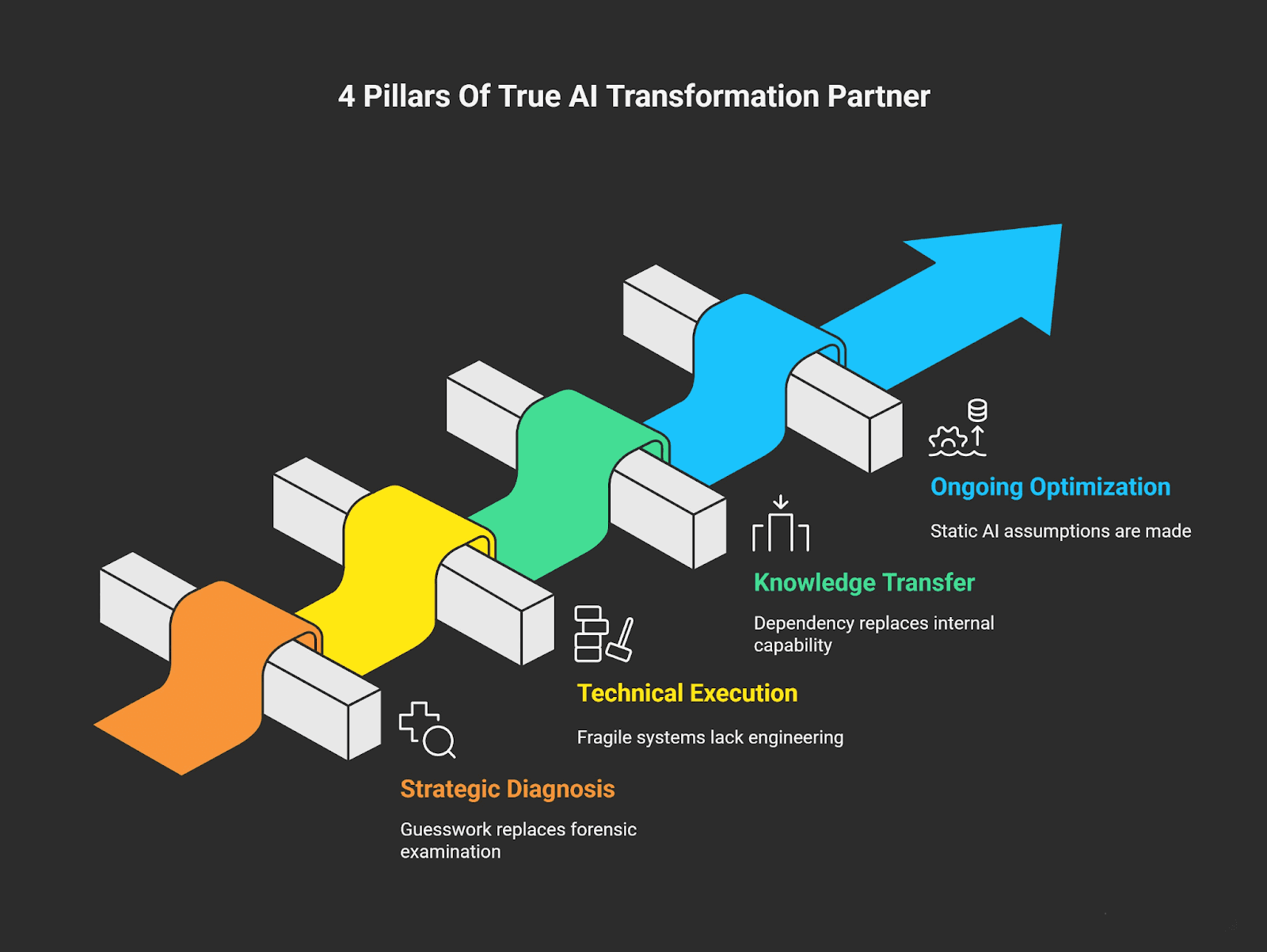
A legitimate AI transformation partner operates across four distinct pillars. Each one addresses a specific failure mode that kills AI initiatives. Miss any single pillar and the engagement will stall.
This is not a menu where you pick what sounds appealing. All four are required. Any AI transformation guide that presents these as optional does not understand why AI projects fail.
Pillar 1: Strategic Diagnosis
Strategy without diagnosis is guesswork.
Most AI consultants skip this step. They arrive with pre-built solutions looking for problems. They pitch what they already know how to sell. The client's actual situation becomes an afterthought.
A real AI transformation partner starts with forensic examination of your current operations. This means process mapping at a level of detail that exposes where time and money actually disappear. Not where executives think the problems are. Where the problems actually live.
What this looks like in practice:
The partner documents your existing workflows step by step. They identify bottlenecks that create delays. They calculate the labor cost of each manual process. They interview the people doing the work, not just the people managing the work.
From this diagnosis, they build a prioritized list of use cases ranked by ROI potential. Not by technical elegance. Not by what would make an impressive demo. By what will move the financial needle fastest.
The output is a roadmap grounded in your specific reality. It answers: What should we automate first? What is the expected return? What are the dependencies? What could go wrong?
If a partner cannot explain their diagnostic methodology, they are guessing. Guessing costs money.
Pillar 2: Technical Execution
Diagnosis without execution is expensive advice.
This is where strategy consultants fail. They deliver the roadmap and hand it to your internal team or a separate vendor. The translation from strategy to implementation creates gaps. Context gets lost. The original intent degrades.
An AI transformation partner owns execution. They build the systems they designed. They write the integrations. They architect the workflows. They ship working software.
The critical distinction: prompting versus engineering.
Many vendors sell "AI solutions" that amount to clever prompts wrapped in a simple interface. This is not engineering. This is configuration.
Engineering means building systems that handle edge cases. That log errors and recover gracefully. That integrate with your existing stack through proper APIs. That scale beyond the pilot without collapsing. That remain maintainable after the engagement ends.
When evaluating technical capability, ask what happens when the AI model returns an uncertain result. Ask how the system handles data that falls outside expected parameters. Ask to see error handling logic. These questions separate engineers from prompt writers.
For AI transformation for business leaders, this distinction matters because prompting creates fragile systems. Engineering creates durable assets.
Pillar 3: Knowledge Transfer
Execution without transfer creates dependency.
Some vendors prefer this. If you cannot operate the system without them, you cannot leave. Dependency becomes their business model.
A legitimate AI transformation partner operates with the opposite intent. They should make themselves progressively less necessary. The goal is internal capability, not permanent reliance.
What knowledge transfer includes:
Documentation that your team can actually use. Not generic README files. Specific documentation for your systems, your data, your workflows.
Training for the people who will operate and maintain the solution. This means hands-on sessions, not slide presentations. Your team should be able to handle routine issues without calling the partner.
Architectural clarity so your technical staff understands how the pieces connect. If you hire an engineer next year, they should be able to read the documentation and understand the system within days, not months.
The test is simple: if the partner disappeared tomorrow, could your team keep the system running? If the answer is no, the transfer is incomplete.
Pillar 4: Ongoing Optimization
Transfer without optimization assumes AI is static. It is not.
The models improve. The APIs change. Your business evolves. The workflows that made sense six months ago may need adjustment. An AI transformation partner understands this and builds ongoing optimization into the engagement model.
What ongoing optimization addresses:
API and model updates. When OpenAI or Anthropic releases a new model version, someone needs to evaluate whether migration makes sense. When APIs deprecate endpoints, someone needs to update integrations before they break.
Performance monitoring. The system should have visibility into accuracy, latency, and cost. When metrics drift, the partner should identify why and recommend adjustments.
Continuous improvement. The first deployment is never the final version. User feedback reveals friction points. Edge cases emerge that the original design did not anticipate. The partner should iterate based on real-world performance.
Employee training as roles evolve. As your team becomes more sophisticated, they need advanced training. As new staff join, they need onboarding. This is not a one-time event.
This pillar is where the "partner" language becomes literal. The engagement does not end at deployment. It continues as long as the system delivers value.
Any AI transformation guide that treats deployment as the finish line is setting you up for decay. AI systems require stewardship. The question is whether that stewardship comes from a partner who knows the system or from your team learning through expensive trial and error.
Before investing in AI, it's critical to understand the difference between AI agents and AI tools, and which one actually solves your problem.
How Does an AI Transformation Partner vs. Other AI Vendors
You are probably already talking to vendors. Maybe several. They all claim to offer AI solutions. They all promise results. But they operate with fundamentally different models, and those differences determine whether your initiative succeeds or stalls.
This comparison is not about declaring one category superior in all situations. It is about helping you understand what you are actually buying so you can match the vendor to your specific need.
If you are using this as an AI transformation guide for vendor evaluation, the goal is clarity. Know what each type does well. Know where each type fails. Then make a decision based on your situation, not their sales pitch.
Strategy Consultancy
What they do: Roadmaps, assessments, executive presentations, organizational readiness frameworks.
Who they are: The large management consulting firms. McKinsey, BCG, Deloitte, Accenture's strategy arm. Also smaller boutique firms focused on digital transformation advisory.
Where they add value: When your organization needs alignment at the executive level before any building begins. When the problem is not technical capability but organizational clarity. When you need a credible external voice to build internal consensus.
Where they fail: They do not build. The roadmap they deliver requires a separate team to execute. This creates a handoff gap where strategic intent gets lost in translation. The consultants who understood your business leave. The engineers who inherit the roadmap interpret it through their own lens.
The pattern to watch: You pay six figures for a strategy document. You then pay another vendor to implement it. The implementation vendor disagrees with parts of the strategy. You end up mediating between two parties, neither of whom owns the outcome.
For AI transformation for business leaders who need execution, not just direction, strategy consultancies alone are insufficient.
Dev Shop or Engineering Firm
What they do: Technical delivery. Software development. System integration. They write code and ship features.
Who they are: Outsourced development firms, staff augmentation agencies, specialized AI development shops. They range from offshore teams to boutique domestic firms.
Where they add value: When you already know exactly what you need built. When the specifications are clear and the strategic questions are answered. When you have internal leadership capable of directing technical work.
Where they fail: They build what you ask for, not what you need. If your specifications are flawed, they will deliver flawed software on time and on budget. They optimize for output, not outcome. The system works as designed. Whether the design solves the actual business problem is not their concern.
The pattern to watch: You scope a project based on your current understanding. The dev shop executes faithfully. Six months later, you realize the requirements missed the real problem. The system works but nobody uses it. You paid for functional software that delivers no value.
Dev shops require a client who can provide strategic direction. If you need the partner to help identify what should be built, a dev shop is the wrong choice.
Automation Agency
What they do: Quick implementations using low-code and no-code tools. Zapier workflows. Make.com automations. Basic chatbot deployments. Template-based solutions.
Who they are: Small agencies, freelancers, and solopreneurs who emerged during the 2022 to 2024 AI hype cycle. They range from legitimate specialists to opportunists who rebranded from other services.
Where they add value: When the problem is simple and well-defined. When you need a basic automation stood up quickly. When the stakes are low enough that a template solution is acceptable.
Where they fail: Depth. The solutions are shallow because the tools are shallow. When you need custom logic, error handling, or integration with complex systems, low-code platforms hit limits. When you need security compliance, audit trails, or enterprise-grade reliability, templates break down.
The pattern to watch: The agency delivers a working automation in two weeks. It handles the happy path perfectly. Then edge cases emerge. The automation breaks. The agency patches it. More edge cases. More patches. Within six months, you have a fragile system held together by workarounds, and the agency has moved on to new clients.
The churn risk is real. Many automation agencies operate on volume. They sell, deliver, and disappear. Long-term support is not their model.
AI Transformation Partner
What they do: End-to-end ownership from diagnosis through deployment through ongoing optimization. Strategy and execution unified under one accountable party.
Who they are: A newer category. Firms that combine consulting depth with engineering capability. They are smaller than the major consultancies but more strategic than dev shops. They position themselves as partners, not vendors.
Where they add value: When you need someone to own the outcome, not just the deliverable. When the problem is complex enough to require both strategic thinking and technical execution. When you want a single accountable party rather than coordinating multiple vendors.
Where they require more from you: Deeper engagement. This is not a transactional relationship. The partner needs access to your operations, your data, your people. They need decision-makers available for input. They need organizational commitment beyond a signed contract.
The pattern to recognize: The engagement starts with diagnosis, not a proposal. The partner asks questions before offering solutions. They want to understand your business before they pitch their capabilities. They talk about outcomes in specific, measurable terms.
Once you've identified the right use cases, the next step is understanding how to implement AI in your business without repeating common mistakes.
Signs You Need an AI Transformation Partner
Not every company needs an AI transformation partner. Use this as a self-diagnostic—if several signs resonate, you're likely to benefit from one.
Your Pilots Have Stalled Between Proof of Concept and Production
The demo worked, stakeholders were impressed, everyone agreed to move forward—then nothing happened. This is the most common sign you need a partner. The gap isn't technical; it's an ownership gap. Nobody has the mandate, bandwidth, and expertise to push it to production. You don't need another pilot. You need accountability for deployment.
Your Internal Team Lacks Bandwidth or AI-Specific Expertise
Your team could figure it out given time, but they're busy maintaining systems and shipping features. AI initiatives require focused attention and learning curves they can't provide while doing their current jobs. The key question: if you assigned this today, would it ship within six months? If not, external partnership changes that math.
Your Current Vendors Deliver Tools but Not Outcomes
You have platforms and subscriptions, but no measurable business impact. The chatbot works but nobody uses it. The automation runs but wasn't addressing the real bottleneck. Vendors are measured on delivery, not outcomes. An AI transformation partner is measured on results: hours saved, errors reduced, revenue influenced.
Your Leadership Sees AI as Strategic but Lacks a Roadmap
The executive team agrees AI is important, but specifics are missing. Where to start? Which processes? What's the expected return? Without a roadmap, strategic intent dissipates into scattered, uncoordinated experiments. A diagnostic engagement can translate strategic intent into executable steps.
Your Operations Depend on Undocumented Tribal Knowledge
Someone in your organization knows how everything works—the exceptions, workarounds, and reasons behind seemingly irrational processes. What happens when they leave? An AI transformation partner can convert tribal knowledge into documented systems, capturing expertise in workflows and procedures that persist beyond any individual.
If you're looking for inspiration, these real-world AI business transformation examples show what's actually working across industries.
How Many Signs Apply to You?
One sign might indicate a situational need. A specific project that needs help. A temporary gap that could be filled in multiple ways.
Three or more signs suggest a structural condition. Your organization is positioned to benefit from a dedicated AI transformation partner, not as a one-time engagement but as an ongoing relationship.
Be honest with yourself. The goal is not to convince yourself you need external help. The goal is to accurately assess your situation so you make the right decision about how to proceed.
See If We Are the Right Fit
If you are evaluating AI transformation partners and want a conversation grounded in diagnosis rather than demos, we should talk.
Novoslo operates as an AI Transformation Partner for businesses. We start with an audit, not a pitch. We build systems that reduce your dependence on us over time. We measure success in outcomes, not outputs.
Book a discovery call to discuss your situation and see if there is a good fit. On the call we will determine whether your challenges align with what we do.
If we are not the right fit, we will be the first to tell you. If we are, you will know exactly what working together looks like.