Article
Dec 31, 2025
Why Google’s Ecosystem (Not ChatGPT) Is the Future of AI Transformation for Businesses
ChatGPT started the wave, but it is failing real businesses. It is just a standalone toy that creates more work. Discover why Google’s integrated ecosystem powered by live data and existing workflows—is the only real path for ROI in 2026. Stop playing with chatbots and start building a system.
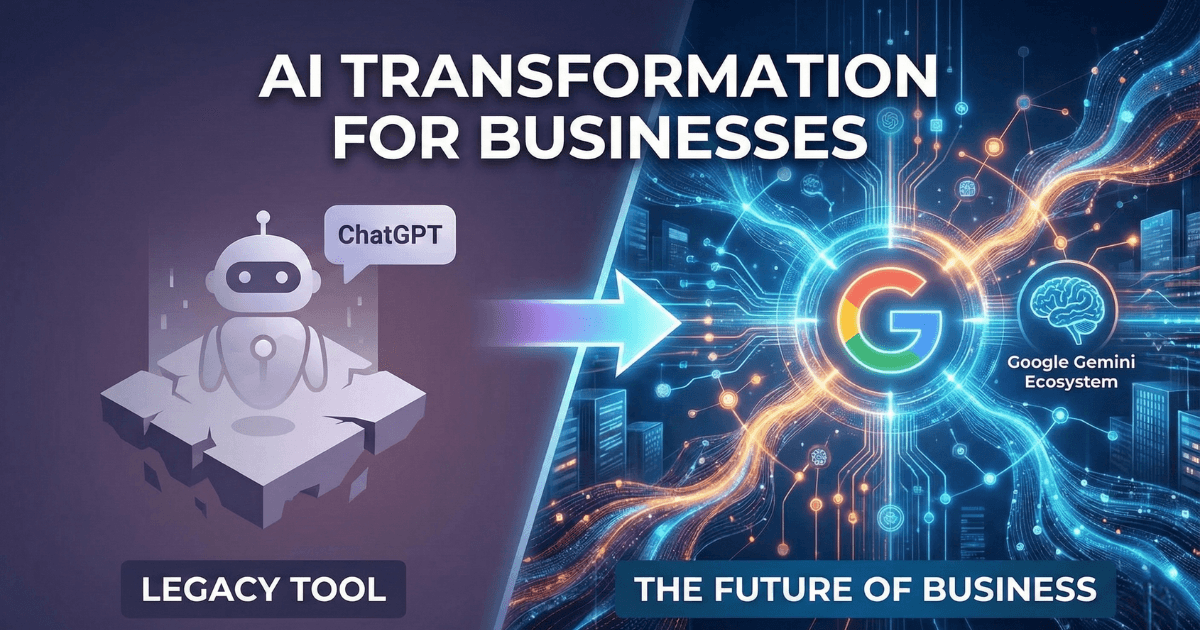
Let’s look at the facts. For the last three years, ChatGPT was on top. It had almost all the market share. But as we end 2025, the numbers are dropping. Real businesses are moving away.
Why is this happening? It is called "AI Fatigue."
Using a chat bot by itself is hard work. You have to copy and paste data back and forth. It is slow. And in business, speed is very important. A standalone bot does not know your company. It does not have your data. It is just a tool on the side. That is not a real business system.
The future for 2026 is the "Ecosystem AI." This is where Google wins. It is not just about having a smart bot. It is about having an operating system that works together. Google has the most data. It sees billions of searches every day. It uses real facts, not old guesses.
To scale efficiently and make money, companies need an AI that lives inside their work, not outside of it. Companies that do not fix this will get eaten.
The "Standalone" Problem: Why ChatGPT Is Stalling in the Enterprise
ChatGPT is losing users in the business world. The numbers show a big drop in 2025. Why? Because it is a "standalone" tool.
For a business, this does not work. To scale efficiently and save money, systems need to talk to each other. Here is why the standalone model is failing.
The "Copy-Paste" Tax Wastes Money
Business is about speed. Speed to lead is very important. But with ChatGPT, employees are slow.
They have to copy text from an email. They open a new tab. They paste it into the bot. They wait. They copy the answer. They paste it back into the email.
This is called the "Toggle Tax." Studies show that workers switch between apps hundreds of times a day. This kills focus. It wastes hours every week. In a real business, time is cash flow. If a tool slows you down, it is not an asset. It is a cost.
The "Black Box" Problem
Most companies do not have good data structures or SOPs. When they use a standalone bot, it gets worse.
ChatGPT is a "Black Box." It does not know your company. It does not know your sales numbers, your client list, or your brand voice. You have to teach it every single time you use it.
This leads to bad data. And data needs to be accurate so we can optimize. If the bot does not know the context, it guesses. In a high-stakes deal, a guess can lose you the client.
No Real ROI
Many companies bought "one-off solutions" like chatbot seats for everyone. But they did not see a return on investment (ROI).
Why? Because a chat bot is just a tool. It is not a workflow.
Real transformation happens when the AI does the work for you, not when you have to chat with it. The standalone model creates more work, not less. Companies that want to survive need systems that run on their own, not toys that need a babysitter.
The Ecosystem Advantage: How Gemini Changes the Game
This is where the game changes. In 2026, the winner is not the best chatbot. The winner is the best system.
We help companies implement AI into day-to-day operations so they scale efficiently. To do that, the AI cannot be sitting on an island outside of your business. It must be inside the walls. This is the Ecosystem Advantage.
When we audit companies that are failing at AI adoption, the root cause is almost always friction. They have great tools, but the tools don’t talk to each other. Employees are stuck in "tab hell," moving data from email to a bot, then to a doc, then to a slack message. It’s clunky. It breaks focus. And worst of all, it kills speed.
Google Gemini isn't trying to be a better "chat" partner. It is trying to be an invisible layer of intelligence that powers the infrastructure you already own. Here is why that matters for your bottom line.
Google Workspace Integration: The End of the "Toggle Tax"
Most capital-intensive B2B companies run on Google Workspace. You live in Docs, Sheets, Slides, and Gmail.
The problem with OpenAI is that it lives outside this house. To use it, you have to leave your work, go to the bot, get the answer, and bring it back. We call this the "Toggle Tax." It might only cost 30 seconds per task, but across a 50-person team, that is hundreds of billable hours flushed down the toilet every month.
Gemini eliminates this tax because it lives inside the house.
In Gmail: Imagine you get a complex inbound lead. Instead of copying it into a prompt, you simply click a button. Gemini reads the thread, checks your calendar for availability, reviews your "Pricing SOP" in Drive, and drafts a reply in your brand voice. You never left the tab.
In Sheets: You don't need to export CSVs to a code interpreter. Gemini is a column in your spreadsheet. It can categorize thousands of rows of messy feedback data instantly.
In Docs: You aren't pasting context. You just type
@Driveand reference your "2025 Strategy Document." The AI reads it instantly and helps you write the execution plan based on your actual rules, not generic internet advice.
This is not just "convenience." This is fulfillment. When you remove the friction, you can handle double the volume with the same headcount. That is how you scale efficiently.
16.4 Billion Daily Searches: The "Live Data" Moat
Data needs to be accurate so we can actually optimize. This is a non-negotiable for us.
The biggest weakness of standalone models like ChatGPT is that they are essentially "frozen in time." They rely on training data that has a cutoff. They are history books.
But business happens now.
If you are auditing a competitor’s pricing today, you cannot use data from six months ago.
If you are researching a market trend, you need the news from this morning.
This is where Google creates a gap that OpenAI cannot cross. Google processes approximately 16.4 billion searches per day. It is the internet. When you ask Gemini a question, it isn't just predicting the next word; it is "grounding" its answer in live search results.
For a business leader, this reduces the risk of "hallucinations." You aren't getting a creative guess; you are getting a cited fact. If you want to survive the next decades, you need to make decisions based on reality, not on a model's imagination.
The "Glass Box" Context: It Actually Knows You
The hardest part of AI adoption is "Context." How do you teach a bot your specific way of doing things? With ChatGPT, you have to write massive system prompts or upload files one by one. It’s tedious.
Gemini changes this with its massive Context Window (up to 2 million tokens). This means it can "hold" a massive amount of information in its head at once.
You can upload a video recording of your entire hour-long sales meeting.
You can upload a 500-page PDF of your technical manuals.
You can point it to a folder of your last 50 successful proposals.
It doesn't just "summarize" them; it understands them. It becomes a "Glass Box"—transparent and accessible—rather than a "Black Box" you have to guess at. When we build AI transformation plans, this is the killer feature. We can turn a new hire into a top performer in days because the AI acts as a mentor that has memorized every SOP the company has ever written.
Multimodality Native: Seeing the Whole Picture
Finally, we need to talk about how the model "thinks." Most older models are text-only. If you want them to see an image or hear audio, they use a plugin to "translate" it into text first. It’s stitched together. It breaks.
Gemini is Multimodal Native. It was trained on video, images, audio, and text simultaneously.
The Use Case: Let's say you are a manufacturing business. You can take a video of a broken machine part, upload it, and ask, "What is wrong with this, and which SOP fixes it?"
Gemini sees the video frames, identifies the part, searches your internal manuals for the fix, and gives you the answer.
ChatGPT struggles to do that smoothly. Google does it natively.
The Bottom Line
Stop playing with toys. The novelty phase is over. If you are still paying for a standalone chatbot that requires copy-pasting, you are burning cash. The future is an ecosystem that knows your data, sees what you see, and works where you work.
2026 is the year of the ecosystem. Adapt, or get eaten.
Real-World Use Cases: What AI Transformation Looks Like in 2026
We do not deal in theory here. We deal in cash flow. When we audit a company, we look for one thing: are you using AI to actually do the work, or are you just playing with it?
There is a big difference between "chatting" with a bot and running a business on an AI ecosystem. Here is what real AI transformation looks like when you switch from a standalone tool to the Google ecosystem.
For Operations: The "No-Tab-Switch" Workflow
Let’s look at a real scenario. You run an agency. You get a complex email from a client asking for a custom quote based on their last three projects.
The Old Way (The "ChatGPT" Way):
You open the email.
You copy the text.
You open a new tab for ChatGPT.
You paste the text.
You realize you need the pricing data from a spreadsheet.
You go find the Google Sheet. You copy the rows.
You go back to the bot. You paste the rows.
The bot gives you a generic answer.
You copy it back to Gmail and fix the formatting.
That whole process took you 6 minutes. It felt clunky. It broke your focus.
The New Way (The Ecosystem Way): You stay in Gmail. You open the Gemini side panel. You type one command:
"Draft a reply to this client. Base the pricing on the data in @Q4_Pricing_Sheet and referencing their last project in @Project_Log."
Gemini reads the email, reads the Google Sheet, and reads the Project Log Doc all at once. It drafts the email right there in the window. You check it. You hit send.
Result: You did it in 45 seconds. You saved 5 minutes per email. If you have 10 employees doing this 10 times a day, you just saved 800 hours a year. That is real money.
For Strategy: The "Deep Research" Advantage
Strategy is about knowing things your competitors don't. If you use a standalone bot, you are getting answers from its "training data" which is basically a history book. It doesn't know what happened this morning. It hallucinates.
Google has a massive advantage here called "Grounding". You can tell Gemini:
"Build a competitor report on [Company X]. Use their latest news from Google Search AND our internal strategy notes in @Competitor_Analysis_Doc."
It pulls live data from the web (using Google Search) to get today's news. It combines that with your private data (your internal PDFs and Docs).
Result: You get a report that is 100% accurate to right now. You aren't getting a creative guess; you are getting cited facts from the live internet.
For Security: The "One-Gate" Rule
This is the boring part that saves your butt. If you use ChatGPT, you are sending your sensitive data to a third party. You have to trust their security. You have to create new logins. It is a risk.
With Google, Gemini is part of the Workspace you already pay for.
Your data stays yours: Google does not use your private Workspace data to train their public models.
No new compliance headaches: If your company is already HIPAA or SOC 2 compliant on Gmail, Gemini follows the exact same rules.
Zero-Trust: You don't have to worry about an employee pasting a password into a public chatbot. The data never leaves your secure "house."
You aren't buying a new tool. You are just turning on the brain for the tools you already have.
The 2026 Forecast: Why Leaders Are Switching
The writing is on the wall. We are moving from the "Cool Phase" to the "Utility Phase."
In 2024 and 2025, companies bought AI because they didn’t want to miss out. They bought "shiny objects." But in 2026, the budget is changing. CFOs are cutting the toys and doubling down on the tools that actually do the work.
The End of "Chatbot" Subscriptions
Here is our prediction at Novoslo: The era of paying $30/month for a standalone chatbot is over.
Enterprises are tired of managing 50 different vendor contracts. It’s a mess. The trend for 2026 is consolidation. Companies are shrinking their vendor lists and moving to "bundled" ecosystems.
Why pay for a separate AI tool when you already have a better one built into the email and document suite you pay for? It makes no sense. The "toggle tax" combined with the subscription cost is killing the standalone model. Leaders are realizing that if the AI isn't in the workflow, it isn't worth the budget.
From Novelty to Utility
For the last two years, we saw a lot of "novelty." People used AI to write funny poems, generate weird images, or write generic LinkedIn posts.
That is over.
The shift for 2026 is to Utility. We are moving from "Generative AI" (which creates text) to "Agentic AI" (which completes tasks).
Novelty: Asking a bot to "write a plan for an audit."
Utility: Telling an agent to "audit these 500 invoices against our SOP and flag the errors."
The companies winning in 2026 aren't using AI to be creative; they are using it to be operational. They are automating the boring, heavy lifting compliance, data entry, and financial audits.
If you are still using AI to "brainstorm," you are behind. The real players are using it to execute.
Conclusion: The King Is Dead, Long Live the Platform
OpenAI started the fire. Hats off to them. They showed us what was possible.
But Google built the engine.
As we head into 2026, the friction of using separate tools is too high. The "cool factor" of ChatGPT is gone. It has been replaced by the crushing utility of Google’s data.
The era of the "AI Chatbot" is over. The era of the "AI Ecosystem" has begun.
You have a choice to make. You can keep playing with toys that don't talk to each other. Or you can build a system that actually runs your business.
Don't just buy a tool. Adopt an ecosystem.
If you are a CEO or founder and you are tired of the noise, if you want to build a real AI transformation plan that scales.
Book a strategy call here.
Frequently Asked Questions (FAQ)
Q: Is Gemini actually "smarter" than ChatGPT? A: It doesn’t matter which one writes a better haiku. In business, context wins. Gemini might not be "smarter" in a vacuum, but it is more useful because it knows your calendar, your documents, and your emails. A genius in a black box is less valuable than a smart assistant that actually has the keys to your office.
Q: Will Google use my private company data to train their public models? A: No. If you are on the paid Business or Enterprise tier of Google Workspace, your data is yours. It stays in your "house." Google does not use it to train the public Gemini model. You get the same security protections you already rely on for your corporate Gmail.
Q: My team is used to ChatGPT. How do I get them to switch? A: Don't force them. Just show them the speed. Show them how they can draft a client email without leaving the Gmail tab, or how they can query a Drive folder without uploading files one by one. Once they realize they can stop copy-pasting 50 times a day, they won't want to go back.
Q: Should I cancel my OpenAI subscription immediately? A: If you are paying for expensive Enterprise seats just to have employees write emails or summarize notes, then yes. You are paying double for a feature you likely already have in Workspace. Move that budget into implementation or better data structures.
Q: I’m ready to pivot. What is the first step?A: Don't just buy licenses and hope for the best. Start with an audit. Look at your team's workflows and find the "Toggle Tax"—where are they copying data between apps? That is your first target for automation. Or, if you want to skip the headache, just hit me up and we will handle the audit for you.