Article
May 1, 2026
Top AI Tools for Sales Team Coaching to Boost Performance in 2026
Explore top AI tools for sales team coaching in 2026 with practical advice on features, ROI, and implementation.
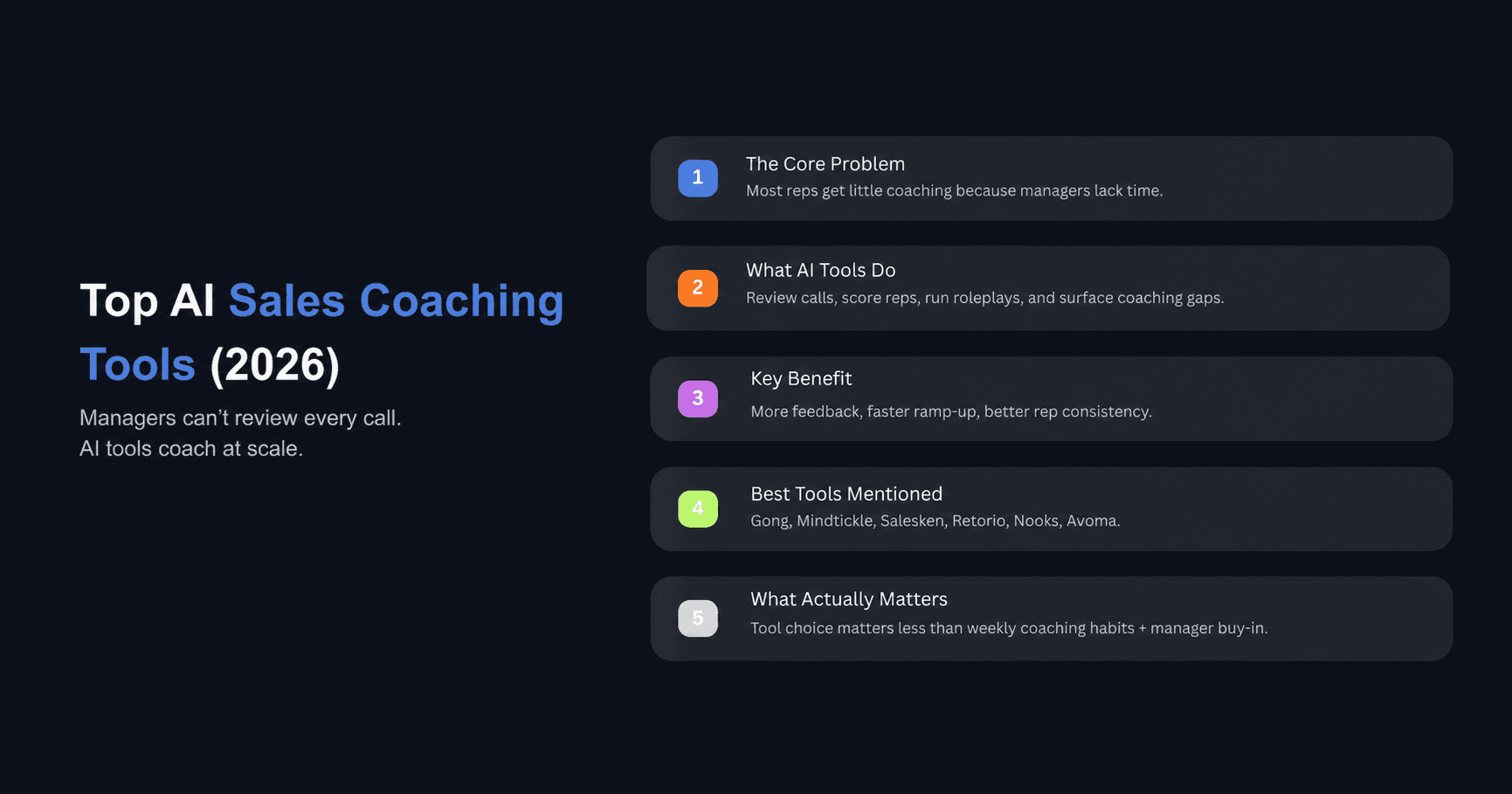
Most sales managers know coaching matters. The problem is math.
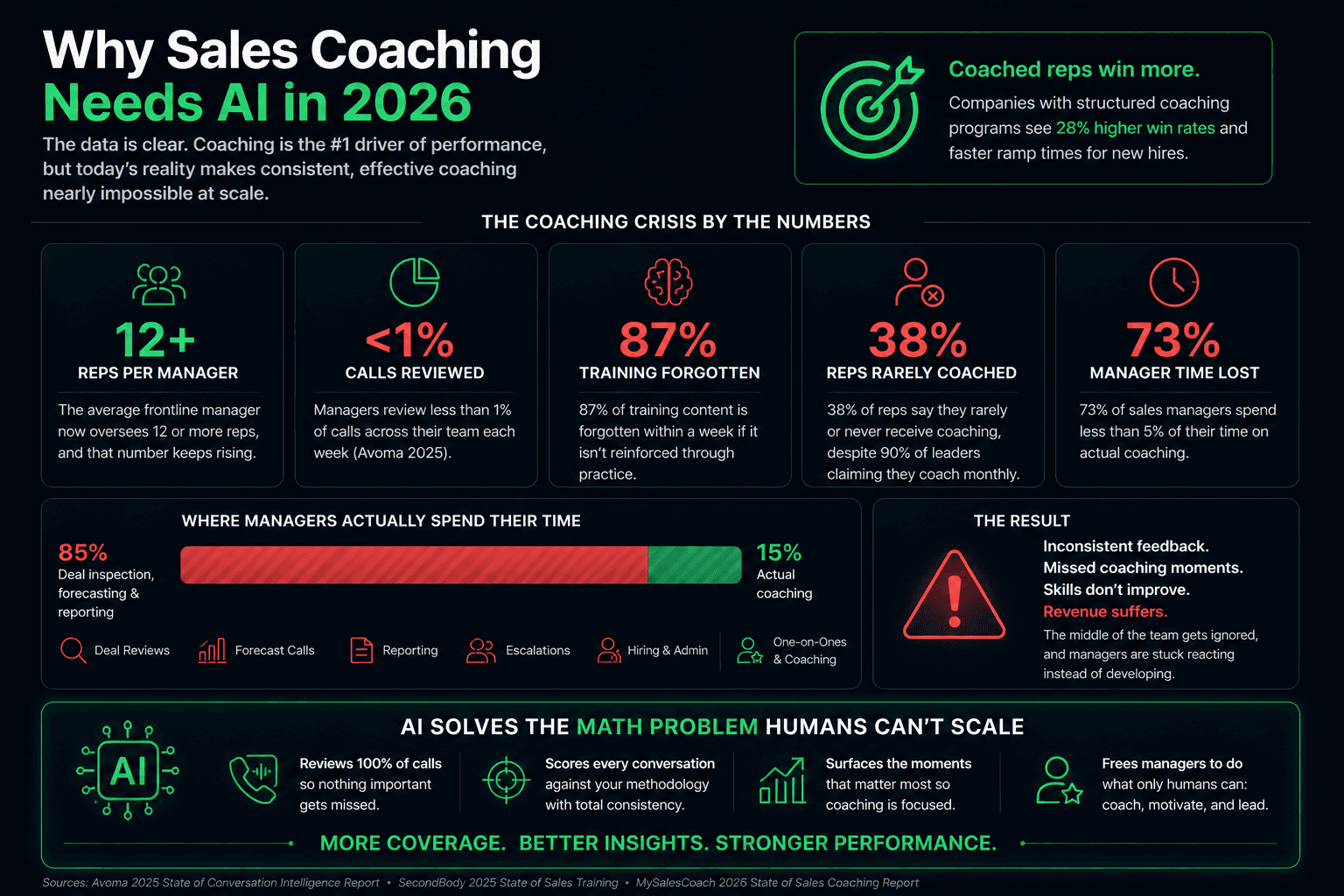
The average frontline manager now oversees 12 or more reps. Across those reps, hundreds of calls happen every week. Less than 1% of those calls get reviewed by a manager, according to Avoma's 2025 research. Meanwhile, 87% of training content is forgotten within a week if it is not reinforced through practice. That means even when coaching happens, most of it does not stick.
AI tools for sales team coaching solve this by doing the parts that managers physically cannot: reviewing every call, scoring rep behavior against a consistent framework, and surfacing the specific moments where coaching will have the most impact. They do not replace the manager. They make the manager's limited hours count for more.
This post breaks down the tools worth evaluating in 2026, how they differ, what to look for before buying, and how to actually fit them into your sales process without creating another piece of unused software.
Why Sales Coaching Needs AI in 2026
The Manager Bandwidth Problem
Sales coaching has always been constrained by time. A manager who spends 30 minutes reviewing a single call can only cover a small fraction of what the team produces each week. The result is inconsistent feedback. Top performers and struggling reps get attention, while the middle of the team goes largely uncoached.
This gets worse as teams scale. When a company goes from 8 reps to 20, the manager's calendar does not expand to match. 38% of reps say they rarely or never receive coaching, despite 90% of leaders claiming they coach monthly. That gap is not a leadership failure. It is a structural one.
AI tools close this gap by automating the review process. They transcribe, score, and flag calls so that a manager can walk into a one-on-one with specific data on which calls to discuss and what behaviors to address. Instead of spending two hours finding something to coach on, the manager spends those two hours actually coaching.
What the Data Says About AI Coaching ROI
The numbers are consistent across multiple studies. Organizations using AI sales coaching tools see 20 to 25% improvement in rep proficiency and 15% faster ramp time for new hires, according to research from Gartner and Forrester. Teams using AI coaching platforms report 24% higher win rates and 37% faster onboarding compared to teams relying on traditional methods.
A 2025 neuroscience study found that reps who received feedback from an AI coach retained 50% more information after 48 hours compared to those who received human feedback alone. The structured, written nature of AI feedback appears to improve memory retention, while human coaching remains stronger for motivation and trust building.
The takeaway is not that AI coaching replaces human managers. It is that AI handles the parts where consistency and coverage matter most, while managers focus on the relationship and judgment calls that require a person.
What Should You Look for in an AI Sales Coaching Tool?
Not every tool in this category does the same thing. Before evaluating platforms, it helps to understand the three core capabilities and decide which ones match your team's actual bottleneck.
Conversation Intelligence and Call Scoring
This is the foundation of most AI coaching platforms. The tool records calls, transcribes them, and uses natural language processing to identify patterns: talk ratios, objection handling, competitor mentions, pricing discussions, and whether the rep committed to clear next steps.
The value here is not just call review. It is the ability to score calls against a consistent framework so that coaching is based on data, not on whichever call the manager happened to overhear. If you want to learn more about building this kind of review process, our guide on how to audit sales calls using AI walks through the setup.
Look for platforms that let you build custom scorecards aligned to your sales methodology, whether that is MEDDIC, SPIN, or something internal. Generic scoring is better than no scoring, but the tools that let you define what "good" looks like for your specific process will produce more relevant coaching.
AI Roleplay and Practice Simulation
Roleplay has always been one of the most effective coaching methods, but it requires a manager or peer to play the buyer, which limits how often reps can practice. AI roleplay tools remove that constraint by generating realistic buyer personas that reps can practice against at any time.
The best platforms build these simulations from your team's actual call recordings rather than generic scenarios. That means reps are practicing against the objections, questions, and buying signals they face in real conversations, not hypothetical situations they may never encounter.
This category is particularly valuable for onboarding. Instead of asking new hires to shadow calls for weeks before getting live experience, they can practice high-stakes scenarios repeatedly with instant feedback until they are ready.
CRM Integration and Pipeline Visibility
A coaching tool that does not connect to your CRM creates a data silo. The most useful platforms sync coaching insights directly with pipeline data so that managers can see which deal behaviors correlate with outcomes, not just which call techniques sound good in isolation.
For example, if a rep consistently scores well on discovery calls but deals stall at the proposal stage, the coaching tool should surface that pattern automatically. Without CRM integration, the manager has to piece together that story manually from separate systems.
Real Time vs. Post Call Coaching
Post-call coaching analyzes conversations after they end and surfaces feedback for the next call. Real time coaching provides prompts and suggestions during the conversation itself, such as suggesting a response framework when a prospect raises a pricing objection or flagging when the rep's talk ratio is too high.
Both approaches have trade-offs. Post-call coaching is less intrusive and works well for skill development over time. Real time coaching can improve outcomes on the current call but requires reps to split attention between the conversation and the coaching prompts. For a deeper look at how real time coaching works in practice, see our breakdown of how AI supports real time sales coaching.
Most teams start with post-call analysis and add real time features once reps are comfortable with the workflow.
Top AI Tools for Sales Team Coaching in 2026
Gong
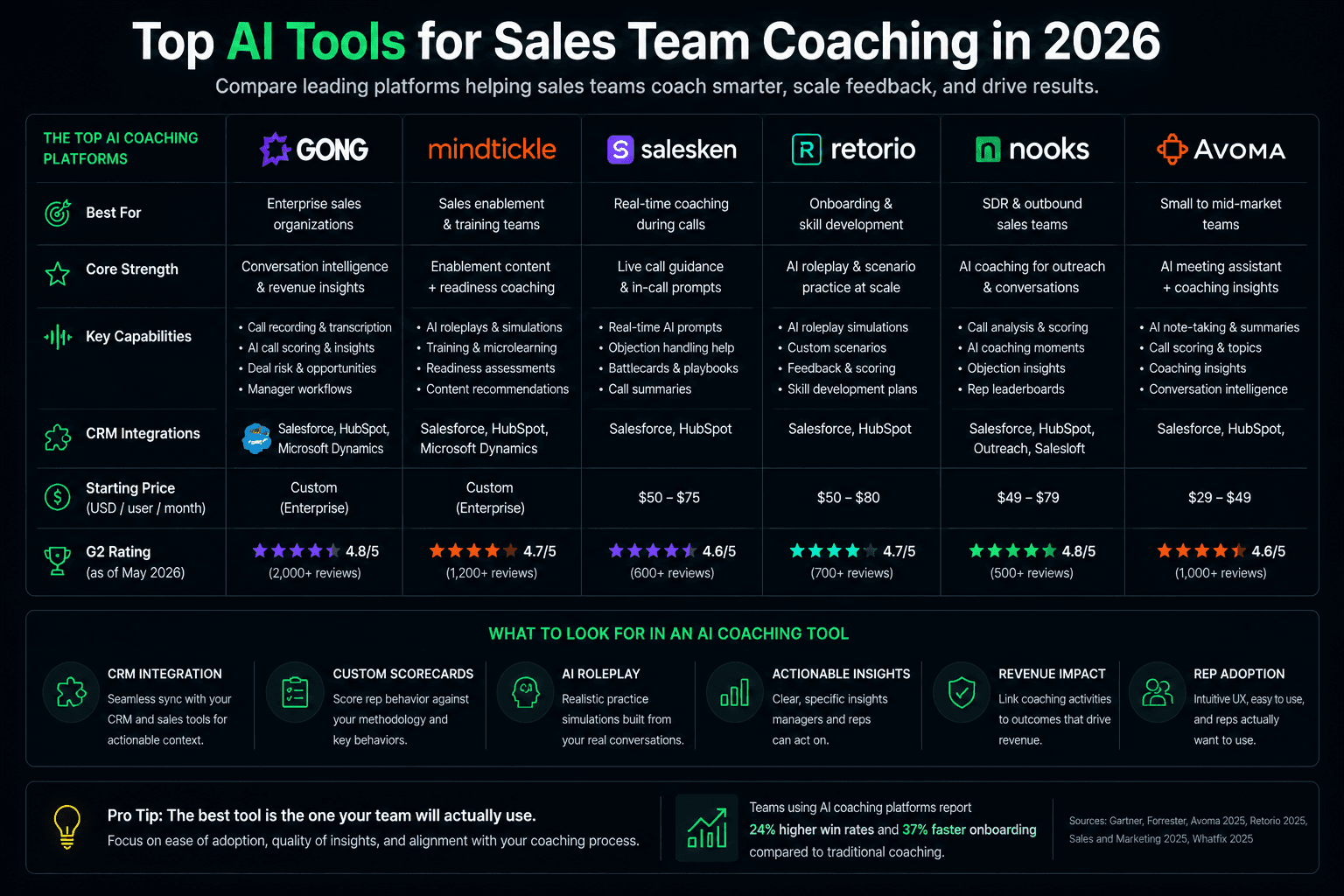
Gong is the most established player in conversation intelligence and has expanded significantly into coaching and enablement. In early 2026, Gong launched Gong Enable, a new product tier that includes an AI Call Reviewer for post-call scoring based on your organization's methodology, an AI Trainer for roleplay practice built from real customer interactions, and AI Skill Assessments that evaluate readiness based on simulated conversations.
What makes Gong strong for coaching is its depth of conversation data. It captures calls, emails, and meetings, then analyzes engagement patterns across the full deal cycle. Managers can see team-wide trends, compare individual rep behaviors to benchmarks, and track improvement over time without manually reviewing recordings.
Gong also supports open interoperability through the Model Context Protocol, which means it can exchange data with AI systems from other platforms like Salesforce and HubSpot. Pricing is custom and tends toward the higher end of the market, which makes it a better fit for mid-market and enterprise teams that can justify the cost against a larger pipeline.
Mindtickle
Mindtickle focuses on the intersection of coaching and readiness. Rather than just analyzing calls, it provides certification workflows, AI skill gap analysis, and structured learning paths that connect training content to actual performance data.
This makes it a strong choice for teams that need to onboard reps into a specific sales methodology and want to verify readiness before reps go live. It scores reps on defined competencies and routes them into targeted training modules when gaps are detected.
Pricing is typically around $45,000 per year for 100 users, which positions it as a mid-market to enterprise solution. The platform is less focused on real time call coaching and more on building consistent skill development across the team.
Salesken
Salesken provides real time call guidance alongside post-call analysis. During live conversations, it surfaces prompts for objection handling, competitor positioning, and next steps. After the call, it delivers a full scorecard with specific coaching recommendations.
The real time component is what sets Salesken apart from platforms that focus exclusively on post-call review. For teams where reps are handling complex or high-volume calls and need in-the-moment support, this can reduce the gap between learning a skill and applying it.
Retorio
Retorio takes a different approach by focusing on AI video roleplay and behavioral analysis. Reps record themselves handling scenarios, and the AI evaluates verbal delivery, emotional intelligence, and adherence to frameworks. One reported result is a 41% reduction in onboarding time for enterprise teams.
This is a good fit for organizations that sell through relationship-heavy or consultative processes where how the rep communicates matters as much as what they say. It also works well for compliance-heavy industries where reps need to demonstrate proficiency before engaging customers.
Nooks
Nooks positions itself as an AI-native workspace that connects coaching directly to outbound execution. Rather than analyzing calls as a standalone activity, it integrates coaching insights into the prospecting workflows reps use daily. Roleplay bots are built from real calls, and coaching feedback flows into which prospects get targeted and what messaging reps use.
This approach is most relevant for teams where outbound prospecting is a core motion. If your team runs high-volume outbound campaigns and you want coaching to directly influence campaign execution rather than sit in a separate system, Nooks is worth evaluating.
Avoma
Avoma combines conversation intelligence with automated note-taking and meeting management. It transcribes calls, identifies key topics and action items, and provides coaching insights based on rep performance metrics.
Avoma is often a good entry point for teams that are new to AI coaching and want a platform that handles meeting workflow alongside coaching. It is less specialized than Gong or Mindtickle but covers a broader set of meeting productivity needs at a more accessible price point. The platform also provides curated libraries of top-performing calls so reps can learn from their peers asynchronously.
How Do AI Coaching Tools Fit Into Your Existing Sales Process?
Starting with Call Review Before Going Real Time
Teams that try to deploy real time coaching before they have a solid call review process often struggle with adoption. Reps need to trust the system's recommendations before they are willing to act on them mid-conversation.
A practical rollout looks like this: start by recording and scoring calls for four to six weeks. Use that data to establish baselines for each rep and identify the two or three behaviors that have the biggest impact on outcomes. Then introduce targeted coaching around those behaviors before layering in any real time prompts.
Reps who receive weekly coaching hit quota at 76%, compared to 56% for those coached monthly and 47% for those coached quarterly. The frequency matters more than the sophistication of the tool, so starting simple and being consistent will outperform buying an advanced platform and using it sporadically.
If you want to start building a coaching workflow before committing to a paid platform, you can analyze sales calls using Claude to set up scoring criteria and extract coaching insights from call transcripts.
Connecting Coaching Data to Revenue Outcomes
The coaching tools that stick are the ones where leadership can draw a line from coaching activity to revenue results. That means tracking not just whether reps are improving their call scores, but whether those improvements correlate with higher win rates, shorter sales cycles, or larger deal sizes.
One enterprise client we worked with doubled their sales efficiency by connecting AI-driven coaching insights to their lead engagement timing, allowing reps to act on data rather than instinct.
This requires connecting your coaching platform to your CRM and pipeline data. If coaching data lives in a separate system with no connection to deal outcomes, it becomes easy for leadership to question the investment. The platforms listed above all offer CRM integrations, but the quality and depth of those integrations vary. Before purchasing, test how coaching data flows into your existing reports and whether managers can see the connection between a rep's skill development and their pipeline performance.
For teams evaluating how AI sales coaching compares to traditional sales training, the data consistently shows that AI coaching delivers faster feedback loops and more consistent coverage, while traditional training remains valuable for motivation and culture.
What Mistakes Do Teams Make When Adopting AI Sales Coaching?
Treating It Like a Dashboard Instead of Infrastructure
The most common failure pattern is buying a coaching platform, connecting it to the tech stack, and then leaving it for managers and reps to figure out on their own. Teams that treat AI coaching as a passive dashboard rather than active infrastructure see minimal returns.
The companies that get the most value embed coaching into their weekly operating rhythm. That means call scores show up in one-on-one agendas, coaching metrics appear alongside pipeline reviews, and rep improvement is tracked as a formal performance indicator. The tool becomes part of how the team works, not something they check when they remember.
Companies that fully embed AI coaching into daily operations report returns as high as 28x their investment, while companies that treat it as a passive dashboard see returns closer to 4x, according to deployment data from SalesAsk.
Skipping Manager Buy In
AI coaching tools are ultimately a force multiplier for managers, but if managers see them as surveillance software or busywork, adoption will fail regardless of the tool's capabilities.
The fix is involving managers in the setup process. Let them define the scorecards, choose which behaviors to track, and decide how coaching data shows up in their workflow. When managers see the tool as something that gives them leverage rather than something imposed on them, adoption follows naturally.
This is also where using Claude Skills for sales workflows can supplement a coaching platform. Teams can build lightweight automation around coaching outputs, such as auto-generating coaching summaries or routing specific call insights to the right manager, without waiting for the vendor to add those features.
Conclusion
AI tools for sales team coaching fall into three broad categories: conversation intelligence platforms like Gong and Avoma that analyze calls and surface coaching insights, roleplay and simulation tools like Retorio and Nooks that let reps practice at scale, and real time coaching platforms like Salesken that guide reps during live conversations.
The tool you choose matters less than how you use it. Weekly coaching cadence, manager buy-in, and a clear connection between coaching data and revenue outcomes are what separate the teams that see real results from the ones that add another unused login to the tech stack.
If you are not sure where your team's biggest coaching gaps are, our AI business audit tool can help you identify the workflows where AI will have the most impact on your sales operations.