Article
Apr 27, 2026
AI Sales Coaching vs Traditional Sales Training: Which One Actually Drives Results?
Compare AI sales coaching and traditional training by cost, retention, and rep performance. A practical guide for leaders choosing what works.
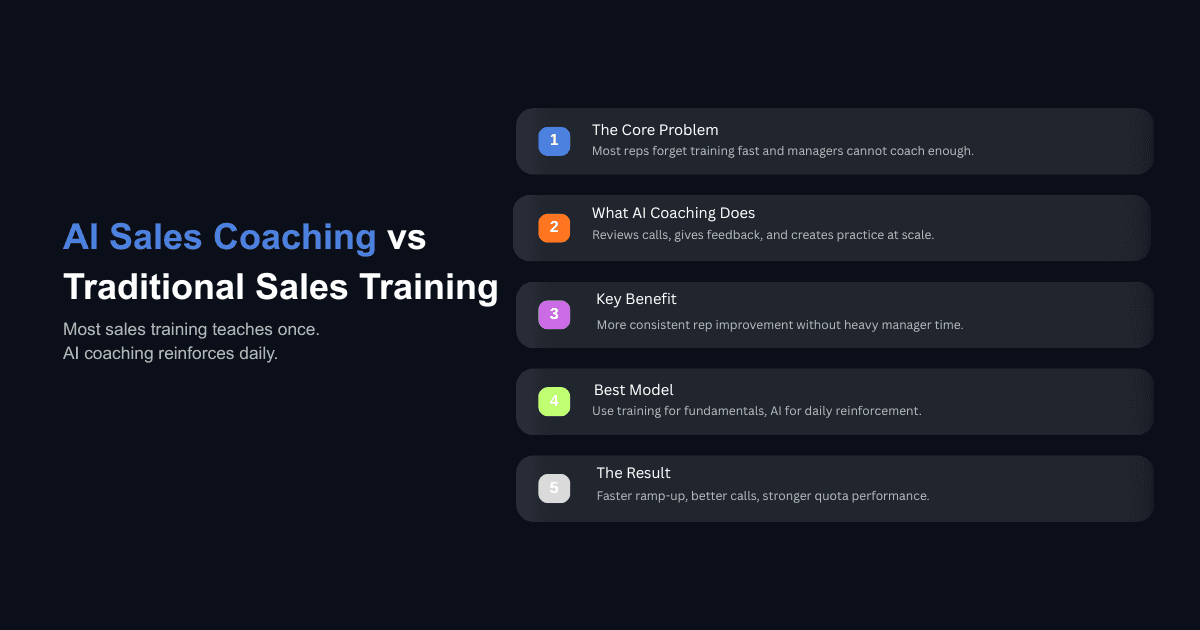
Companies in the US spend close to $100 billion a year on corporate training programs. The sales slice of that budget keeps growing. And yet, research consistently shows that 85 to 90 percent of sales training programs have no lasting impact after 120 days.
That is not a tools problem or a content problem. It is a design problem. Most sales training was built for a world where you could pull 20 reps into a conference room, run them through a two-day methodology workshop, and assume the knowledge would stick. That world does not exist anymore, and the assumptions behind it were already questionable when it did.
AI sales coaching has entered the conversation as a potential fix, but the framing of "AI versus traditional" oversimplifies the decision. The real question for operations leaders and sales executives is more specific: which parts of your training stack are actually changing rep behavior, and which parts are burning budget on activities that feel productive but produce no measurable lift?
This post breaks down where traditional training falls apart, what AI coaching does differently in practice, and how to build a system that combines both in a way that moves revenue numbers.
Where Traditional Sales Training Falls Apart
Traditional sales training is not useless. Methodology workshops, product training, and structured onboarding programs build the foundation that reps need to understand what they are selling and how the organization expects them to sell it. The problem is what happens after the workshop ends.
The Forgetting Curve Is Not a Theory
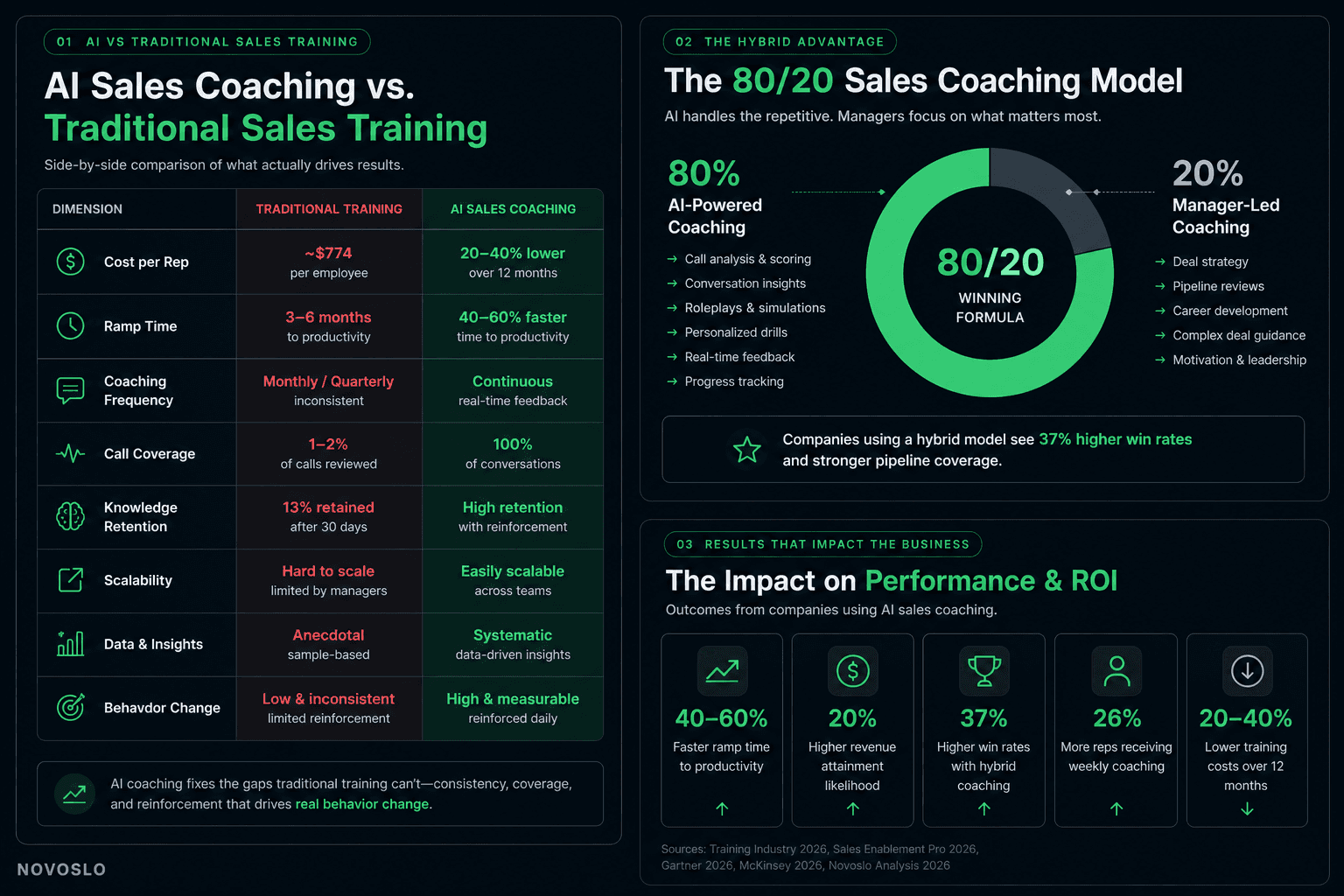
Hermann Ebbinghaus documented the forgetting curve in 1885, and the data has only been confirmed since. B2B sales reps forget 70 percent of the information they learn within a week of training, and 87 percent forget it within a month. This is not a reflection of how smart your reps are. It is how human memory works when information is not reinforced through repeated application.
Most organizations treat training like a vaccination: one dose and done. Only 47 percent of companies provide post-training reinforcement, despite evidence that organizations using reinforcement strategies see 34 percent more first-year reps achieve quota. The training content itself may be excellent, but without a system for embedding it into daily behavior, the ROI collapses within weeks.
The Manager Bottleneck
Sales managers are the most common delivery mechanism for ongoing coaching, and they are also the biggest bottleneck. 44 percent of sales managers admit they do not have enough time to coach regularly, and the ones who do make time can only review a fraction of their team's actual performance. A frontline manager with eight direct reports can realistically listen to one or two percent of total calls in a given week.
This means coaching becomes reactive rather than systematic. A manager catches a bad call, gives feedback on that call, and hopes the rep generalizes the lesson across future conversations. There is no mechanism for identifying patterns across hundreds of interactions or catching skill gaps before they cost you pipeline.
Only 26 percent of reps receive weekly coaching, and the quality of that coaching varies enormously depending on the manager's own skill as a coach. Many sales managers were promoted because they were strong sellers, not because they had any training in how to develop other people.
The Cost Math Nobody Does
The average cost of sales training is roughly $774 per employee, with onboarding running closer to $9,500 per new rep when you factor in time, travel, and lost productivity. Most organizations never calculate the cost of that training being forgotten. If 87 percent of the content disappears within 30 days, the effective cost per retained unit of knowledge is several multiples of the sticker price.
Traditional programs also carry hidden costs in manager time. Every hour a senior seller or manager spends running roleplay sessions or reviewing calls is an hour they are not spending on pipeline, deal strategy, or customer conversations that generate revenue.
What AI Sales Coaching Actually Does Differently
AI sales coaching is not a replacement for training. It is a different layer of the development stack that addresses the specific failure modes of traditional methods: inconsistency, limited coverage, and the absence of reinforcement between formal training events.
Analyzing 100 Percent of Conversations Instead of One Percent
The most immediate operational difference is coverage. Traditional coaching relies on a manager sampling a handful of calls per rep per month. AI platforms process every recorded interaction and surface patterns that would be invisible at that sample size.
This changes the nature of coaching from anecdotal to systematic. Instead of a manager saying "I think you need to work on discovery questions," the system can show that a specific rep asks an average of two discovery questions per call compared to a team average of five, and that their win rate on deals where they ask four or more is 40 percent higher. That specificity makes the coaching conversation more productive for both the manager and the rep.
If you want to see how this works in practice, you can analyze sales calls using Claude to extract objections, score conversations, and identify patterns across your team.
Personalized Feedback Without Manager Time
AI coaching platforms deliver individualized feedback based on each rep's actual performance data. If one rep struggles with negotiation but handles discovery well, and another rep has the opposite profile, the system adapts to each without requiring a manager to diagnose and prescribe separately.
B2B companies that incorporate AI coaching are 20 percent more likely to see higher revenue outcomes than organizations that do not, according to Highspot's 2025 State of Sales Enablement Report. The advantage comes from consistency and coverage. Every rep gets feedback on every interaction, not just the ones a manager happens to catch.
Unlimited Practice in a Zero-Stakes Environment
One of the strongest operational advantages of AI coaching is the ability for reps to practice without consequences. AI roleplay platforms let reps run through objection handling, discovery calls, and negotiation scenarios as many times as they need. The system provides immediate scoring on talk-to-listen ratio, question quality, and response effectiveness.
This matters because traditional roleplay creates performance anxiety that actually inhibits learning. When a rep is practicing in front of their manager or peers, they default to safe behaviors rather than experimenting with new techniques. AI removes that social pressure while still providing structured, measurable practice.
How Do the Results Compare?
The data on AI coaching outcomes is still relatively early, but the directional evidence is consistent across multiple studies and use cases.
Onboarding and Ramp Time
Traditional onboarding takes an average of 38 days at a cost of roughly $9,500 per rep, and many organizations report that new hires take nine or more months to reach full productivity. AI coaching platforms have demonstrated the ability to cut ramp time by 40 to 60 percent by providing structured practice from day one and delivering feedback at a pace that traditional methods cannot match.
The mechanism is straightforward: instead of waiting for a new rep to accumulate enough live call experience to develop pattern recognition, AI simulations compress that learning cycle. A rep can run 15 practice scenarios before their first real call of the day, building confidence and muscle memory on the specific situations they are most likely to encounter.
Win Rates and Quota Attainment
Companies using AI in their training programs report 3.3 times year-over-year growth in quota attainment compared to those relying on traditional methods alone. Win rate improvements in the range of 20 to 36 percent are reported across multiple studies, with the highest gains coming from organizations that use AI to analyze real call data and feed insights back into both individual coaching and team-wide training programs.
One enterprise client we worked with doubled their sales efficiency using AI-driven insights and now engages leads at optimal times using data-backed decisions. The improvement came from combining call analysis with lead scoring, not from any single tool or platform.
Cost Per Rep
The economics are difficult to argue against. AI coaching platforms typically run $12 to $20 per user per month, compared to $2,000 to $5,000 per rep per year for traditional workshop-based training. The AI cost includes unlimited practice sessions, automated call review, and continuous feedback, all of which would require significant manager time under a traditional model.
That said, cost comparison alone does not capture the full picture. The question is not whether AI is cheaper, but whether the combination of reduced cost and improved outcomes produces a better return per dollar of training budget. The evidence so far suggests it does, with some organizations reporting 15 percent reductions in total sales costs alongside meaningful improvements in rep performance.
Why the Answer Is a Hybrid Model (and How to Build One)
Neither AI coaching nor traditional training works well in isolation. The strongest results come from combining both approaches, which produces 37 percent higher win rates compared to using either method alone. This is not a compromise position. It is what the data supports.
Let AI Handle Volume, Let Managers Handle Strategy
The hybrid model works because AI and human coaches are good at different things. AI handles the high-volume, repetitive elements of skill development: drilling objection handling, practicing openers, reinforcing methodology frameworks, and monitoring call quality across the entire team. Human managers handle the elements that require judgment, context, and relationship: complex deal strategy, career development, emotional intelligence coaching, and navigating situations where the standard playbook does not apply.
Teams combining ongoing coaching with effective training are 63 percent more likely to produce top performers. The key is clarity about which activities belong in which bucket. If a manager is spending time running basic roleplay exercises, that time is better allocated to strategic deal reviews while AI handles the repetition.
The 80/20 Split in Practice
A practical structure looks like this: AI handles roughly 80 percent of practice volume, including daily micro-coaching after calls, automated skills assessment, and roleplay simulations. Managers handle the remaining 20 percent through weekly one-on-one sessions focused on pipeline strategy, account planning, and professional development.
New hires might spend their first two weeks doing 50 or more AI-simulated conversations before taking a live call, building foundational skills without consuming manager time. Veteran reps use five to ten minutes of AI practice daily to maintain sharpness on current market objections. Managers review AI-generated scorecards and focus their limited coaching time on the specific areas where human judgment adds the most value.
If you are looking to automate your sales workflow as part of this transition, building reusable AI skills for outreach, call preparation, and follow-ups is a practical starting point.
What to Measure to Know It's Working
Track both leading and lagging indicators. Leading indicators include coaching frequency, AI engagement rates (how often reps are actually using the platform), and skill competency scores from simulations. Lagging indicators include win rates, deal velocity, quota attainment, and ramp time for new hires.
The organizations that get the most value from this model are the ones that connect training activity directly to revenue outcomes, rather than measuring completion rates and satisfaction scores in isolation.
What Should You Implement First?
If you are evaluating AI sales coaching for the first time, resist the urge to buy a platform and deploy it to the entire team on day one. The organizations that succeed with this technology take a more deliberate approach.
Start With Call Auditing, Not Roleplay
The highest-value, lowest-risk entry point is automated call analysis. Before investing in AI roleplay or simulation platforms, start by getting visibility into what is actually happening on your team's calls. Most organizations have no systematic way to review more than a tiny fraction of sales conversations, which means they are coaching based on incomplete information.
You can audit sales calls using AI to extract objections, identify buying signals, and surface coaching insights from every recorded conversation. This gives you data to make informed decisions about where to invest in additional training and coaching resources.
Build Feedback Loops Before Buying Platforms
The technology only works if it connects to a feedback loop that changes behavior. Before selecting a platform, define the specific skills and behaviors you want to improve, establish baseline measurements, and create a process for reviewing AI-generated insights with your team. A platform without a feedback loop is just another piece of shelfware.
This is where having a clear framework for implementing AI in your business matters. The companies that fail with AI coaching usually fail for the same reason they failed with traditional training: they bought a solution without building the operational infrastructure to support it.
The 30-Day Pilot Structure
Run a focused pilot with a small group of reps, ideally five to ten, over 30 days. Define one or two specific skills to target, such as discovery question quality or objection handling on pricing conversations. Measure baseline performance before the pilot, track engagement and skill scores during, and compare win rate or deal progression data at the end.
If the pilot shows measurable improvement, expand gradually. If it does not, you have learned something valuable about either the platform, the implementation, or the specific skills you targeted, all of which you can adjust before committing a larger budget.
The Bottom Line
Traditional sales training builds knowledge. AI coaching builds the reinforcement layer that turns knowledge into consistent behavior. The organizations seeing the strongest results are not choosing one over the other. They are using traditional methods to establish frameworks, methodology, and product knowledge, then layering AI coaching on top to ensure those skills are practiced, measured, and maintained over time.
The starting point is not a platform decision. It is an honest assessment of where your current training investment is producing returns and where it is leaking value. If you want to quantify that, our AI ROI calculator can help you estimate the potential savings from augmenting your existing training with AI-driven coaching and automation.