Article
Apr 29, 2026
How AI Can Support Real-Time Sales Coaching to Close More Deals Faster
Learn how AI supports real-time sales coaching to improve win rates, cut ramp time, and deliver consistent feedback your managers can't scale alone.
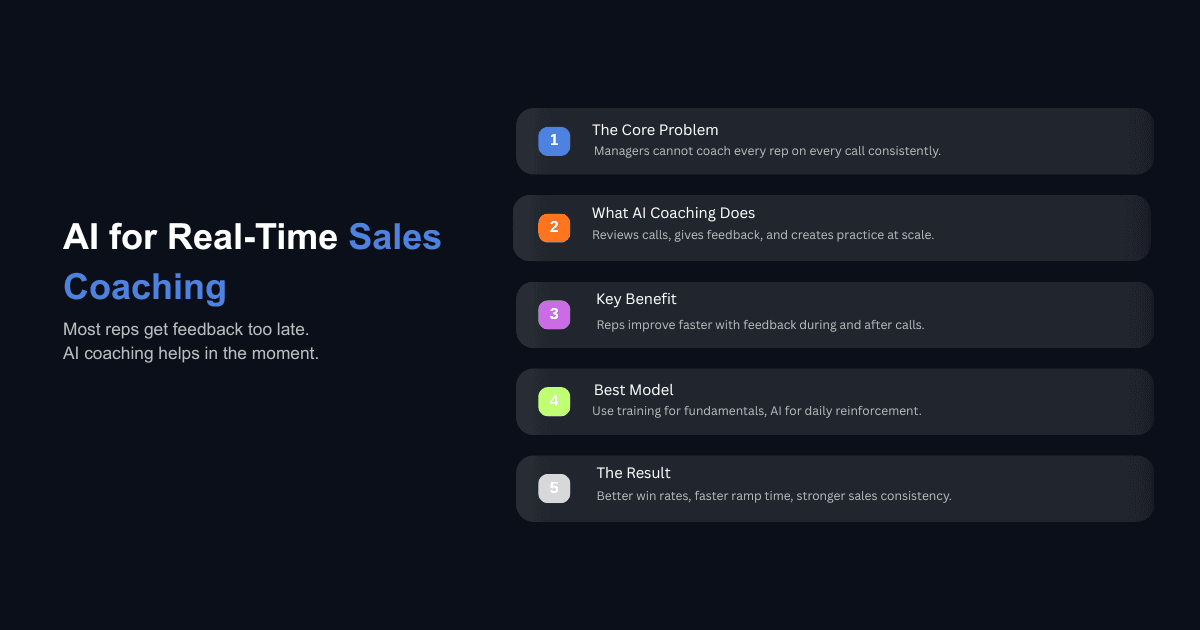
Most sales organizations agree that coaching is the single most reliable lever for improving rep performance. The data backs this up consistently. Companies with structured coaching programs see 28% higher win rates and significantly faster ramp times for new hires.
And yet, the actual coaching most reps receive is inconsistent, generic, or missing entirely. According to MySalesCoach's 2026 State of Sales Coaching report, 38% of reps say they rarely or never receive coaching, while 90% of leaders claim they coach monthly. That gap tells you everything. Leaders think the coaching is happening. Reps know it isn't.
AI doesn't fix bad coaching culture. But it does solve the math problem that makes consistent coaching nearly impossible at scale. This post breaks down what AI sales coaching actually looks like in practice, where it delivers measurable results, and how to implement it without creating another tool your team ignores.
Why Sales Coaching Falls Apart at Scale
The Manager Time Problem
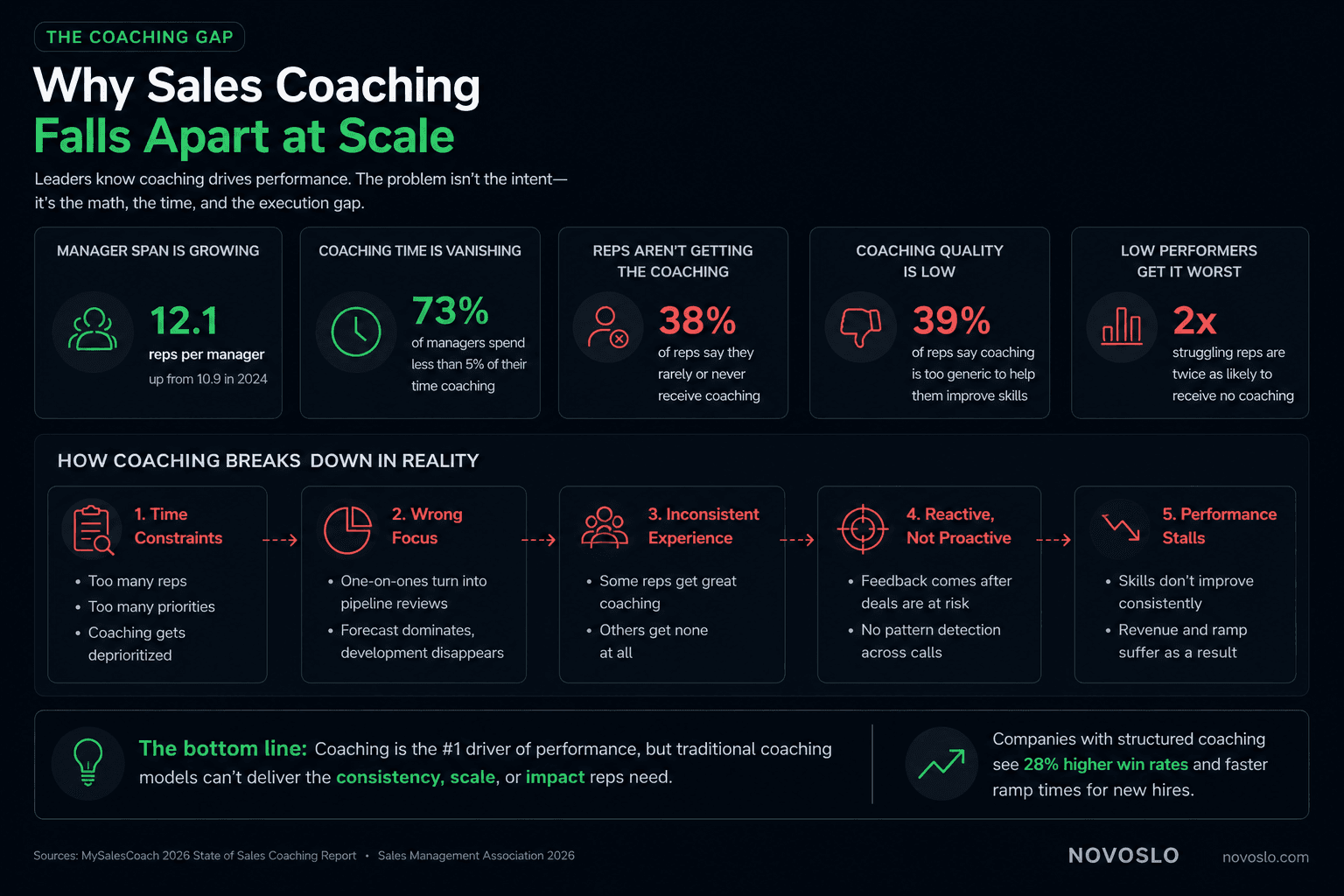
The average frontline sales manager now oversees 12.1 direct reports, up from 10.9 in 2024. That number keeps climbing because companies are trying to grow revenue without growing headcount, which means managers absorb more reps without gaining more hours.
When a manager is responsible for 12 people, the coaching math breaks immediately. Even if a manager dedicates 30 minutes per rep per week, that's six hours of pure coaching time before accounting for pipeline reviews, forecast calls, hiring, and escalations. In practice, 73% of sales managers spend less than 5% of their time on actual coaching. The rest gets consumed by deal inspection and reporting.
The result is predictable. One-on-ones become pipeline interrogations. Managers ask "where is this deal?" instead of "what happened in that call and how can you adjust?" The business gets its forecast update. The rep gets nothing they can use.
What Reps Actually Say About Coaching Quality
The MySalesCoach 2026 survey found that almost half of reps rate their coaching as below average. 39% say it's too generic to help them improve on specific skills. 50% want coaching focused on skill development, but what they actually receive is KPI reviews and pipeline interrogation disguised as development.
There's also a tenure problem. Organizations tend to reduce coaching investment as reps gain experience, assuming senior sellers don't need it. The data shows the opposite. Experienced reps handling complex, high-value deals are often the most neglected and the most vocal about wanting more support.
Low performers get it worst. Reps who are struggling are twice as likely to receive no coaching at all compared to their higher-performing peers, which means the people who need the most help are the ones least likely to get it.
What Does Real-Time AI Sales Coaching Actually Look Like?
The phrase "AI sales coaching" covers three distinct workflows, and understanding the difference matters because each one solves a different problem.
During the Call: Live Coaching
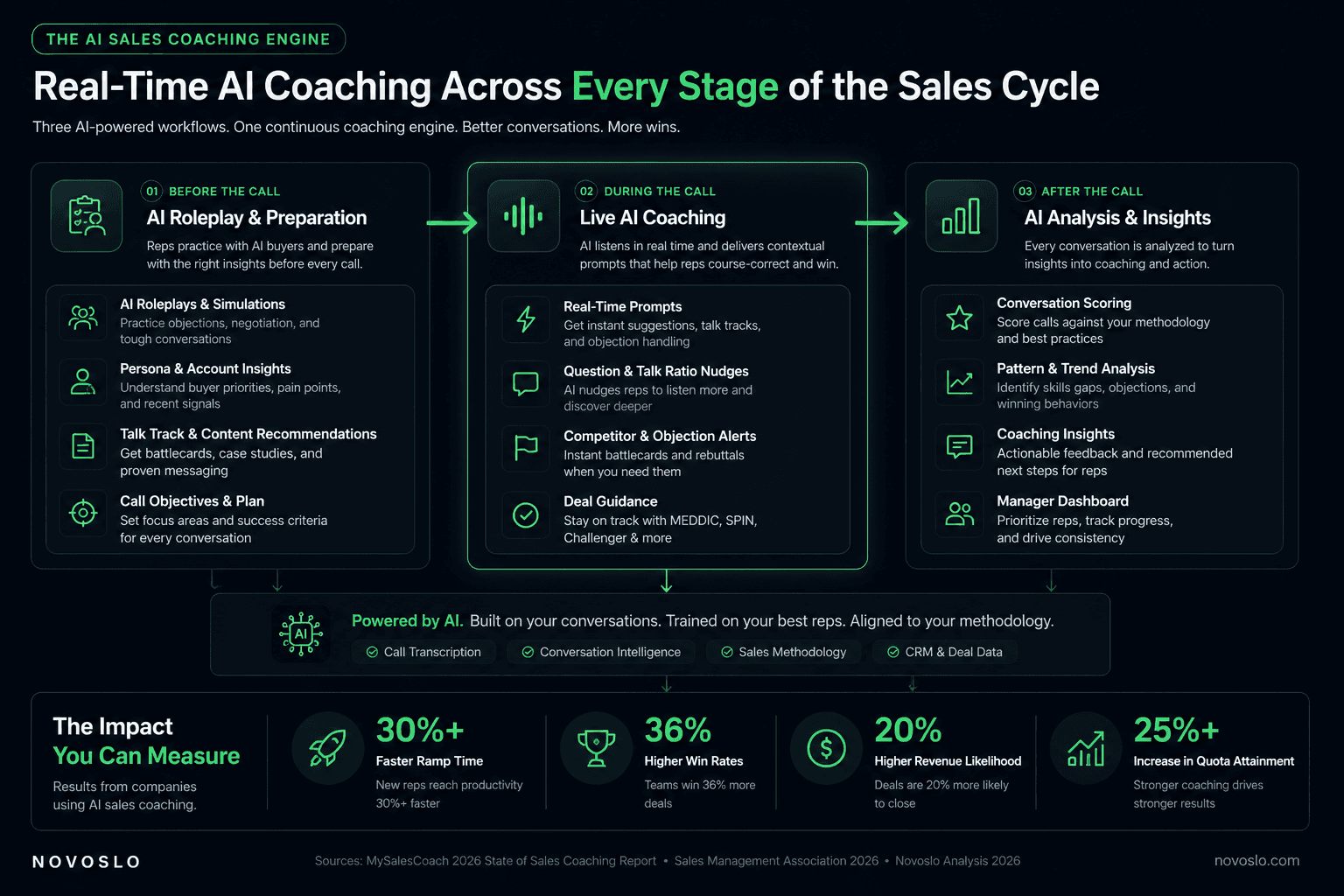
Live coaching tools listen to sales conversations in real time and surface contextual prompts directly to the rep's screen while the call is happening. When a prospect raises a pricing objection, the AI can surface a tested response framework. When a competitor gets mentioned, it pulls up the relevant battlecard. When the rep is talking too much, it nudges them to ask a question instead.
The rep sees this information on screen. The prospect doesn't know it's happening. The entire cycle from spoken word to coaching card takes less than one second on most platforms.
This is the type of AI coaching that most directly impacts deal outcomes, because it intervenes at the moment when the rep can still change what happens next. Post-call feedback tells you what went wrong. Live coaching helps you avoid the mistake before it costs you the deal.
After the Call: Post-Call Analysis and Scoring
Post-call analysis is where most teams start because it requires less behavioral change from reps. The AI records and transcribes every call, then scores it against your chosen sales methodology, whether that's MEDDIC, SPIN, Challenger, or something custom.
Managers can audit sales calls in seconds instead of spending hours listening to recordings. The AI identifies patterns across hundreds of calls that no human could spot manually, such as which objections are coming up most frequently, which talk tracks correlate with closed deals, and which reps consistently miss discovery questions.
You can also analyze sales calls using AI to extract objections, buying signals, and coaching insights from every conversation, then feed those insights directly into your coaching cadence.
Before the Call: AI Roleplay and Preparation
The third layer is pre-call preparation and practice. AI roleplay tools let reps simulate sales conversations against AI buyers that are modeled after real customer personas and common objection patterns. The rep practices handling a hostile CFO or a skeptical procurement lead before they ever face one on a live deal.
This solves a problem that traditional training has never been able to address well. 87% of training content is forgotten within a week if it isn't reinforced through practice. Classroom training and LMS modules teach knowledge, but they don't build the muscle memory that reps need in high-pressure selling moments. AI roleplay gives reps repetitions in realistic scenarios without requiring a manager's time or risking a live deal.
Where AI Coaching Delivers Measurable Results
Ramp Time, Win Rates, and Deal Velocity
The numbers from organizations that have adopted AI coaching are consistent enough to draw real conclusions.
Companies using AI-driven coaching have reported ramp time reductions of 30% or more for new reps, which translates directly to revenue. Every month a new rep spends below full productivity is a month of lost pipeline. Cutting ramp from eight months to four months, as one enterprise organization achieved using live call coaching, saves hundreds of thousands of dollars in lost productivity per rep.
Win rates also move. Highspot's research found that AI-guided sales coaching increased win rates by 36% shortly after implementation. A separate analysis showed that real-time AI deal coaching elevated win rates by approximately 19%, with qualified lead conversion improving from 45.5% to 64.1% when AI coaching and conversational analysis were embedded in the CRM workflow.
One enterprise client we worked with doubled their sales efficiency using AI-driven insights to engage leads at the right time with data-backed decisions, which matches the patterns we see across the industry when coaching moves from periodic to continuous.
B2B companies that incorporate AI coaching into their go-to-market operations are 20% more likely to see higher revenue outcomes compared to those that don't, according to Highspot's State of Sales Enablement Report.
Coaching Consistency Across the Entire Team
The less obvious but equally important benefit is consistency. In a traditional coaching model, the quality of coaching a rep receives depends entirely on which manager they report to, how busy that manager is, and whether that manager is actually a competent coach. Only 34% of sales leaders say they've ever received training on how to coach effectively. Most were promoted because they were good sellers, not because they knew how to develop other sellers.
AI coaching doesn't replace the manager. It creates a baseline of consistent feedback that every rep receives regardless of their manager's skill level or availability. The manager's role shifts from being the primary source of all coaching to being the person who interprets AI-generated insights and applies human judgment to the most complex situations.
This is the model that actually scales. The AI handles the volume (scoring every call, surfacing patterns, delivering real-time prompts), and the manager handles the depth (career development conversations, complex deal strategy, mindset and motivation).
How Should You Implement AI Sales Coaching Without Disrupting Your Team?
Start With One Workflow, Not the Whole Stack
The fastest way to kill an AI coaching initiative is to deploy five tools at once and expect reps to change their entire workflow overnight. We see this pattern constantly.
Pick one coaching workflow and build around it. For most teams, post-call analysis is the right starting point because it requires the least behavior change. Reps don't have to do anything differently on the call itself. The AI records, transcribes, and scores automatically. Managers get structured insights they can use in their next one-on-one instead of relying on memory or gut feel.
Once post-call analysis is embedded and producing useful insights, layer in pre-call roleplay for new hires during onboarding. Live coaching comes last because it requires the most trust from reps and the most tuning to be genuinely helpful rather than distracting.
If you want a structured approach to building AI into your sales operations, you can automate your sales workflow step by step instead of trying to overhaul everything at once.
Use AI to Inform Manager Coaching, Not Replace It
The companies that get the most value from AI coaching treat it as a coaching amplifier for managers, not a replacement. The AI surfaces what's happening across the team. The manager decides what to do about it.
For example, the AI might flag that a rep's discovery calls consistently run too short, averaging eight minutes when top performers average fourteen. That's useful data. But the manager is the one who sits with that rep and figures out why. Maybe the rep doesn't have enough questions prepared. Maybe they're rushing because they feel uncertain about the product. Maybe the prospects they're calling don't fit the ICP well enough.
AI tells you what's happening. Humans figure out why it's happening and what to do about it. Teams that skip the human layer end up with reps who feel surveilled rather than supported, and that's how coaching tools become shelfware.
What Separates Useful AI Coaching From Expensive Shelfware?
Integration With Your Existing CRM and Call Infrastructure
AI coaching tools that sit outside your existing workflow don't get used. If a rep has to log into a separate platform to see their coaching insights, most of them won't. The tools that deliver results are the ones that embed coaching directly into the systems reps already live in: their CRM, their dialer, their email client.
Before evaluating any AI coaching platform, map your current tech stack and identify where coaching insights would need to surface for reps to actually see them during their workday. If the tool can't integrate with your CRM and call recording infrastructure, the adoption problem will outweigh whatever coaching benefits the tool promises.
72% of sales leaders now prioritize platforms with deep CRM integrations and real-time analytics, which signals that the industry has already learned this lesson the hard way.
Feedback Loops That Change Behavior, Not Just Report on It
Many AI coaching tools are excellent at generating reports and dashboards. Fewer are good at actually changing rep behavior, which is the entire point.
The distinction matters. A tool that tells a manager "this rep has a 72% talk ratio" is reporting. A tool that nudges the rep during a live call to pause and ask a question when their talk ratio is climbing is coaching. A tool that assigns a targeted roleplay exercise based on the specific objection the rep fumbled on yesterday's call is development.
Look for tools that close the loop between insight and action. The best implementations connect post-call analysis directly to pre-call practice, so each rep's practice sessions are personalized based on their actual performance gaps rather than a generic training curriculum.
164% more companies are using AI in their sales training programs compared to the previous year. The adoption curve is steep because the results are real. But the difference between the companies seeing returns and the ones adding another unused tool to their stack almost always comes down to whether the tool changes daily behavior or just produces weekly reports.
Conclusion
The core shift in sales coaching is from reactive to proactive. Traditional coaching reviews what already happened, often days after the moment passed. AI coaching intervenes during the call, personalizes practice before the call, and gives managers structured data to coach with precision instead of guesswork.
This matters because the coaching gap is widening, not shrinking. Manager spans are growing. Rep expectations are rising. The organizations that build AI coaching into their operational infrastructure now will develop a compounding advantage in rep performance, ramp speed, and win rates.
If you're not sure where AI coaching fits into your current sales operations, start by understanding where the gaps are. You can identify AI opportunities across your business and get recommendations specific to your team's setup, workflow, and goals.