Article
Apr 10, 2026
Claude Projects Use Cases for Marketing
Explore Claude Projects use cases for marketing from content and email to sales copy. See how teams use it in 2026.
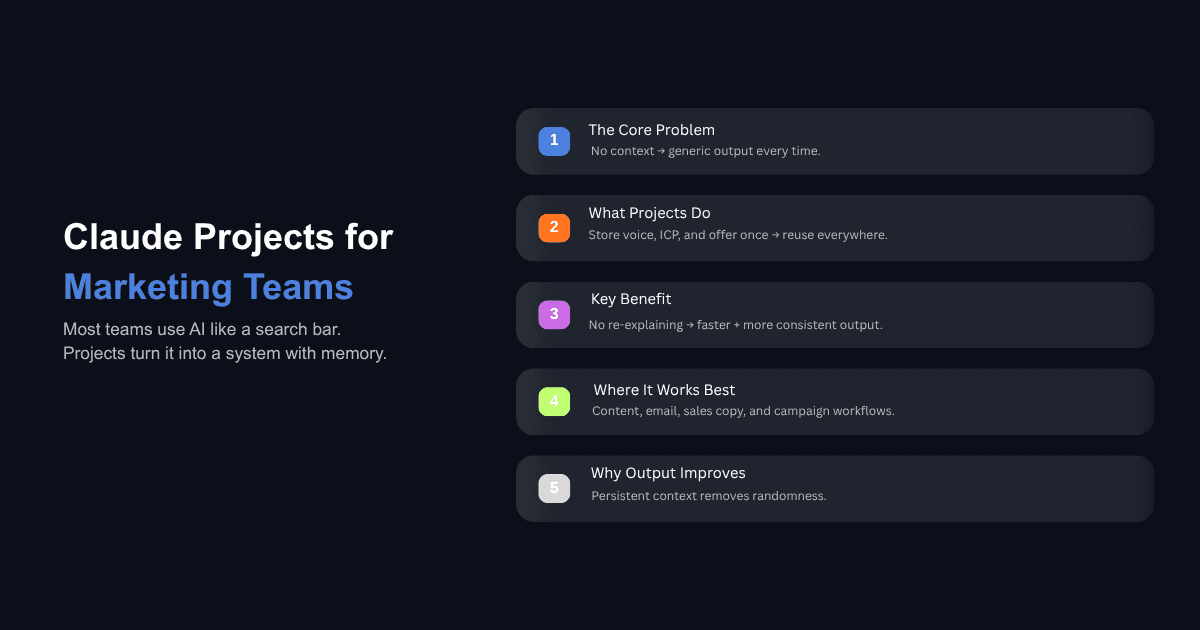
Most marketing teams using Claude are still treating it like a search bar with better grammar. They open a new chat, paste in a prompt, get a response, and start over the next day with zero context. The output is fine. It's also generic, because Claude has no idea who you are, what you sell, or how your brand sounds.
Claude Projects changes that. It gives you a persistent workspace where your brand guidelines, audience personas, tone documentation, and past content examples carry across every conversation you start inside it. Instead of re-explaining your business every session, you set the context once and Claude references it automatically going forward.
This post walks through the specific marketing use cases where Projects makes the biggest difference — content production, email marketing, sales copy, and campaign workflows — along with how to set one up so the output is actually usable.
What Are Claude Projects and Why Do They Matter for Marketing?
Claude Projects are persistent workspaces inside Claude where you upload documents and set custom instructions that apply to every conversation you start within that project. For marketing teams, that means you upload your brand guide, your audience research, your tone-of-voice document, and your best-performing content examples once, and Claude references all of it automatically every time you open a new conversation in that project.
This matters because the number one complaint marketers have about AI writing tools is that the output sounds generic. It sounds generic because the model has no context about your business. Projects fix that by giving Claude the information it needs to produce output that matches your positioning, your audience, and your voice from the first prompt.
How Projects Eliminate the Cold Start Problem
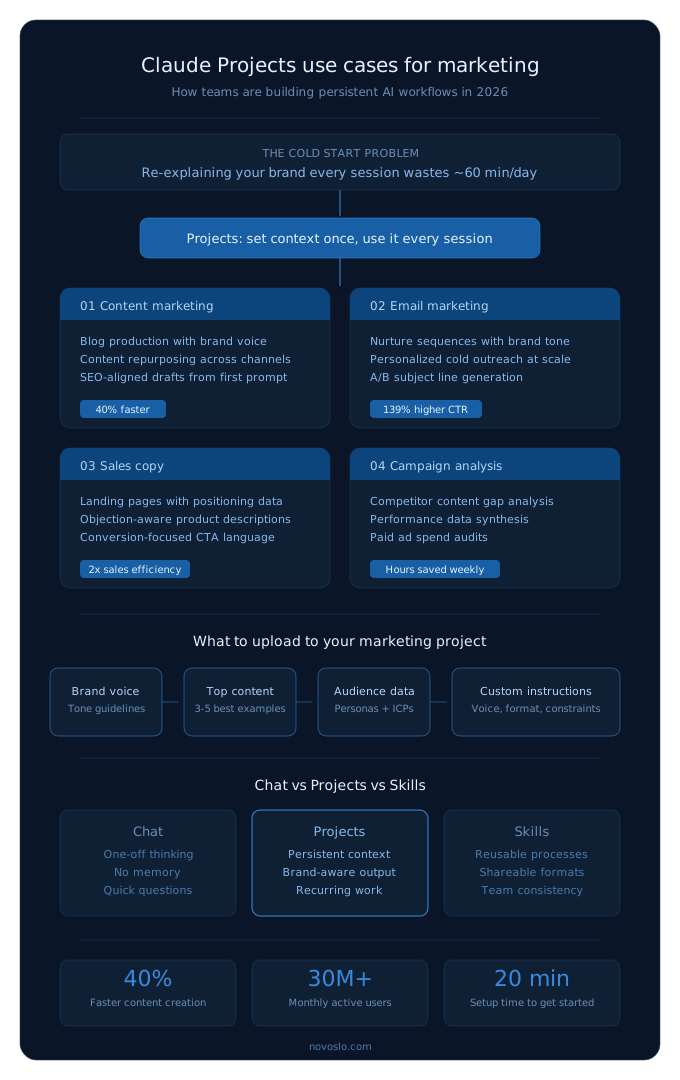
Every time you start a fresh Claude conversation, you're paying what you might call a context tax. You re-explain your brand, your audience, your tone, your goals. That takes five to ten minutes per session. If you're using Claude ten times a day across your marketing tasks, you're losing close to an hour just setting the stage before you get any real work done.
Projects eliminate that entirely. Teams using Projects report roughly 40% faster content production compared to standard chat, and most of that gain comes from removing the repetitive context-setting that slows down every session.
The compounding benefit is consistency. When every conversation inside a project draws from the same brand documentation, the output stays aligned across blog posts, emails, social content, and ad copy — regardless of which team member is prompting.
The Difference Between Chat, Projects, and Skills
These three features serve different purposes, and understanding the distinction early prevents misuse.
Chat is for thinking. Quick questions, brainstorming, one-off analysis. No persistent context, no memory between sessions.
Projects are for working. Persistent context, uploaded documents, custom instructions that carry across every conversation. This is where your recurring marketing work should happen.
Skills are for standardizing. A Skill is a reusable instruction set — stored as a markdown file — that you can invoke in any conversation. If you want to learn more about how Skills work alongside Projects, we have a full breakdown on what Claude Skills are and how they work.
The practical rule: use Chat for thinking, Projects for ongoing marketing work, and Skills for encoding your specific processes so they execute the same way every time, across every team member.
Claude Projects Use Cases for Content Marketing
Content marketing is the most common and highest-impact use case for Projects because content production is inherently repetitive. You write blog posts, social updates, landing page copy, and newsletter content on a recurring cadence, and all of it needs to sound like your brand. Projects makes that possible without re-prompting every session.
Blog Production With Brand Voice Consistency
The standard approach to using AI for blog content — pasting a prompt into a blank chat — produces output that sounds like every other AI-generated article on the internet. Claude Projects solves this by giving the model access to your brand voice documentation, your best-performing posts, and your editorial guidelines before you even type your first prompt.
A well-configured content project includes your tone-of-voice document, three to five examples of content that performed well (with notes on why they worked), your target audience personas, and your SEO guidelines. When you start a conversation inside that project and ask Claude to draft a blog post on a specific topic, the output already reflects your positioning and voice instead of defaulting to generic AI copy.
Claude handles reasoning, synthesis, and long-context understanding particularly well, which makes it effective at tasks like analyzing competitor content, identifying gaps in existing coverage, and producing structured drafts that require pulling from multiple source documents simultaneously.
Content Repurposing Across Channels
One of the highest-value applications of a content Project is repurposing. You produce a long-form blog post or a podcast transcript, and then you need LinkedIn posts, email content, Twitter threads, and newsletter sections that all carry the same core message but adapted for each platform.
Without a Project, you'd re-explain your brand voice and platform preferences every time. With a Project, Claude already knows your tone for LinkedIn versus email versus social, because you've uploaded your platform-specific guidelines as project knowledge. You feed in the original content and ask Claude to produce derivatives. The output is consistent because the context is persistent.
This is also where the line between Projects and Skills becomes useful. Your Project holds the brand context. A Skill can encode the specific process for how you repurpose — the structure, the length, the CTA style for each platform. When you combine both, you get a repeatable content production system that runs the same way regardless of who on your team is using it.
How Do Claude Projects Work for Email Marketing?
Email is one of the best use cases for Projects because email marketing is highly repetitive and format-driven. Welcome sequences follow a predictable structure. Subject lines need a consistent tone. Follow-up emails have specific timing logic. Cold outreach requires personalization at scale without losing your brand voice. All of these benefit from persistent context.
Building Email Sequences With Persistent Brand Context
A dedicated email marketing Project contains your brand voice documentation, your email copywriting frameworks, your audience segmentation data, and examples of your highest-performing campaigns. When you ask Claude to draft a five-part nurture sequence or a re-engagement campaign, it draws from all of that context automatically.
The difference between a Project-backed email draft and a cold-chat email draft is significant. With the right context loaded, Claude produces subject lines that match your established tone, body copy that references the right pain points for each segment, and CTAs that align with your conversion strategy. Without that context, you get competent but generic copy that could belong to any company in your industry.
For a deeper look at how to build reusable email workflows inside Claude, including the specific Skill structures for different campaign types, see our guide on Claude Skills for email marketing.
Personalizing Cold Outreach at Scale
Cold outreach is where Projects become especially useful because the challenge is producing personalized messaging at volume without every email reading like a template. A Project configured with your ICP data, your value proposition, and your outreach tone allows Claude to generate tailored first lines and body copy that reference each prospect's specific situation.
One enterprise client doubled their sales efficiency by using AI-driven insights to engage leads at the right time with data-backed decisions. The key was that the AI had enough context about the business and its audience to produce outreach that felt specific rather than mass-produced.
Personalized email campaigns generate substantially higher click rates than non-personalized ones, which makes the upfront investment in configuring a proper Project — with real customer data and positioning documents — worth the setup time.
Claude Projects Use Cases for Sales Copy and Landing Pages
Sales copy requires more precision than general content marketing because the stakes per piece are higher. A landing page, a product description, or a sales email has a direct line to revenue. Getting the positioning, the objection handling, and the CTA language right matters more than it does for a blog post.
Setting Up a Sales Copy Project
A sales copy Project should contain your product positioning document, your competitive differentiation notes, customer testimonials and objection data, and examples of your best-performing sales pages or emails. The custom instructions should specify your copywriting framework — whether that's problem-agitation-solution, before-after-bridge, or something specific to your business.
When you start a conversation inside that Project, Claude already knows what you sell, who you sell it to, what objections they raise, and how your existing copy handles those objections. That means the first draft is already aligned with your positioning instead of starting from a blank slate.
Connecting Sales Copy to Your Broader Marketing System
If your team uses Claude for both content marketing and sales copy, those should be separate Projects with distinct instructions and knowledge bases. A content Project optimizes for SEO, readability, and thought leadership. A sales copy Project optimizes for conversion, urgency, and objection handling. Mixing them into one mega-Project produces confused output because the goals are different.
For a step-by-step walkthrough of building a dedicated sales copy workspace, including the exact custom instructions and files to upload, we published a full guide on how to set up a Claude Project for writing sales copy.
Can Claude Projects Replace Your Marketing Tools?
This is a question we hear frequently, and the answer requires some nuance. Projects are not a replacement for your marketing stack. They are a layer that sits on top of it and makes certain parts of your workflow faster.
What Projects Can and Cannot Do
Projects handle the thinking and writing parts of marketing well: drafting content, generating email copy, building outlines, analyzing competitor positioning, repurposing content across formats. These are tasks that are time-consuming, repetitive, and context-dependent, which is exactly what Projects are designed for.
Projects do not handle execution. They do not send emails, publish blog posts, schedule social media, manage ad budgets, or track analytics. Your ESP, your CMS, your ad platforms, and your analytics tools still handle those functions. Claude's role is to produce the content and analysis that feeds into those tools.
Where things get interesting is when you connect Claude to your existing tools through integrations. Claude can pull data from Google Drive, Slack, and other platforms through connectors, which means your Projects can reference real campaign data and internal documents alongside your brand guidelines. That combination — persistent context plus live data access — is where the productivity gains compound.
For teams running paid campaigns, Claude Skills for paid ads covers how to build reusable analysis workflows that audit spend, diagnose CPA issues, and generate optimization recommendations using your actual campaign data.
Where Human Oversight Still Matters
Claude produces drafts. Humans make decisions. That separation is important, and teams that blur it tend to publish content that sounds competent but lacks the specificity and judgment that comes from understanding your market firsthand.
Strategy, positioning, final editorial judgment, compliance review, and anything involving sensitive customer data — these remain human responsibilities. Claude accelerates the production layer so your team can spend more time on the strategic work that actually differentiates your brand.
The broader point is that Claude Cowork and related features for business AI transformation are designed to amplify what your team already knows, not to operate independently. The teams getting the most value treat Claude as a well-informed junior team member who needs direction, not as an autonomous marketing department.
How to Set Up Your First Marketing Project in Claude
Setting up a Project takes about twenty minutes if you already have your brand documentation organized. If you don't, the setup process itself is a useful forcing function because it requires you to articulate your brand voice, audience, and positioning clearly enough for an AI to act on them.
Custom Instructions That Produce Usable Output
The difference between a Project that produces publishable output and one that produces generic copy comes down to the custom instructions. Vague instructions like "write good marketing content in our brand voice" give Claude nothing to work with. It defaults to safe, forgettable output.
Effective custom instructions are specific about voice, constraints, formats, audience context, and what to avoid. They include concrete examples of good and bad output so Claude can calibrate. They specify the decision-making framework Claude should follow when generating content, including your preferred copywriting structures, formatting rules, and topics that are off-limits.
A practical approach: instead of writing custom instructions from scratch, start a conversation with Claude outside the project and ask it to interview you about your brand, your audience, and your content standards. Then use that conversation to draft the instructions. The output from a structured interview tends to be more thorough than what most people write starting cold.
What to Upload as Project Knowledge
The documents you upload become the reference material Claude draws from in every conversation. For a marketing Project, the highest-impact uploads are your brand voice and tone guidelines, three to five annotated examples of your best content with notes on why each performed well, your target audience personas with specific pain points and language patterns, your competitive positioning document, and any style guides or editorial standards your team follows.
The key word is annotated. Uploading raw documents helps, but adding notes that explain why specific examples worked — which hook landed, what made the CTA effective, why a particular angle resonated with your audience — teaches Claude your taste and judgment, not just your format.
Start with one Project for your highest-volume marketing task. Get comfortable with how it works, refine your custom instructions based on the output quality you see, and then expand to additional Projects for other marketing functions once you've validated the approach.
Moving From Setup to System
Claude Projects is not a feature you try once to see if AI can write a decent blog post. It's a workspace you configure once and use daily as the foundation for how your marketing team produces content, writes emails, builds sales copy, and analyzes campaigns.
The teams getting the most out of it share a few traits: they invested twenty to thirty minutes in proper setup, they uploaded real brand documentation instead of generic placeholders, and they treat the output as a first draft that gets refined rather than a finished product.
If your marketing operation is spending hours each week on repetitive writing tasks that follow predictable patterns, a well-configured Project will compress that time significantly. The setup cost is low and the productivity gain compounds with every session.
If you want help figuring out where Claude Projects fits into your specific marketing workflow — or how to build a broader AI system around your operations —book a call with our team and we'll walk through it together.