Article
Feb 9, 2026
AI Use Cases in Private Equity: Where Firms Are Actually Creating Value
Explore top AI use cases reshaping private equity, from deal sourcing and due diligence to portfolio management and exits in 2026.
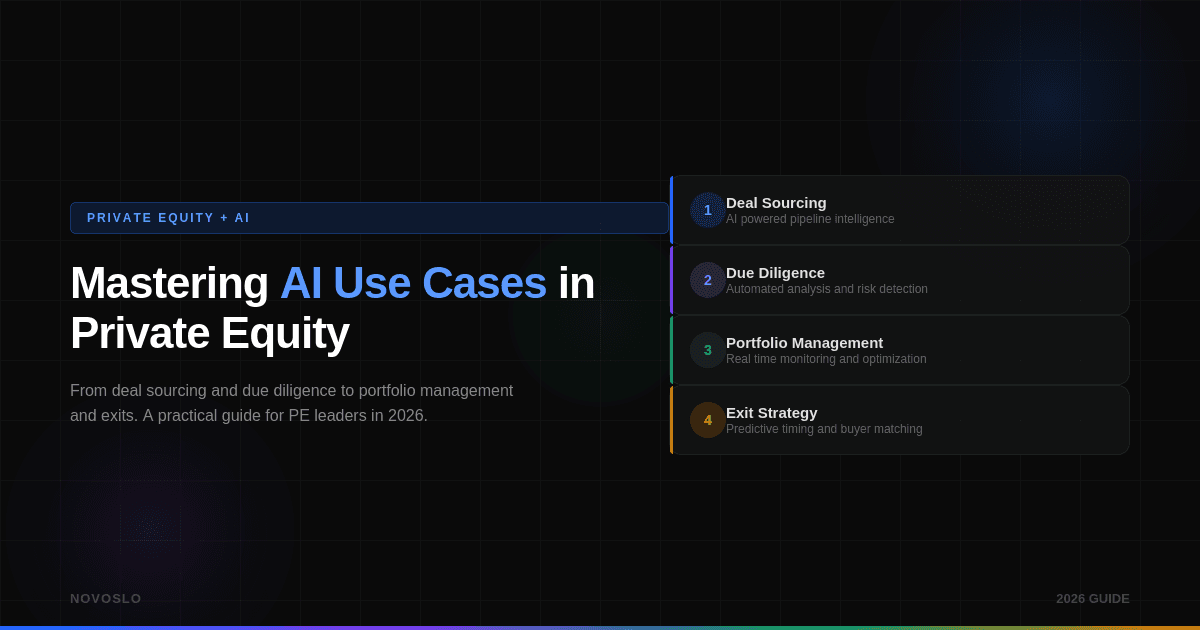
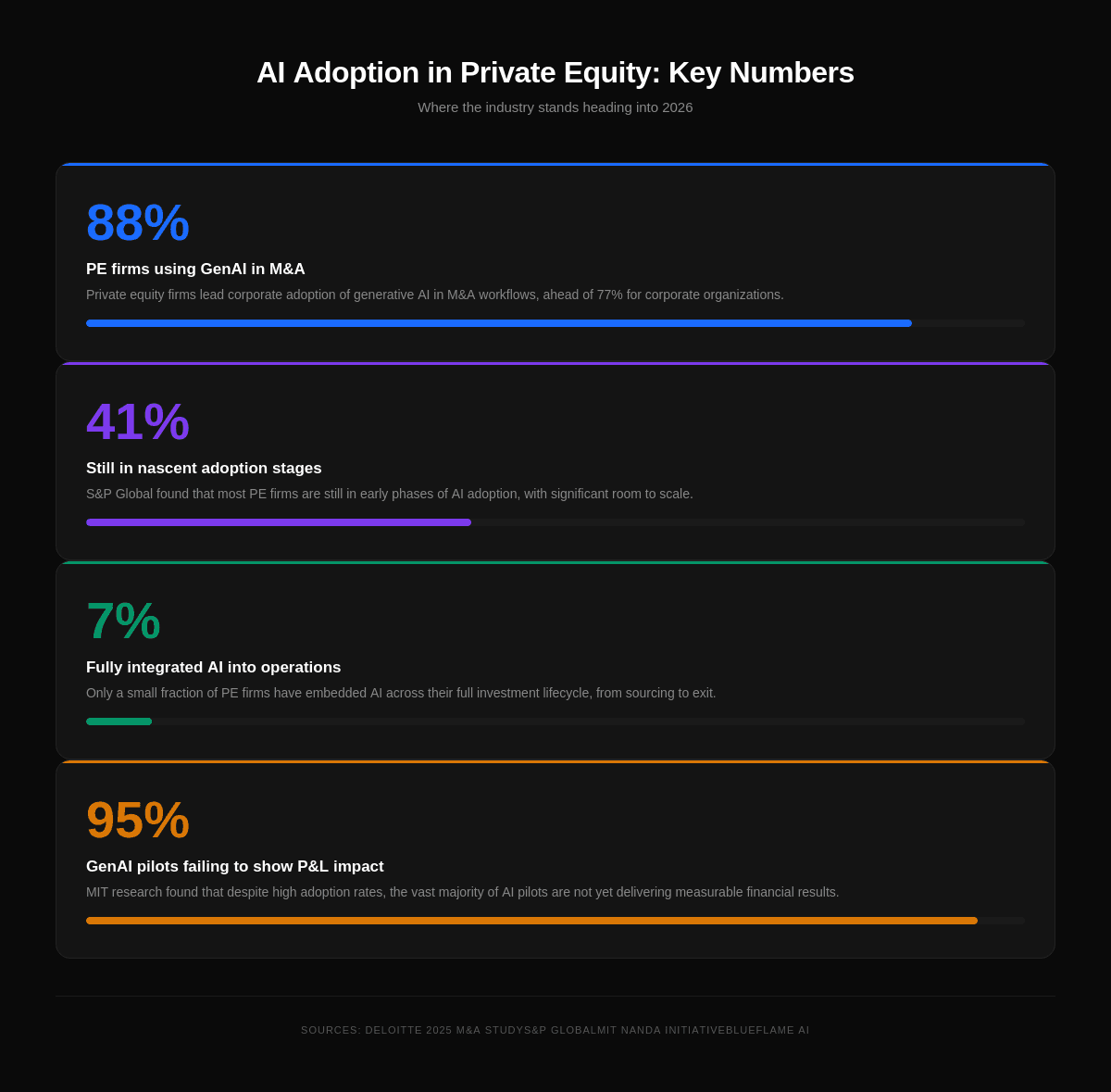
Private equity firms have spent the last few years talking about AI. The tools are available, the budgets are growing, and the use cases are well documented. According to Deloitte's 2025 M&A Generative AI Study, 86% of organizations have now integrated generative AI into their M&A workflows, and PE firms lead adoption at 88% compared to 77% of corporate organizations. Yet results remain uneven. A recent MIT study found that 95% of generative AI pilots at companies are failing to produce measurable P&L impact. As we move into 2026, the gap between adoption and results is where most of the opportunity sits.
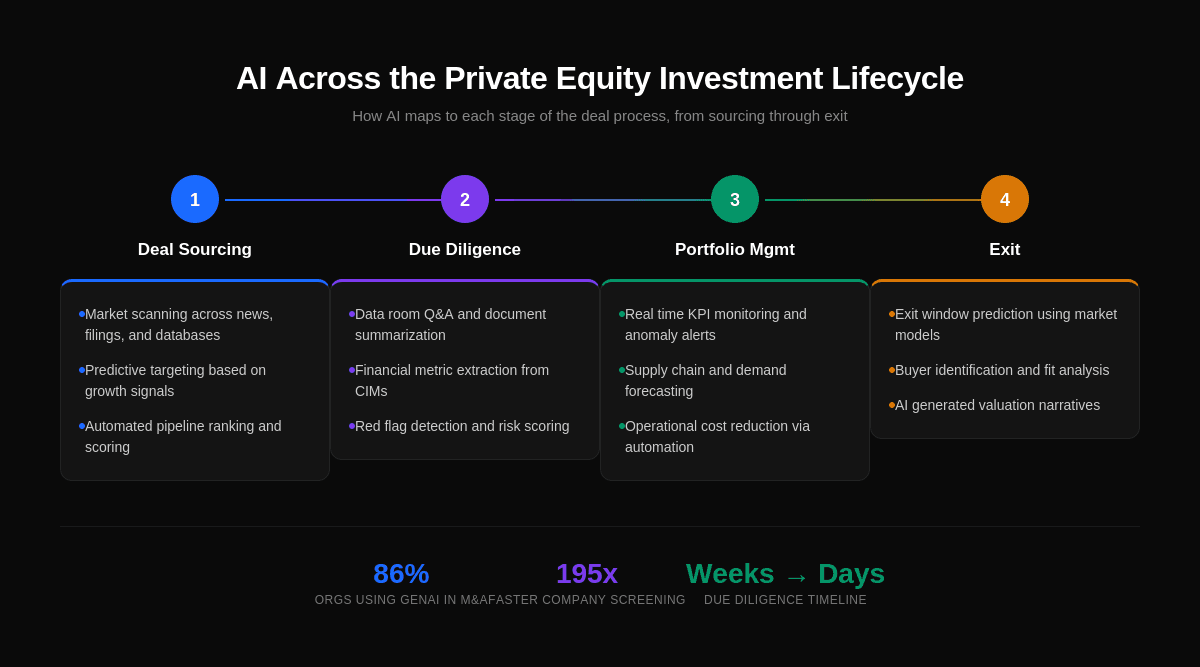
This article walks through the primary AI use cases across the PE investment lifecycle, from deal sourcing through exit, with attention to what is working in practice and where firms continue to struggle. The goal is to give operations leaders, GPs, and portfolio company executives a clear view of where AI creates value today and where it is heading next.
Understanding AI in Private Equity
What Does AI Actually Do in PE?
AI in private equity refers to a set of technologies including machine learning, natural language processing, and predictive analytics that process large volumes of structured and unstructured data to support investment decisions. In practice, this means scanning financial documents, analyzing market signals, summarizing data rooms, forecasting portfolio performance, and identifying patterns across thousands of companies simultaneously. The technology does not replace investment judgment, but it compresses research timelines and surfaces information that would otherwise take analysts days or weeks to compile. For firms unfamiliar with the broader landscape, understanding what AI transformation actually means is a useful starting point before evaluating specific use cases.
Why It Matters Now More Than Before
According to EY's analysis of AI in PE, AI is establishing itself as a third pillar of value creation alongside financial engineering and operational excellence. The shift is driven by several factors converging at once: LP pressure for more efficient capital allocation, a backlog of over 4,000 U.S. portfolio companies aged five or more years waiting to exit, and a data environment that has become too large and complex for manual analysis to handle effectively. S&P Global found that 41% of PE firms are still in nascent adoption stages, while only 7% have fully integrated AI into their operations. Heading into 2026, the competitive window for early movers remains open, but it is narrowing as more firms move from pilot programs to production deployments.
How Are PE Firms Using AI for Deal Sourcing?
Deal Sourcing and Pipeline Intelligence
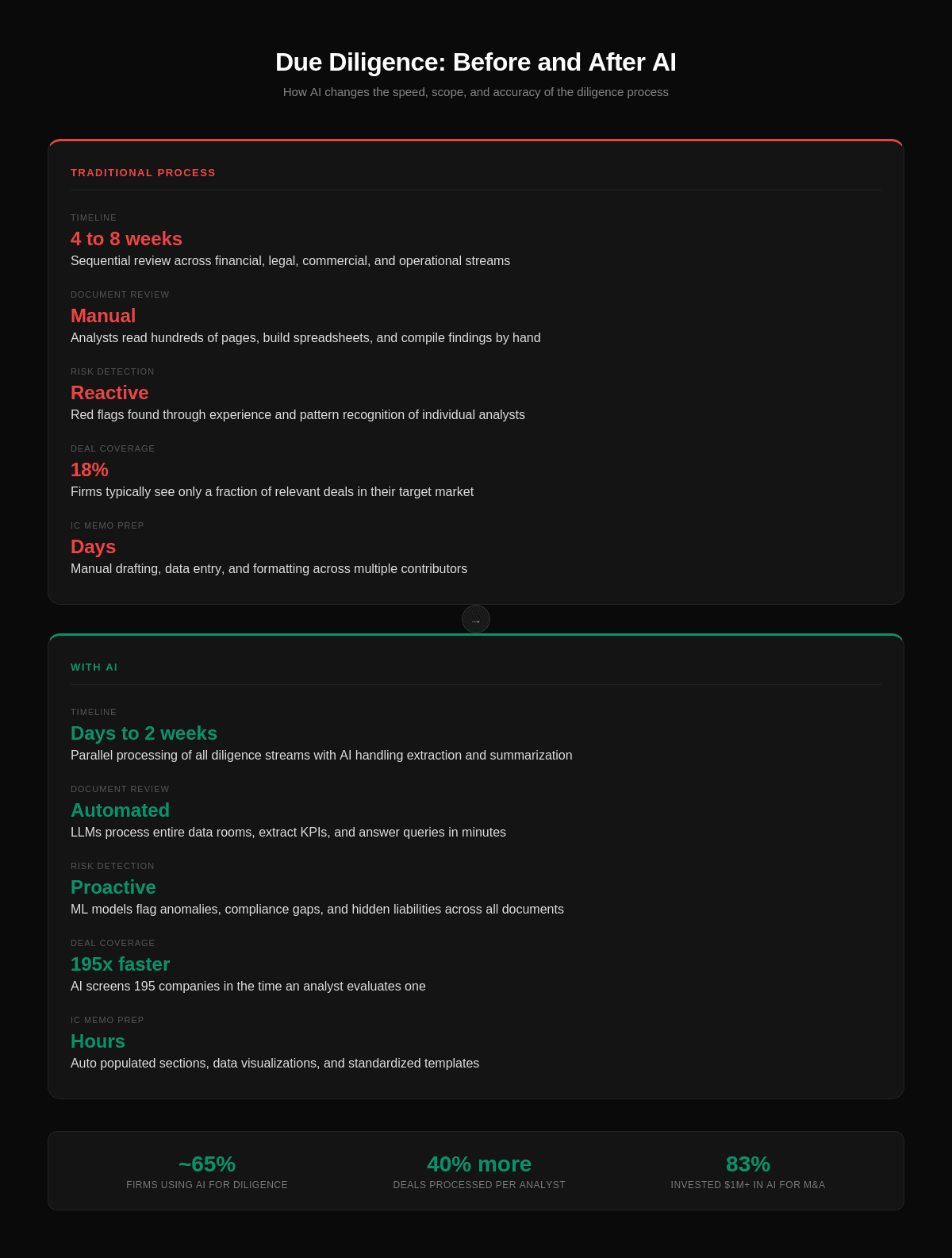
Deal sourcing is one of the most mature AI applications in private equity. AI platforms scan financial news, company filings, third party databases, and market signals to identify potential acquisition targets that match a firm's investment thesis. The volume advantage is significant: World Economic Forum research notes that AI can identify 195 relevant companies in the time it takes a junior analyst to evaluate a single one. Firms like EQT have built proprietary platforms such as Motherbrain, which consolidates over 140,000 data points for real time M&A insights. Traditional deal origination depends heavily on personal networks and proprietary channels, a process constrained by human bandwidth and often resulting in firms seeing only a fraction of the relevant deals in their market. AI based sourcing tools expand that coverage substantially while learning from outcomes to refine targeting over time.
Predictive Analytics for Targeting
Predictive analytics adds another layer by ranking potential targets based on historical performance patterns, sector growth rates, leadership quality signals, and macroeconomic indicators. These models process financial statements alongside alternative data sources such as job postings, patent filings, and customer sentiment to identify companies showing growth potential or strategic alignment. The practical effect is that deal teams can evaluate a larger volume of opportunities with greater precision, reducing the risk of missing strong candidates and improving the quality of the pipeline before any human review takes place.
What Does AI Powered Due Diligence Look Like?
Automated Document and Data Room Analysis
Due diligence is arguably the area where AI delivers the most immediate and measurable returns. According to Blueflame AI's adoption analysis, nearly two thirds of firms already apply AI to due diligence and data analysis, and smart teams are cutting deal evaluation timelines from weeks to days through automated financial modeling and preliminary screening. Large language models can now run Q&A sessions across entire virtual data rooms, extracting key performance indicators, churn metrics, and cohort data from hundreds of documents in minutes rather than the days or weeks an analyst would require.
The technology handles several specific tasks well: extracting financial metrics from CIMs and 10 Q reports, standardizing data points across multiple sources for consistent comparison, summarizing lengthy legal documents to surface key terms, and populating standardized sections of investment committee memos. For a deeper look at how this works in practice, Novoslo's guide on AI in private equity due diligence covers the tools, workflows, and implementation steps that PE teams are using today.
Risk Assessment and Red Flag Detection
AI systems excel at identifying risks that manual review processes frequently miss. Machine learning models trained on historical deal data can flag compliance issues, reputational risks, unusual financial patterns, and hidden liabilities by cross referencing information across contracts, regulatory filings, and market data. A PE firm in Singapore, for example, used AI to analyze the codebase of a SaaS acquisition target and uncovered significant technical debt and security vulnerabilities that traditional due diligence would have overlooked. The consistent theme across firms adopting these tools is not that AI replaces the diligence team, but that it handles the volume and pattern recognition work that allows analysts to focus on interpretation and judgment.
AI Driven Portfolio Management
Real Time Performance Monitoring
Once an investment is made, AI supports ongoing portfolio management through real time performance tracking and anomaly detection. Rather than relying on quarterly reviews and manual spreadsheet analysis, AI platforms can continuously monitor financial KPIs, supply chain disruptions, customer sentiment, and operational metrics across portfolio companies. Bain's 2025 Global PE Report found that nearly 20% of portfolio companies have already operationalized generative AI use cases and are seeing concrete results. Ardian, for instance, uses its own AI based tool that creates individualized LP status reports, automatically answers questions about portfolio development, and improves the consistency of investor communication.
Operational Efficiency Across Portfolio Companies
Firms like Blackstone and KKR have started embedding data science teams directly into portfolio companies to drive operational improvements through AI. These initiatives target supply chain optimization, demand forecasting, customer churn prediction, and cost reduction through workflow automation. Vista Equity Partners reports that its portfolio companies using AI based code generation tools are seeing up to 30% increases in coding productivity, while 80% of Vista's majority owned companies are deploying generative AI tools internally or developing new AI powered products.
One enterprise client doubled their sales efficiency by using AI to identify the right moment to engage leads, the kind of operational improvement that translates directly into portfolio company EBITDA. These are not theoretical gains. They are measurable outcomes that GPs can point to when communicating value creation to LPs.
Can AI Improve Exit Strategies?
Timing the Market with Predictive Models
Exit timing has traditionally depended on a combination of quarterly performance reviews, market condition analysis, and the judgment of experienced deal teams. AI changes this by analyzing historical transaction data, market trends, economic indicators, and geopolitical signals simultaneously to predict optimal exit windows. Machine learning models can simulate various exit scenarios and forecast how different market conditions would affect valuations, giving deal teams a data driven basis for timing decisions rather than relying primarily on intuition. In a higher interest rate environment where multiple expansion has become less reliable, the ability to time exits with greater precision becomes increasingly valuable.
Identifying and Attracting Buyers
AI also supports the buyer identification process by analyzing strategic fit, acquisition history, and capacity signals across potential acquirers. The technology can match portfolio companies with likely buyers based on their previous deal patterns, sector focus, and publicly available growth strategies. Additionally, AI generated insights included in the sale process, such as detailed performance analytics and market positioning data, are increasingly seen as value added assets that make investments more attractive to prospective buyers and support stronger valuation narratives.
What Are the Real Risks of Implementing AI in PE?
Data Privacy and Regulatory Exposure
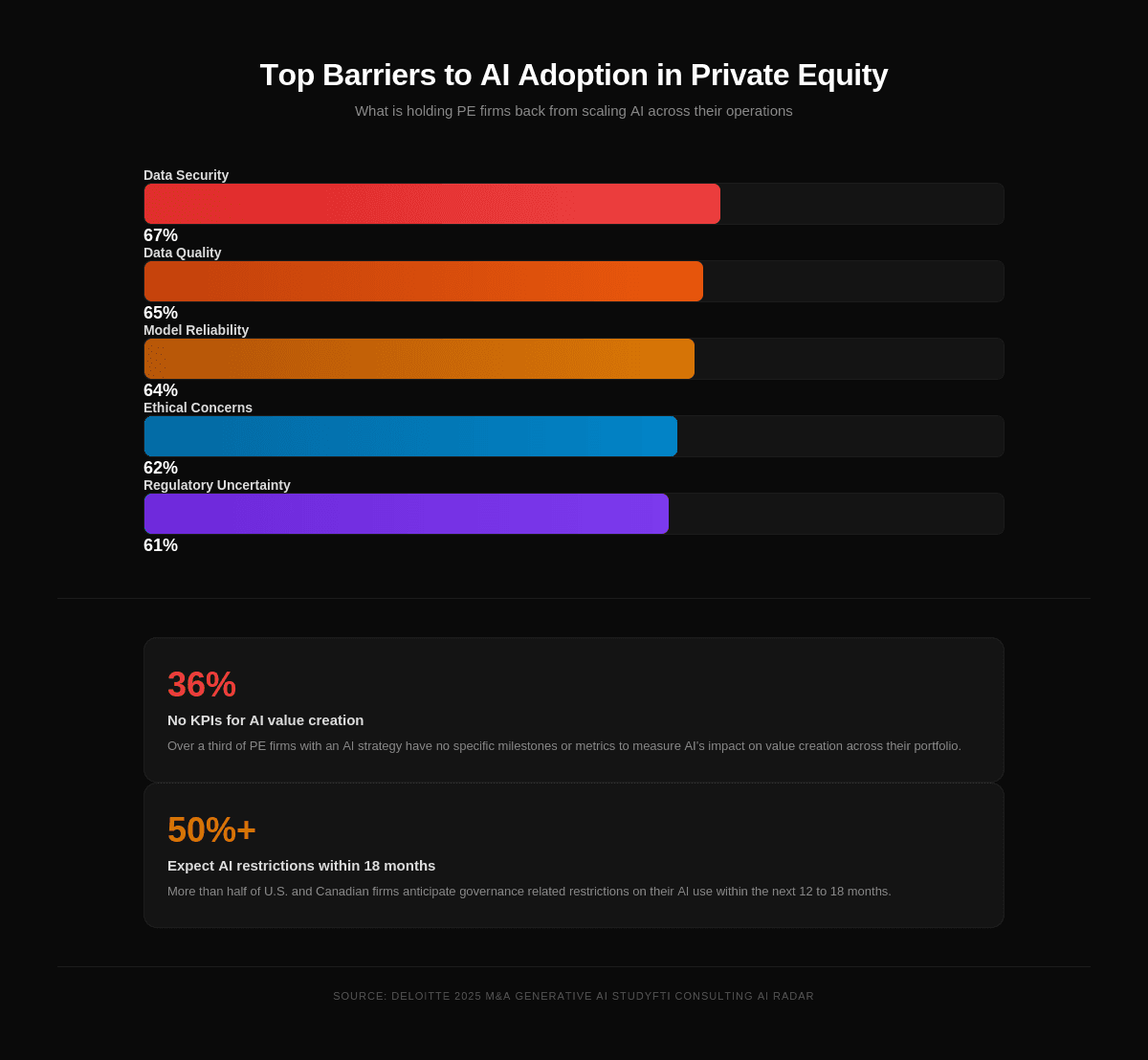
The barriers to AI adoption in PE are practical rather than theoretical. Deloitte's survey found that data security is the primary concern for 67% of respondents, followed closely by data quality concerns at 65% and model reliability at 64%. PE firms handle sensitive financial information, proprietary deal data, and confidential company records, all of which require careful governance when processed through AI systems. More than half of U.S. and Canadian firms expect restrictions on their AI use within the next 12 to 18 months due to governance concerns. Firms that build strong data governance frameworks now will be better positioned than those forced to retrofit compliance later. Understanding the hidden costs behind AI implementation is equally important, since many projects fail not because the technology underperforms but because the total cost of deployment was underestimated from the start.
The Skill Gap Problem
The talent challenge is real but often misunderstood. According to Harvard Business Review, firms are finding more success hiring operating partners who understand both business operations and AI implementation rather than investing heavily in data scientists who are difficult to retain. The practical approach for most PE firms is to combine internal expertise with external consultants and full stack engineers who can deploy specific use cases without requiring a permanent team of AI researchers. FTI Consulting's AI Radar survey found that 36% of PE firms with an AI strategy currently have no specific milestones or KPIs for measuring AI's impact on value creation, which suggests that the measurement and accountability gap is as significant as the skills gap itself. Firms looking for a structured approach to closing this gap can benefit from a workflow first implementation framework that ties AI initiatives directly to measurable business outcomes.
Where Is AI in Private Equity Headed Next?
Agentic AI and Continuous Monitoring
The next major shift in PE is the move from point in time AI applications to continuous, agentic systems. Rather than using AI only during discrete phases like sourcing or diligence, firms are building always on intelligence that monitors portfolio companies, market conditions, and competitive dynamics in real time. Agentic AI systems can autonomously execute multi step workflows, alert deal teams to shifts in KPIs or market conditions, and support investment committee processes with continuously updated data. Apollo Global Management has established a Center of Excellence that appraises AI vendors, evaluates use case ROI, and runs regular workshops with portfolio company management teams. The distinction between AI agents and AI tools matters here, since agents that can operate autonomously within defined parameters offer a different value proposition than standalone tools that require manual prompting for each task.
The Convergence of AI, Blockchain, and Infrastructure
PE firms are increasingly investing not just in AI software but in the physical infrastructure that powers it. BlackRock, Global Infrastructure Partners, and Microsoft launched a partnership to invest up to $100 billion in AI data centers, while Brookfield announced a $9.9 billion data center project in Sweden. Blockchain technology is entering the picture as a solution for data provenance, transparency, and secure transaction management in AI driven workflows. The convergence of these technologies points toward an investment environment where AI is embedded across the entire value chain, from sourcing through exit, supported by infrastructure that PE firms themselves are financing. Vista Equity Partners expects that AI's impact on software company performance will eventually rewrite the industry standard Rule of 40, pushing the benchmark for revenue growth plus margin to 50% or even 60%.

Conclusion
AI is becoming a core part of how private equity firms source deals, conduct due diligence, manage portfolios, and plan exits. The firms pulling ahead are not waiting for the technology to mature fully before acting. They are identifying specific use cases, deploying solutions in stages, measuring results, and sharing what works across their portfolios. For operations leaders and GPs evaluating where to start, the most productive first step is identifying which part of the investment lifecycle is most bottlenecked by manual processes and putting AI to work there. A practical AI transformation roadmap can help structure that process.
If you are a PE firm looking to implement AI internally across your fund operations or within your portfolio companies, Novoslo can help you move from evaluation to deployment with a clear, measurable plan. Book a call with our team to identify your highest impact AI use cases and build a roadmap that delivers operational efficiency and measurable EBITDA improvement across your portfolio.
Frequently Asked Questions
What is the most common AI use case in private equity?
Deal sourcing and due diligence are the most widely adopted use cases. AI tools that scan market data for acquisition targets and automate data room analysis are deployed at the majority of firms actively using AI, because they deliver measurable time savings and expand deal coverage with relatively low implementation complexity.
How much does AI implementation cost for PE firms?
Costs vary significantly depending on scope. Deloitte found that 83% of firms have invested $1 million or more in AI technology for their M&A teams. However, many firms start with off the shelf tools at a fraction of that cost and scale up based on results. The most common cause of cost overruns is underestimating integration, data preparation, and change management requirements.
Is AI replacing human analysts in private equity?
AI is not replacing analysts but is changing what they spend their time on. By automating data extraction, document summarization, and preliminary screening, AI allows analysts to focus on interpretation, judgment, and relationship building. Firms that deploy AI effectively tend to process more deals without increasing headcount rather than reducing existing teams.