Article
Apr 6, 2026
Claude Skills for Writing Website Copy
Learn how to build Claude Skills for writing website copy that sounds like your brand, follows proven frameworks, and converts visitors into customers
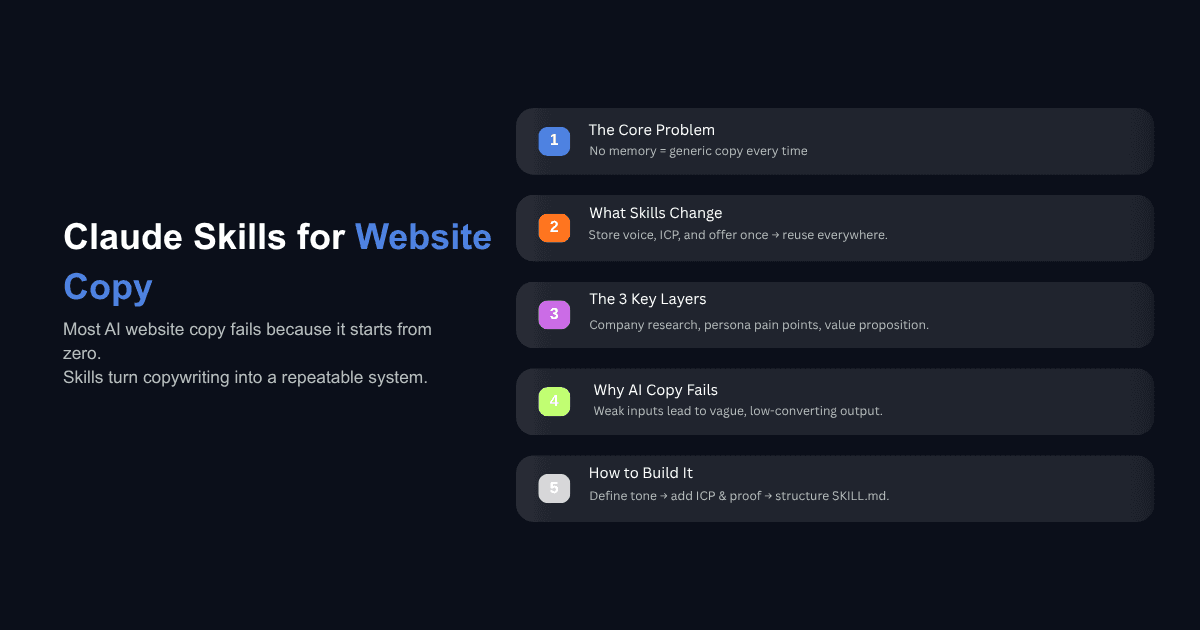
Most businesses using AI for website copy are starting from scratch every single time. They open a new chat, paste in some notes about their offer, and ask for a landing page. The output reads like it could belong to any company in any industry. It lacks the specifics that make someone stop scrolling and actually read.
This is the core problem with using AI for copywriting without a system underneath it. The AI has no memory of your brand, your audience, your proof, or even which pages on your site it should be linking to. Every conversation is a blank slate, and blank slates produce generic copy.
Claude Skills solve this by letting you package your entire business context, your tone of voice, your offer details, your ICP research, your internal links, and your copywriting frameworks into a reusable set of instructions that Claude loads automatically. Instead of re-explaining who you are every time, you build the system once and use it across every piece of website copy you produce.
This article covers what Claude Skills are, why they matter for website copywriting specifically, and how to build one that produces copy your team can actually use.
What Are Claude Skills and Why Do They Matter for Website Copy?
If you are already familiar with what Claude Skills are and how they work, you know the basics. A Claude Skill is a folder containing a SKILL.md file with structured instructions, along with optional reference documents, scripts, and templates. According to Anthropic's engineering team, Skills are folders of instructions, scripts, and resources that Claude loads dynamically to improve performance on specialized tasks.
What makes Skills different from Projects or custom instructions is how they activate. Projects give Claude a static knowledge base that applies to conversations within that project. Custom instructions apply broadly across all your chats. Skills sit in between: they activate dynamically when Claude recognizes that a task matches what the Skill is designed to do, and they work everywhere across Claude's interfaces.
For website copy, this distinction matters. You do not want your brand voice guidelines and offer details loaded into every conversation about data analysis or code. You want them loaded specifically when you ask Claude to write a homepage, a service page, or a landing page. Skills handle this automatically.
What Goes Into a Copywriting Skill
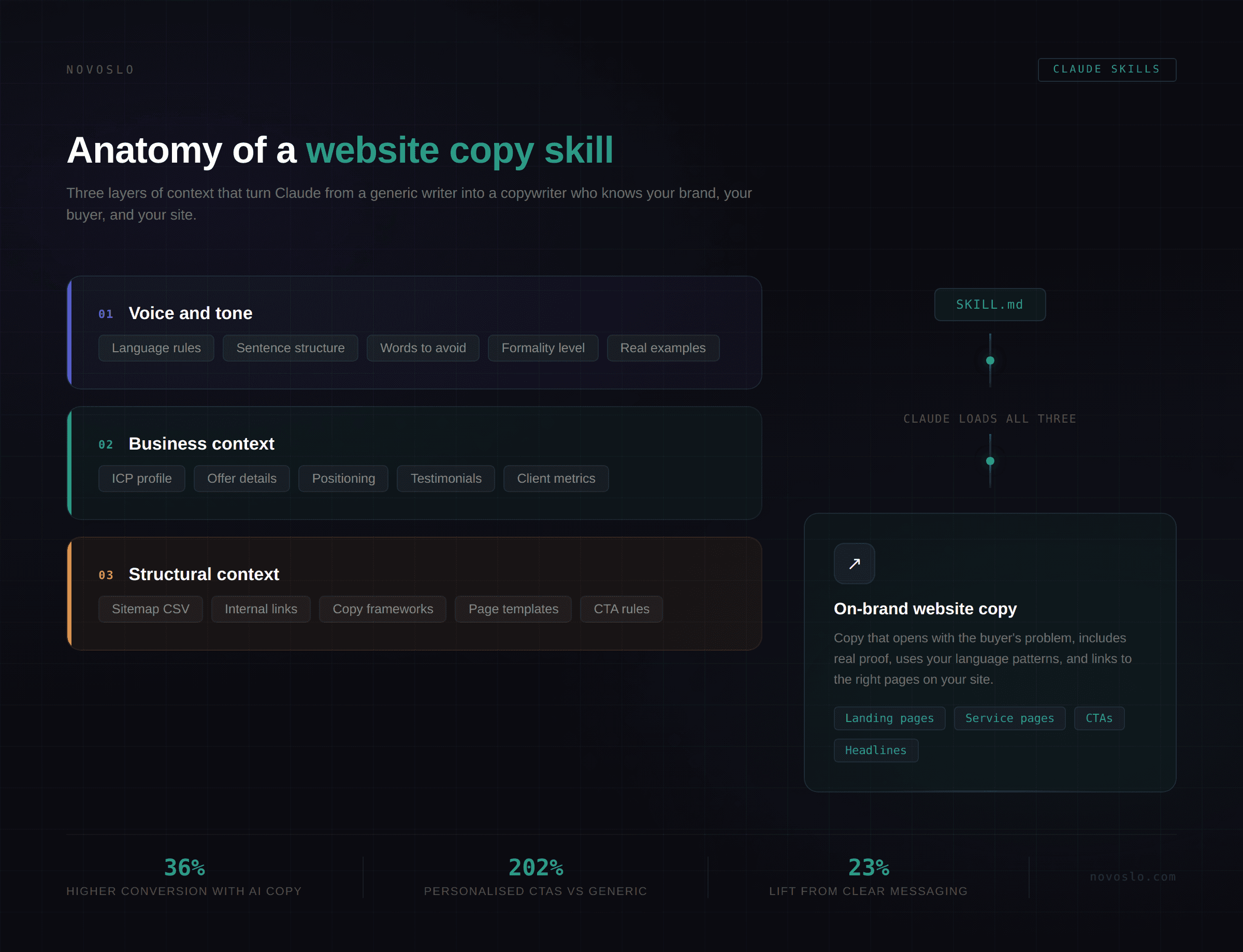
A website copywriting Skill typically contains three layers of context that Claude needs to produce useful output.
The first layer is voice and tone. This is a document that defines how your brand sounds, what words to avoid, what sentence structures to follow, and what emotional register to hit. Without this, Claude defaults to its own writing patterns, which sound competent but interchangeable.
The second layer is business context. This includes your ICP (ideal customer profile), your offer details, your competitive positioning, the problems you solve, and the proof you have that you actually solve them. Testimonials, case studies, specific metrics, all of it belongs here.
The third layer is structural context. This is where you define the pages on your website that Claude should be aware of for internal linking, the copywriting frameworks you want it to follow (such as PAS or AIDA), and any formatting standards your team uses. A simple CSV of your key URLs, titles, and meta descriptions gives Claude enough to make intelligent internal linking decisions without hallucinating pages that do not exist.
The people building effective copywriting Skills are packaging all three layers together so that Claude starts every piece of website copy with the same depth of context a senior in-house copywriter would have after three months on the job.
Why Most AI Website Copy Fails
According to a recent content marketing survey, 97% of content marketers plan to use AI in 2026, up from 64.7% in 2023. The adoption is not the problem. The output quality is.
The Context Problem
When you prompt Claude or any other LLM with "write me a landing page for my SaaS product," you are giving it almost nothing to work with. It does not know your buyer, your pricing model, your key differentiator, or even what industry you operate in. So it fills in the gaps with generic defaults: "streamline your workflow," "save time and money," "trusted by thousands."
This is not an AI problem. It is an input problem. The same thing would happen if you hired a freelance copywriter and gave them a one-sentence brief with no background research.
Skills eliminate this by front-loading the context. When a copywriting Skill activates, Claude has already read your tone guide, your ICP profile, your client wins, and your site structure before it writes a single word.
Generic Output Kills Conversions
A Search Engine Land analysis argues that AI exposed how little real copywriting was being done in the first place. The flood of AI-generated content has raised the bar for what actually converts, because buyers have learned to recognize and skip past copy that sounds templated.
When we tested Claude against ChatGPT and Gemini for cold outreach emails, the gap between a well-prompted Claude output and a generic one was significant. The same principle applies to website copy. The model producing the copy matters less than the system feeding it context.
How to Build a Claude Skill for Website Copy
Building a copywriting Skill does not require coding. The entire system is markdown and reference files zipped into a folder. Here is the practical process.
The Foundation: Tone of Voice and Brand Context
Start with a tone of voice document. This is not a vague list of adjectives like "professional, friendly, innovative." Those descriptions apply to half the internet and give Claude nothing useful.
A strong tone document includes specific language rules (words to use, words to never use), sentence structure preferences, examples of writing that matches your brand, and an honest description of how formal or conversational you want to sound. It should describe what your writing sounds like when someone reads it out loud.
If you do not have a tone document, you can create one by feeding Claude 10 to 15 examples of your best existing copy (emails, social posts, website pages, even transcripts of how your founder speaks) and asking it to extract the patterns. The result is a detailed voice profile that captures the actual rhythms of how your brand communicates, not just a wish list.
This is the same process that agencies building copy systems for clients follow. They analyze transcripts, pull out the specific ways a person phrases things, identify the dos and donts, and encode all of it into a reference that Claude reads before producing anything. One enterprise client we worked with delivered quality results with limited initial information by having a structured copy system that compensated for gaps in the brief, which is exactly what a well-built Skill does.
Adding Your Offer, ICP, and Proof
The second document in your Skill should cover your offer and audience in detail. Include who your buyer is, what stage they are in when they land on your website, what they already believe, what beliefs need to shift before they buy, and what specific proof you have (testimonials, case studies, metrics) that supports each claim you want the copy to make.
This document does the heavy lifting. Without it, Claude writes copy that describes what you do. With it, Claude writes copy that addresses what your buyer is thinking.
For AI workflow automation for writing, the tool is rarely the problem. The workflow underneath it is. The same is true for website copy. A Skill with detailed offer context produces meaningfully better landing pages than the most sophisticated prompt without context.
Structuring the Skill File
Your SKILL.md file is the instruction layer that tells Claude what to do with all the context you have provided. A typical website copywriting Skill includes a workflow with defined steps: first read the tone guide, then read the ICP and offer context, then check the sitemap for internal linking opportunities, then follow a specific copywriting framework for the page type requested.
You can also include rules about what Claude should never do, such as never use certain phrases, never invent statistics, never link to pages not listed in the sitemap, and never produce copy without including at least one piece of proof. These constraints are what keep the output consistent across different team members using the same Skill.
The folder structure looks something like this: a SKILL.md file at the root, a references folder containing your tone-of-voice.md, your sitemap.csv, and your client-wins.md or proof document. You zip the entire folder and upload it through Claude's settings under Capabilities, or install it via Claude Code if you are working in that environment.
What Should a Website Copy Skill Actually Produce?
Landing Pages and Service Pages
The highest-value use case for a website copy Skill is landing pages and service pages, because these are the pages where conversion happens and where generic copy costs you the most.
According to conversion research, brands with clear messaging see up to 23% higher conversion rates compared to those with vague or jargon-filled copy. Personalised CTAs perform 202% better than generic ones. These are not marginal differences. The words on your service pages and landing pages are among the highest-leverage variables in your entire marketing system.
A well-built Skill should produce landing page copy that opens with the problem (not a description of your product), names the buyer's situation specifically, introduces your solution through the lens of what changes for them, includes proof from real clients, and ends with a CTA that references a specific outcome.
Copywriting research consistently shows that benefit-focused copy converts 20 to 40% better than feature-focused copy. A good Skill encodes this principle directly into its instructions so that Claude automatically leads with outcomes rather than capabilities.
Headlines, CTAs, and Supporting Copy
Beyond full pages, a copywriting Skill can also handle the smaller but high-impact elements: headlines, subheadlines, CTA buttons, and short descriptions for navigation or feature sections. These elements often get the least attention during a website build, but they carry outsized weight in how visitors experience the page.
A Skill can include specific frameworks for headlines (such as leading with a specific outcome in ten words or fewer) and CTA copy (such as always using first person and referencing the next step, not just "submit" or "learn more"). These small rules compound across an entire site.
Does AI Website Copy Actually Convert?
Yes, but only when the AI is given enough context to write something specific. The data supports this. AI-generated landing page content produces 36% higher conversion rates according to recent marketing data, and AI-assisted ad copy improves click-through rates by 38% while reducing cost per click by 32%.
The difference is the word "assisted." The teams seeing those results are not pasting raw AI output onto their websites. They are using structured systems, often with layered Skills, that give the AI detailed context and then editing the output to match their brand. The AI handles the first 80% of the work. The human handles the 20% that makes it feel real.
This is the same pattern we see with teams that implement AI in their business successfully. The tool does not replace the thinking. It accelerates the execution once the thinking is done.
How Do You Keep Claude From Sounding Generic?
The most common complaint about AI-written copy is that it sounds like AI. This happens for specific, addressable reasons.
First, Claude defaults to a balanced, neutral tone when it has no voice guidelines. A tone of voice document fixes this immediately by giving Claude specific patterns to follow and specific patterns to avoid.
Second, generic copy usually comes from generic inputs. If your Skill includes real testimonials, specific numbers, and named outcomes, Claude weaves those into the copy. If it only has a vague description of what your company does, it fills the gaps with filler.
Third, you can explicitly ban common AI writing patterns in your Skill. Phrases like "in today's fast-paced world," "streamline your operations," or any sentence that starts with "whether you're a" can be listed as forbidden language. Claude follows these rules consistently, which is something that is harder to enforce with a human writer who may default to familiar constructions under deadline pressure.
The people building the most effective copywriting Skills are feeding Claude 20, 30, even 50 pages of transcripts and existing copy so that the voice profile is detailed enough to sound like a specific person, not like a language model.
Can You Combine Multiple Claude Skills for Copywriting?
Yes, and this is where Skills become particularly useful for teams producing website copy at volume.
A common setup uses a foundational Skill for brand voice and tone (which applies to everything), a second Skill for specific page types (landing pages, service pages, about pages), and a third Skill for SEO requirements (keyword placement, internal linking, content structure for AI search citation).
Claude can load multiple Skills simultaneously when they are relevant to the same task. If you ask it to write a service page, it can pull voice guidelines from one Skill, page structure from another, and linking strategy from a third. This modular approach means you can update your tone of voice without rebuilding your entire copywriting system.
This is the same approach that works for Claude Skills for LinkedIn posts and other content types. You encode your voice once, build format-specific Skills on top of it, and let Claude compose them together based on what the task requires.
Conclusion
Claude Skills turn website copywriting from a blank-page problem into a systems problem. Instead of re-explaining your brand, your audience, and your offer every time you need a new page, you build the context once and let Claude load it automatically.
The practical steps are straightforward: document your tone of voice with real examples and specific rules, compile your offer details and ICP research into a structured reference, add your sitemap for internal linking, and wrap everything in a SKILL.md file that defines the workflow Claude should follow.
The teams getting measurable results from AI copywriting are the ones treating it as an infrastructure decision, not a prompting trick. A well-built Skill is the difference between copy that sounds like it could belong to anyone and copy that sounds like it belongs to your business.
If you are looking at where AI fits into your operations more broadly, our AI business audit tool can help you identify which workflows across your company are ready for this kind of structured automation.