Article
Jan 12, 2026
5 AI Business Transformation Examples in the Legal Industry
AI agents are rewriting legal work and ending the billable hour. Learn how legal AI agents let firms sell outcomes, see 5 real examples of firms shifting from time to outcomes.
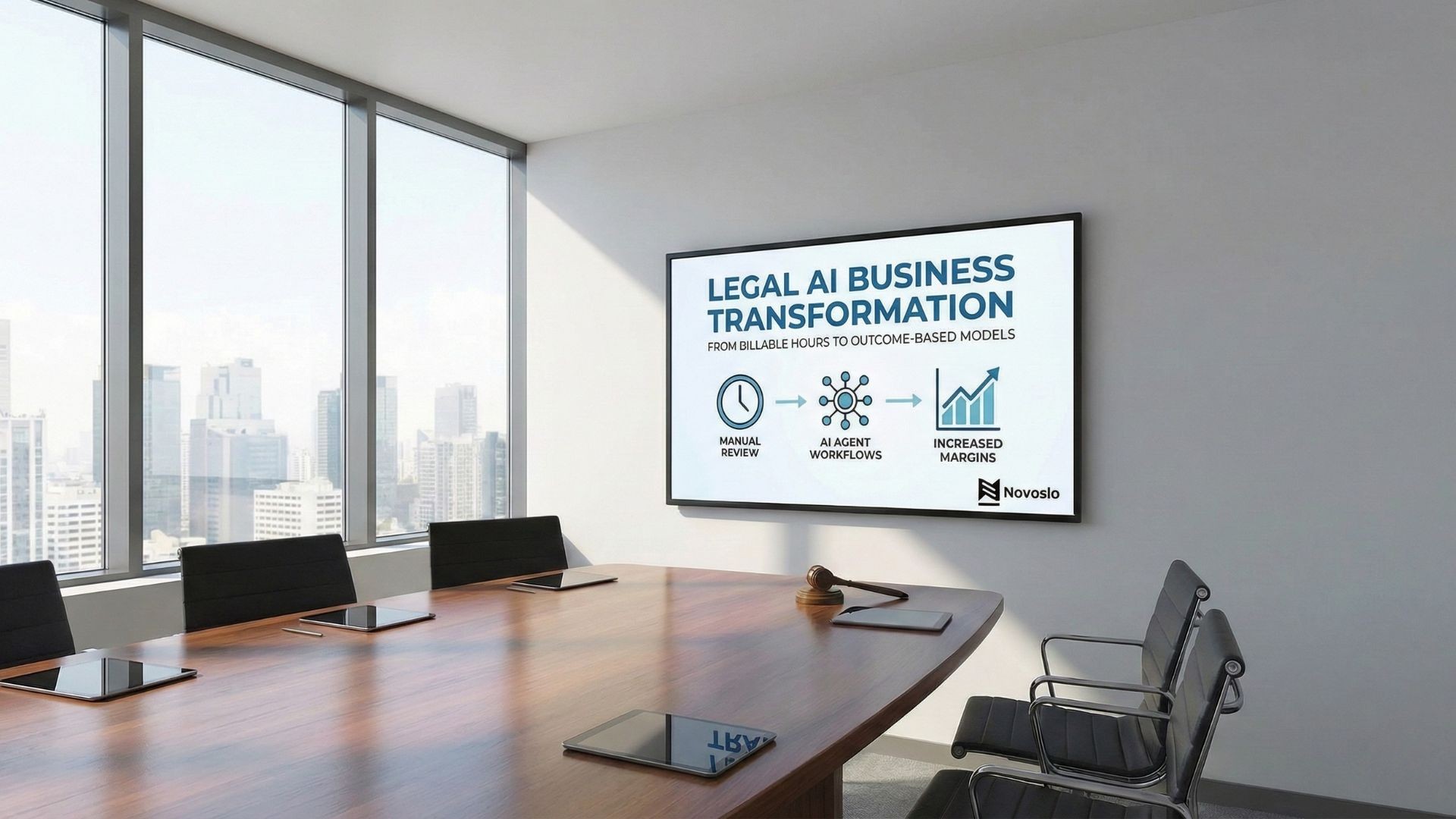
The "Billable Hour" is dying. And if we are being honest with ourselves, it is eventually going to happen.
In 2025, the legal industry treated AI as a novelty. We saw lawyers using early versions of ChatGPT to summarize PDFs or draft awkward, slightly robotic emails. It was viewed as a "productivity tool" , a slightly faster way to do the same old things.
In 2026, the game has changed entirely. We are no longer talking about productivity (doing the same things faster); we are talking about business transformation (doing entirely new things).
At Novoslo, we are seeing a massive shift in how our legal clients operate. The firms that are winning market share right now aren't just using AI to check for typos. They are using "Agentic AI" to fundamentally change their business model from "selling time" to "selling outcomes."
If you are a Managing Partner still clinging to the hourly billing model while your competitors use agents to execute complex workflows in seconds, you are setting yourself up for failure.
In this article, we break down 5 real-world examples of how Artificial Intelligence is transforming the actual business mechanics of the legal industry.
Why Are Businesses Shifting from “Chatbots” to “Agents”?
Most partners I speak with still think of AI as a "Chatbot." You ask it a question, and it gives you a text answer. That was the reality of 2024. That technology is useful for drafting a marketing email, but it is useless for high-stakes legal work because it hallucinates and lacks context.
The transformation we are discussing today is driven by AI Agents.
Here is the difference:
The Chatbot (GenAI): You upload a contract and ask, "Summarize this." It gives you a paragraph of text. It is passive.
The Agent (Agentic AI): You give it access to your Data Room and a goal. "Review these 5,000 files, flag every Change of Control clause that conflicts with Delaware law, draft the amendment redlines, and prepare a risk summary email for the Senior Partner."
The Agent does the work. It reasons and navigates your internal file systems, checks its own work against legal databases, and then produces a final deliverable.
This shift from "Chatting" to "Doing" is what allows for the business transformations listed below.
Example 1: The Due Diligence "Swarm" (M&A)
The Old Business Model: In traditional Mergers and Acquisitions (M&A), Due Diligence is a volume game. A Senior Partner lands a deal to acquire a mid-sized tech company. To assess the risk, they need to review 5,000+ contracts held by the target company.
The firm’s solution? Throw bodies at the problem. They assemble a "War Room" of 15 junior associates who spend two weeks working 16-hour days, manually reading PDFs, looking for specific clauses (indemnification, assignment, change of control).
It is a "Time & Materials" model. The client pays for the inefficiency. The firm bills 800 hours at $400/hour. It can generate revenue, but it also exhausts talent and, more importantly, increases the likelihood of human error, for example, a fatigued associate working at 2:00 a.m. is far more likely to overlook critical details.
The AI Transformation: Firms are now deploying "Swarms" of custom agents (often built on secure, private instances of models like Claude or specialized legal LLMs like Harvey).
The New Workflow:
Ingestion: The entire Data Room (10,000+ documents) is uploaded to a secure, vector-embedded database.
The Swarm: Instead of one AI reading one document, the system spins up hundreds of parallel "Agents." Agent A looks for IP risks. Agent B looks for Employment liabilities. Agent C looks for Real Estate encumbrances.
Cross-Referencing: Apart from reading the AI also cross-references. It notices that an Employment Agreement in Folder A conflicts with a Vesting Schedule in Folder B.
The Output: By the next morning, the Senior Partner receives a "Red Flag Report." The AI hasn't just summarized the docs; it has identified the 50 specific documents that actually pose a risk to the deal context.
The Business Transformation (The Money): This is where the business model breaks down: if AI can complete 800 hours of work in just four hours, billing by the hour no longer makes sense because you can’t charge enough to cover your costs, and the model quickly becomes financially unsustainable.
Forward-thinking firms are using this to pivot to a Fixed Fee "Tech-Enabled" Model.
Instead of billing 800 hours, they charge a flat fee of $150,000 for "Due Diligence."
Their cost to deliver the work drops from $100,000 (associate salaries) to $5,000 (compute costs + oversight).
Result: The margin on the deal triples. The client is happy because the price is predictable and the turnaround is faster. The firm makes more profit while doing "less" work.
Example 2: "Moneyball" for Litigation Prediction
The Old Business Model: "Should we settle this case, or should we go to trial?" This is the single most expensive question in law.
Historically, the answer relied on "The Gut." A Senior Partner with 30 years of experience would look at the facts, look at the judge assigned to the case, and say, "I have a good feeling about this judge. Let's fight it."
Frankly, this is a form of gambling. It depends on anecdotes and personal recollection, both of which are inherently unreliable. Clients dislike unpredictability, yet they’ve had little choice but to rely on the partner’s intuition.
The AI Transformation: Litigation boutiques are moving toward Predictive Litigation Analytics. This is "Moneyball" for the courtroom.
The New Workflow:
Judge Profiling: The firm connects an AI agent to legal research databases (like LexisNexis or Westlaw) but on a massive scale. The Agent scrapes every single ruling the assigned Judge has made in the last 15 years.
Pattern Recognition: The AI analyzes the Judge's behavior in specific contexts. Does this Judge tend to grant Summary Judgment motions in Class Action suits involving tech companies?
Opposing Counsel Analysis: The AI analyzes the opposing law firm. Do they usually settle when pushed past Discovery, or do they go to trial?
The Probability Score: The AI outputs a dashboard. "Based on Judge Smith's last 400 rulings, there is a 72% probability he will deny our motion to dismiss. However, Opposing Counsel settles in 85% of cases where the damages are under $5M."
The Business Transformation (The Strategy): This data allows the firm to change how they sell their services. They can now offer Risk-Sharing Fee Structures.
The Offer: "We are so confident in our assessment that we will take a 20% lower hourly rate in exchange for a 10% 'Success Fee' if we settle below $X million."
The Why: They can make this bet because they know the mathematical odds. It turns litigation from an art into a science.
The Client View: The client loves this. It aligns incentives. The firm isn't incentivized to drag the case out to bill more hours; they are incentivized to get the best result efficiently.
Example 3: The 24/7 Regulatory Watchdog
The Old Business Model: Regulatory compliance has traditionally been "Reactive." A new law is passed for example, the EU AI Act or a new SEC cybersecurity ruling. The law firm's partners read about it in the news. They organize a committee. They write a "Client Alert" newsletter. They email it out two weeks later.
Then, they wait for clients to call them in a panic. Many clients fall through the cracks, and the firm misses revenue opportunities because they aren't fast enough to identify exactly who needs help.
The AI Transformation: We are helping firms build "Watchdog Agents" that live in the background of their practice management systems.
The New Workflow:
The Scanner: An AI Agent is connected to global regulatory registers (Federal Register, EU Official Journal, etc.). It monitors these feeds 24/7.
The Matchmaker: When a new regulation drops, the Agent doesn't just read it. It "understands" it. It then turns inward and scans the firm’s internal client database.
The Connection: It cross-references. "New SEC rule regarding SaaS revenue recognition → Identifying all clients in our database tagged as 'SaaS' or 'Software' with revenue over $50M."
The Action: The Agent drafts a highly personalized email for the Relationship Partner to send to those specific 15 clients. "Hi [Name], this new SEC rule just dropped this morning. Based on your Q3 filing, this exposes you to risk. We need to review your revenue recognition policy this week."
The Business Transformation (The Retention): This turns the law firm into a Proactive SaaS Platform.
Old Way: The client views the lawyer as a "Cost Center" they call when they are in trouble.
New Way: The client views the lawyer as an "Insurance Policy."
This stickiness allows firms to charge Monthly Retainers for "Monitoring Services" rather than just billing for the hours spent fixing problems. It creates recurring, passive revenue streams for the firm (subscription revenue) which significantly increases the valuation of the firm itself.
Example 4: The "First Pass" Contract Associate
The Old Business Model: The "Grind." Every firm has a pile of "low value" work that needs to be done: Non-Disclosure Agreements (NDAs), Vendor Agreements, Master Services Agreements (MSAs).
Usually, this work is dumped on junior associates. It is boring, repetitive work. "Read this NDA. Make sure it matches our playbook." The problem? It burns out your talent. High-potential lawyers quit because they are tired of reviewing NDAs. Plus, clients hate paying $300/hour for an associate to review a document that hasn't changed in ten years.
The AI Transformation: Firms are deploying "Playbook Agents."
The New Workflow:
The Playbook: The firm uploads its "Golden Standard" clauses. "We never accept indefinite indemnification. We always require New York governing law."
The Auto-Redline: When a client sends over a vendor contract, the Agent does the "First Pass." It reads the incoming contract, compares it to the Playbook, and actually inserts the redlines.
The Commenting: The Agent inserts comments explaining why it made the change. "Deleted per Firm Policy Section 4.2."
The Escalation: The human lawyer only sees the document after the Agent has cleaned it up. They spend 5 minutes reviewing the redlines instead of 60 minutes reading the whole doc.
The Business Transformation (The Scale): This allows the firm to handle 5x the volume without hiring more staff.
The Product: Some firms are now packaging this as a "Managed Legal Service" for corporate legal departments. "Send us all your NDAs. We will clear them for a flat monthly fee."
The Economics: Because the AI does 90% of the work, the firm can offer a price point that no traditional firm can match, effectively cornering the market on high-volume, low-complexity work.
Example 5: The "Silent" Billing Agent
The Old Business Model: "Time Leakage." This is the silent killer of law firm profitability. Lawyers are notoriously bad at tracking their time. A partner takes a call from a client in the car. They answer three emails while waiting for coffee. They think about a case strategy while in the shower.
Most of this time never gets billed. Or, at the end of the month, the lawyer tries to "reconstruct" their timesheet from memory. This leads to inaccurate bills, client disputes ("You spent 4 hours on what?"), and massive revenue loss. Conservative estimates suggest firms lose 15-20% of billable time simply because they forgot to write it down.
The AI Transformation: Passive "Silent Agents" that run locally on the lawyer's device.
The New Workflow:
The Observer: With strict privacy permissions enabled, an AI agent runs in the background of the lawyer's laptop and phone.
The Context: It observes activity. It sees you spent 12 minutes writing an email to "Client X." It sees you spent 45 minutes reviewing a PDF named "Merger_V2."
The Draft: It doesn't bill the client automatically (that would be dangerous). Instead, it auto-populates the lawyer's timesheet draft. "0.2 Hours - Email correspondence regarding merger terms."
The Human Review: The lawyer logs in on Friday, sees the pre-filled timesheet, adjusts the narrative, and hits "Submit."
The Business Transformation (The Margin): This is pure profit recovery.
If a firm does $50M in revenue, "Time Leakage" could be costing them $5M to $8M a year.
By implementing silent agents, they instantly recover that revenue without hiring a single new person or winning a single new client.
Furthermore, the narratives written by the AI tend to be more detailed and objective, leading to fewer disputes from clients when the bill arrives.
How Does the Novoslo Framework Help You Survive the Transition?
Reading these examples usually triggers two reactions in a Partner:
"This sounds incredible."
"How do we actually do this without breaking everything?"
The danger is real. If you implement AI but keep your old business model (billing by the hour), you will accidentally destroy your revenue. If you automate a 10-hour task down to 10 minutes, and you still bill hourly, you just lost 9 hours and 50 minutes of revenue.
This is why Business Transformation is more important than the tech itself.
At Novoslo, we operate as an AI transformation partner and guide firms through a specific 3-step pivot:
1. The Audit (Find the Bleed)
We don't start with software. We start with the P&L. We look for where you are "leaking value."
Where are you writing off associate time?
Which fixed-fee projects are unprofitable?
Where are senior partners doing junior work? This identifies the high-ROI targets for automation.
2. The Model Pivot (Fix the Incentives)
Before we turn on the AI, we have to change how you charge. We help you repackage your services from "Hourly Rates" to "Fixed Fee Products" or "Subscription Retainers." You must capture the value of the efficiency. If the AI saves time, the firm should keep that margin, not just give it away to the client.
3. The Deployment (Build the Agents)
Only then do we build. Whether it is configuring off-the-shelf tools like Harvey and CoCounsel, or building custom secure agents on Azure/AWS, we implement the specific workflows that drive the margin.
The Bottom Line
The legal industry is not disappearing. But the current shape of the legal industry is dissolving before our eyes.
Your corporate clients are already using AI. Their procurement teams are using AI to analyze your legal bills. They know exactly how long tasks should take in an AI-enabled world.
The question isn't "Will AI replace lawyers?" The question is: "Will you be the firm that uses AI to replace the Billable Hour, or will you be the victim of it?"
The firms that make this transition in 2026 will look like technology companies that happen to practice law. They will have higher margins, happier talent, and stickier clients. The firms that don't will simply slowly bleed out, wondering why their associates are burning out and their clients are leaving for "tech-enabled" competitors.
Ready to future-proof your firm?
We don't just talk about AI; we build the infrastructure that powers it. Book a 15-Minute Audit with Novoslo and let’s see where your "Billable Bleed" is happening and how we can turn it into your competitive advantage.
Frequently Asked Questions About Legal AI Transformation
Will AI replace lawyers in 2026?
No, AI will not replace lawyers, but it will replace the "Billable Hour" business model. In 2026, AI replaces the administrative and process work that lawyers used to bill for (document review, research, drafting). Lawyers who refuse to adopt AI will be replaced by "Tech-Enabled" firms that can deliver the same results 10x faster and 50% cheaper. The future belongs to lawyers who use AI to focus on strategy and counseling rather than rote tasks.
What is the difference between Generative AI and Agentic AI in law?
Generative AI (Chatbots) creates text, while Agentic AI (Agents) executes workflows.
Generative AI (like ChatGPT) is passive; you ask it to summarize a case, and it gives you text.
Agentic AI is active; you give it a goal (e.g., "Review these 500 contracts and redline all indemnity clauses"), and it autonomously opens files, makes changes, and finalizes the work without human hand-holding. Agents are the key to business transformation.
Is it safe to put client data into AI?
Yes, but only if you use "Private Instances" or Enterprise-grade models. You should never put client data into public tools like the free version of ChatGPT. Leading law firms use "walled garden" environments (via Microsoft Azure, AWS, or specialized platforms like Harvey) where the data never leaves the firm’s secure cloud and is not used to train the public model. Security is now a procurement requirement, not just an IT preference.
How much does it cost to implement AI in a law firm?
The cost varies, but the ROI is typically measured in months, not years. For a mid-sized firm, off-the-shelf AI tools (like CoCounsel) cost between $100-$500 per user/month. However, building custom "Agentic Workflows" (like a proprietary Due Diligence Swarm) is a capital investment (often $50k - $150k upfront) that pays for itself by allowing the firm to switch to high-margin Fixed Fee billing.
Can AI predict the outcome of a lawsuit?
AI cannot predict the future, but it can calculate "Win Probability" with high accuracy. By analyzing thousands of past rulings by a specific judge, Litigation Analytics agents can determine statistical patterns (e.g., "Judge Smith grants summary judgment in 68% of similar patent cases"). This transforms litigation strategy from "gut feeling" to data-driven risk management.