Article
Apr 15, 2026
How a B2B Company Builds a Cold Email System with Claude for Consistent Deal Flow
Learn how B2B companies use Claude to build a cold email system that handles lead scoring, enrichment, copy, and campaigns from one workspace.
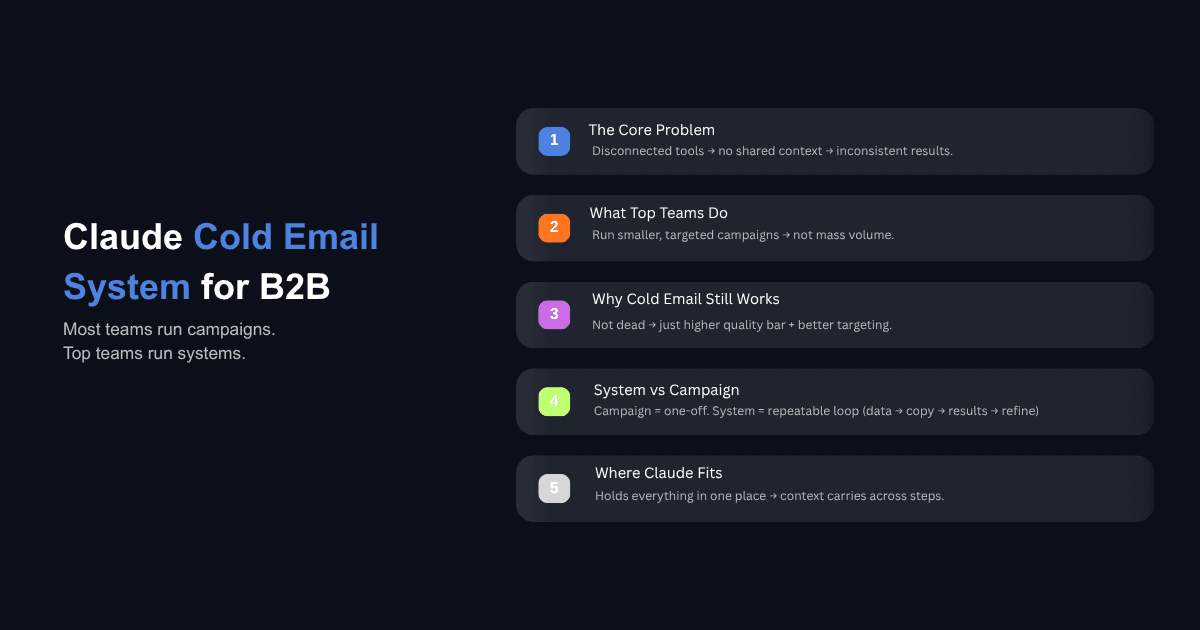
Cold email reply rates have dropped to an average of 3.4% in 2026, according to Instantly's benchmark report. Most B2B teams are responding by sending more volume, which makes the problem worse. The teams clearing 10% or higher reply rates are doing the opposite: running smaller, more targeted campaigns with better personalization and tighter infrastructure.
The difference between those two outcomes is usually not talent or budget. It is whether the team has a system or just a collection of disconnected tools. When your ICP definition lives in a spreadsheet, your enrichment runs through a separate platform, your copy gets written in another tool, and your sequences get loaded into a fourth, nothing talks to anything else. Each stage starts from scratch because there is no shared context across the workflow.
This post walks through how a B2B company can build that system inside Claude, where ICP scoring, lead enrichment, copy generation, and campaign setup all happen in one workspace that remembers your rules and gets better with each campaign. If you want the full technical walkthrough, our step by step guide to building a cold email system with Claude covers the implementation in detail. This piece focuses on why the system works and how to think about each layer.
Why Cold Email Still Works for B2B Companies in 2026
The narrative that cold email is dead keeps circulating, but the data tells a different story. Around 61% of B2B decision makers still prefer email as the primary channel for outreach, according to 2026 industry surveys. The channel has not lost its effectiveness. What has changed is the quality bar.
Gmail, Yahoo, and Microsoft have tightened enforcement on bulk senders. Inboxes are more crowded. Buyers have developed strong filters for anything that reads as a template. But the teams that treat cold email as a repeatable process rather than a volume play are still booking meetings with enterprise buyers consistently.
The real shift is that personalized campaigns outperform generic ones by a factor of two to three. Campaigns targeting 50 or fewer recipients average a 5.8% reply rate, compared to 2.1% for lists of 1,000 or more. Smaller lists force better targeting, and better targeting produces better results across every other metric. The question is how you make those small, targeted campaigns efficient enough to run at meaningful volume. That is where the system matters.
What Makes a Cold Email System (Not Just a Campaign)
Most B2B teams run campaigns. They pull a list, write some emails, load them into a sequencer, and press send. When that campaign finishes, they start from scratch with the next one. Each campaign is a standalone project with no connection to what came before it.
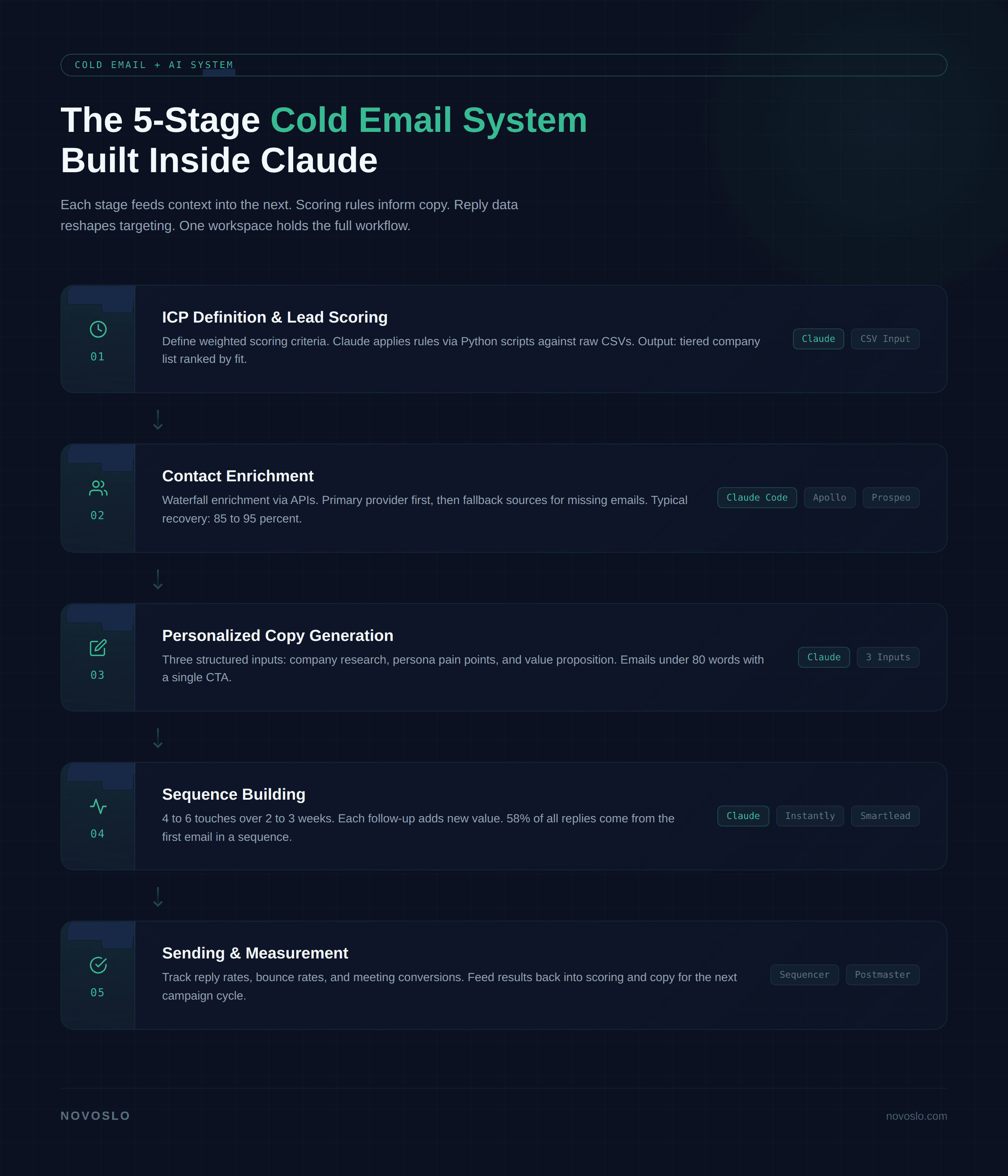
A system is different. A system has five components that feed into each other: ICP definition and scoring criteria, list building and qualification, contact enrichment, copy generation, and sending with measurement. The scoring rules you set in the first stage directly inform the copy decisions in stage four. The reply data from stage five feeds back into how you define your ICP for the next campaign.
When those stages live in separate tools, the connections between them break. Your enrichment tool does not know your scoring criteria. Your copywriting tool does not know which signals your best performing campaigns referenced. Each tool sees its own slice of the work, and you become the integration layer, manually transferring context between them.
The advantage of building this inside Claude is context continuity. Claude can hold your scoring logic, your enrichment results, your best performing email structures, and your campaign analytics in one workspace. When you launch a new campaign, the system already knows what worked last time.
How Claude Fits Into Each Stage of the Workflow
Defining Your ICP and Scoring Leads
The first step is translating your ideal customer profile into a scoring model that Claude can apply against a raw list. This is where most teams make a mistake: they describe their ICP in vague terms like "mid-market SaaS companies" and expect the AI to figure out what matters. The better approach is to define weighted scoring criteria.
You give Claude a CSV of companies with firmographic data (employee count, funding stage, industry, tech stack, hiring signals) and a set of rules like: Series A or B funding in the last 12 months scores 3 points, 20 to 200 employees scores 2 points, hiring for a head of sales or marketing scores 2 points. Claude writes a short Python script that reads the raw CSV and applies these rules mathematically. There is no guessing involved because the data does the scoring, not the language model. The model handles the parts where language helps, like deciding which signals are worth referencing in a personalized first line.
The output is a tiered list: Tier 1 companies that match three or more criteria, Tier 2 that match two, and so on. This tiering directly shapes how much personalization effort each prospect gets, which makes the copy stage significantly more efficient.
Enriching Contact Data
Once you have a scored list of companies, you need names, titles, and verified email addresses. Claude Code can call enrichment APIs directly, starting with your primary provider (Apollo, for example) and running a second pass through a waterfall provider like Prospeo or Lemlist data for any contacts that come back without a work email.
Typical recovery rates are 85 to 95 percent depending on the niche and the providers you use. The detailed walkthrough for this step is in our guide on how to enrich your lead list using Claude Code. The key point is that the enriched data stays in the same workspace as your scoring output, so Claude already knows which tier each contact belongs to and which signals to reference when writing the email.
Writing Personalized Copy That Does Not Sound Like AI
This is the stage where most AI cold email efforts fall apart. The common approach is to open Claude or ChatGPT, type something like "write me a cold email to a VP of marketing," and get back something that sounds like every other email sitting in that VP's inbox. The output reads fine on the surface, but it contains nothing specific to the company, the person, or the problem.
The fix is structured inputs. Instead of one vague prompt, you give Claude three specific things: a company research document (what the company does, recent news, tech stack, hiring patterns), a persona profile (who you are emailing, what their role cares about, what problems they face), and an offer brief (your value proposition, the specific result you deliver, proof points). When Claude has all three, the output shifts from generic to contextual because the model is reasoning from actual data rather than guessing.
We tested Claude against ChatGPT and Gemini for cold email and found that Claude produces more natural, conversational copy when given the right inputs. The emails read less like marketing and more like a knowledgeable peer reaching out with a relevant observation.
The best performing cold emails in 2026 share a few structural patterns: they stay under 80 words, use a single call to action, and lead with the prospect's problem rather than the sender's product. Our walkthrough on writing personalized first lines for cold email outreach covers the specific prompt structure and signal hierarchy that makes this work at scale.
Building and Managing Sequences
A single cold email has a 1 to 2 percent chance of getting a reply. A sequence of 4 to 6 touches spread over 2 to 3 weeks can push the cumulative response rate to 12 to 15 percent on well targeted segments. The data consistently shows that 58% of all replies come from the first email in a sequence, but the follow ups are what separate a one-off attempt from a real pipeline.
Each touch in the sequence should add something new rather than repeating the first message. The second email might include a case study or a relevant data point. The third might shift to a different angle or a lower friction ask. Claude can generate the full sequence in one pass because it has the company research, persona data, and offer brief from the previous stage, and it can vary the structure across touches while maintaining consistent messaging.
The sequence gets exported in whatever format your sending platform requires, whether that is Instantly, Smartlead, or another tool. Claude handles the content; the sending platform handles deliverability and scheduling.
What Does the Infrastructure Look Like?
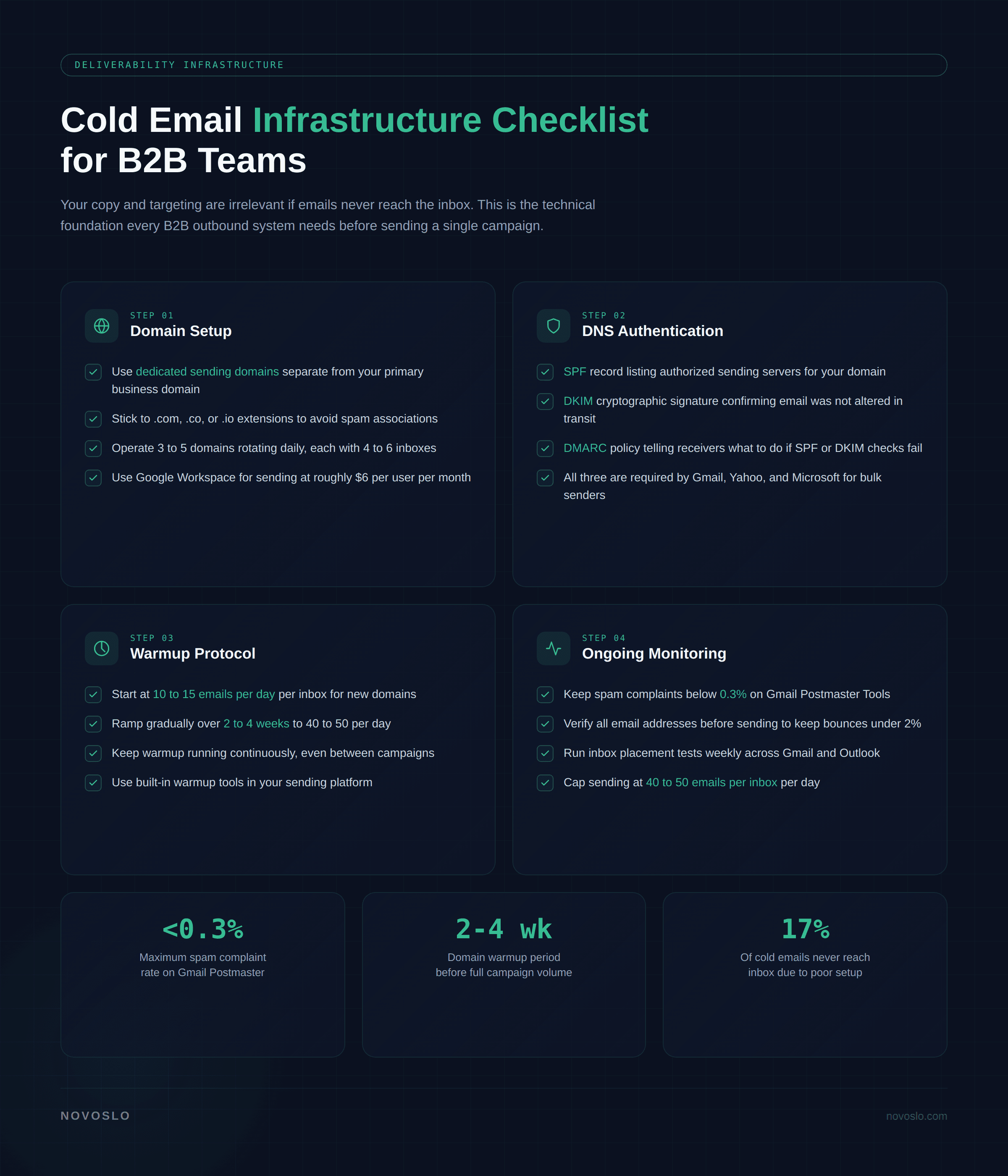
None of the copy or targeting work matters if your emails never reach the inbox. Deliverability has become a strategic requirement in 2026, not a backend setup task.
The baseline is straightforward but non negotiable. You need dedicated sending domains that are separate from your primary business domain. If a sending domain gets flagged, it should not affect your main company email. Each sending domain needs three DNS records: SPF (which servers are authorized to send on your behalf), DKIM (a cryptographic signature confirming the email was not altered in transit), and DMARC (a policy telling receiving servers what to do if SPF or DKIM checks fail). All three are now required by Gmail, Yahoo, and Microsoft for bulk senders.
New domains need a warmup period before they can handle campaign volume. The standard approach is to start at 10 to 15 emails per day per inbox and gradually increase over 2 to 4 weeks. Most cold email platforms (Instantly, Smartlead, Lemlist) have built in warmup tools that automate this by sending and receiving emails through a network of real accounts.
The ongoing discipline is keeping your spam complaint rate below 0.3% on Gmail Postmaster Tools, verifying email addresses before sending (to keep bounce rates under 2%), and monitoring inbox placement regularly. Teams that build this infrastructure once and maintain it weekly avoid the cycle of burning domains and starting over.
What Kind of Results Should You Expect?
Realistic expectations are important because the gap between average and top performance in cold email is large.
The overall average reply rate across all B2B cold email campaigns in 2026 is around 3.4%. Teams that use Claude with proper targeting, structured personalization, and clean infrastructure report reply rates in the 4 to 10 percent range depending on niche, offer, and list quality. Elite campaigns on tight segments with strong personalization can exceed 10 to 15 percent.
The reply rate lift from using Claude does not come from the model writing better sentences than a human could write manually. It comes from consistency and speed. When campaign creation takes 15 minutes instead of half a day, you can run eight campaigns per month instead of two. The compounding effect of testing more offers, more subject lines, and more segments is larger than any single copy improvement.
One enterprise client we worked with doubled their sales efficiency by applying AI driven insights to their lead scoring and outreach timing. The improvement came from systematizing their process, not from any single clever email.
Smaller campaigns consistently outperform larger ones. Lists of 50 or fewer recipients average nearly three times the reply rate of lists over 1,000. The system makes running many small campaigns practical by reducing the setup cost of each one.
Common Questions About Building This System
Can I just use Claude to write all my emails without editing?
No. The model needs structured inputs to produce usable copy, and every email should be reviewed before sending. AI generated copy that goes out without editing tends to sound robotic, miss nuances about the prospect, or include details that are slightly off. The goal is to get 80 to 90 percent of the way there with Claude and spend a few minutes per batch refining the output. That is still dramatically faster than writing from scratch.
Do I need separate tools or can Claude do everything?
Claude handles research, scoring, enrichment orchestration, and copy generation. You still need a sending platform (Instantly, Smartlead, or similar) for deliverability, warmup, inbox rotation, and sequence scheduling. You also need data providers (Apollo, Prospeo, or equivalent) for contact information and email verification. Claude is the brain of the system; the other tools are the infrastructure it sits on top of.
How long does it take to set up?
Infrastructure setup (domains, DNS records, warmup, sending platform configuration) takes a few hours spread over the warmup period of 2 to 4 weeks. Building the Claude workspace with your scoring criteria, persona profiles, offer briefs, and email frameworks takes another few hours. After the initial setup, a weekly campaign becomes a 15 to 20 minute exercise: pull the list, run it through scoring and enrichment, generate the copy, review, and load into your sequencer.
Building Consistent Deal Flow
The point of this system is not to send more emails. It is to build a repeatable process that produces qualified conversations with the right people, week after week, without requiring a dedicated team to manage it.
The companies getting consistent deal flow from cold email in 2026 are the ones that have turned campaign creation into a system rather than a project. Claude makes that possible by holding the full workflow in one context, from ICP scoring through copy generation, so each campaign builds on what came before it.
If you want to see where AI fits into your broader operations, the AI ROI calculator is a good starting point for mapping which workflows are worth automating first.
If you want help implementing this system in your B2B business, book a call with our team. We will walk through your current outreach process, identify where the gaps are, and build the infrastructure that turns cold email into a consistent source of deal flow.