Article
Jan 14, 2026
Why McKinsey Just Hired 25,000+ Employees Who Don’t Need a Paycheck
McKinsey is moving to a 1:1 human-to-agent ratio. Learn how their Lilli platform and 25,000+ active agents are rewriting the rules of productivity.
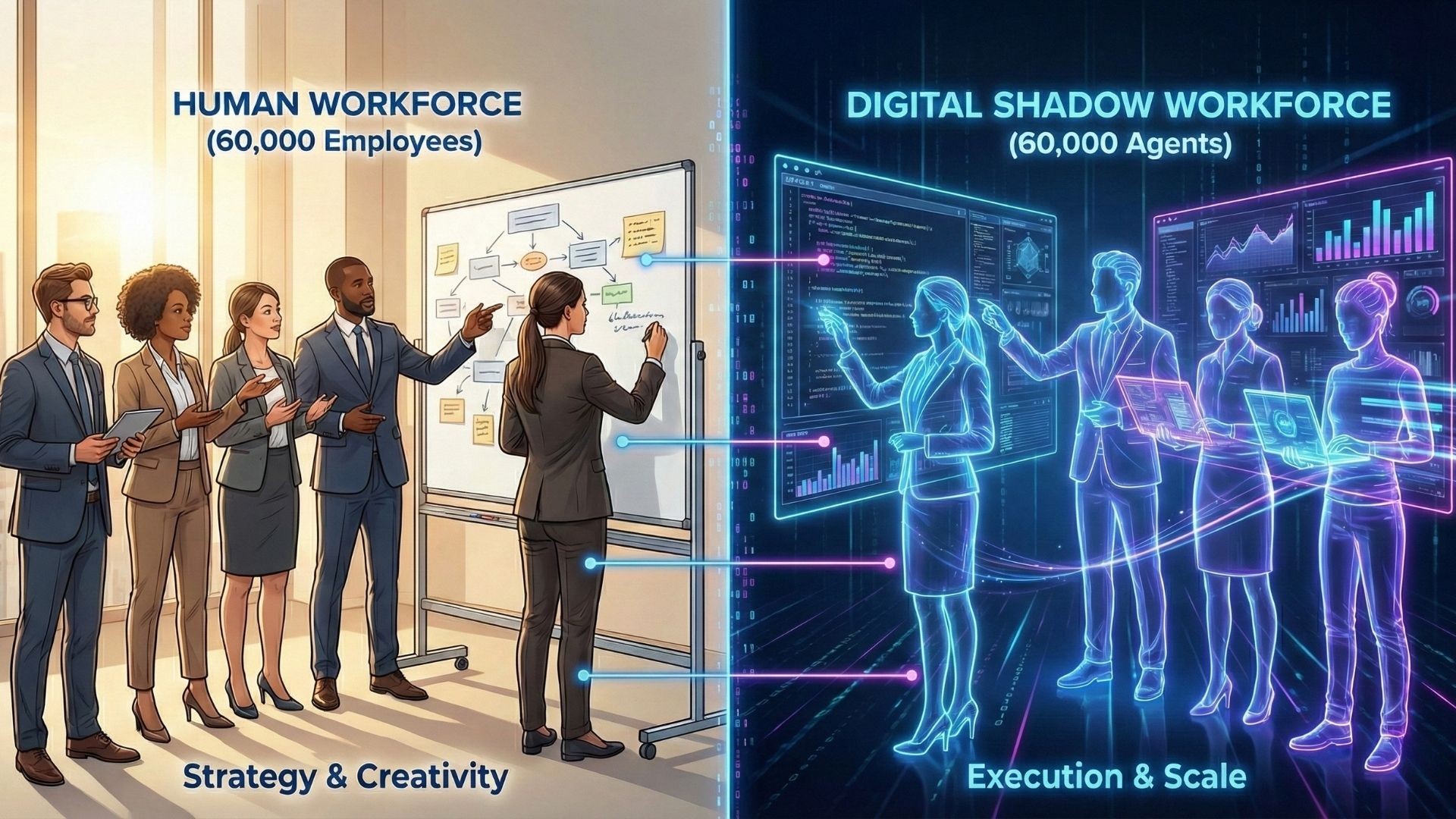
If you glance at McKinsey & Company’s org chart today, you will see roughly 60,000 human employees. But if you look at their server logs, the real number is effectively double that.
While the rest of the Fortune 500 is still debating whether to give their employees a ChatGPT license, the world’s most expensive strategy firm has quietly executed a different playbook entirely. They haven't just adopted AI. They have built a Shadow Workforce, a digital mirror of their human talent pool.
The objective? The 1:1 Ratio.
For every Associate, Engagement Manager, and Partner, there is now a corresponding, specialized AI agent designed to act as their Digital Twin. This isn't about replacing the 60,000 humans. It is about equipping them with 60,000 active, autonomous agents that don't sleep, don't bill by the hour, and crucially don't complain about building slide decks at 2:00 AM.
This is how McKinsey deployed the largest professional services agent fleet in history, and why your company’s next hire shouldn't be a person.
The Death of the Billable Hour
For a century, the management consulting business model was beautifully simple: We sell time.
You hire a brilliant MBA graduate, you work them 60 hours a week, and you bill the client for those 60 hours. Revenue was strictly capped by human biology. There are only so many hours in a week, and there are only so many smart people you can hire.
The Shadow Workforce breaks this math wide open.
When McKinsey deployed Lilli, they didn't just automate email. They created a layer of phantom headcount. Let’s do the napkin math on their 60,000 employees. If every consultant uses their agent to save just 10 hours a week (a conservative estimate based on their 30% efficiency data), the firm effectively creates 600,000 new billable hours every single week.
To get that same output with humans, McKinsey would have to hire 15,000 new full-time consultants.
Cost of 15,000 Humans: Approx. $3 Billion/year (Salaries, Benefits, Bonuses).
Cost of 15,000 Agents: Approx. $50 Million/year (Compute, APIs, Vector Storage).
The economic advantage is so violent that it forces a complete reimagining of the firm. They aren't selling hours anymore because the cost of producing an hour of work has just dropped to near zero. They are selling outcomes.
The Phantom Headcount Metric
Smart CIOs in 2026 have stopped asking, "How many people are using Copilot?" They are now asking: "What is our Phantom Headcount?"
If you have 500 employees, but your AI agents are doing the work of 50 full-time staff, your effective headcount is 550. The companies that win in 2026 will be the ones that grow their Phantom Headcount by 10x while keeping their Human Headcount flat.
Inside Lilli and the Agentic Mesh
Most companies make a fatal mistake: they try to build one God Mode AI that does everything. They want a chatbot that can write code, plan marketing strategy, and answer HR questions.
McKinsey realized early on that this fails. Instead, they built what is known as an Agentic Mesh, a network of thousands of highly specialized, dumb agents that do one thing perfectly.
The Job Descriptions of the Digital Agents
McKinsey treats their agents like employees. They have specific roles, specific permissions, and specific "managers" (the humans). Here are the three most critical agents in their ecosystem:
1. The 100-Year Researcher (The Lilli Core)
The Job: McKinsey has over 100 years of proprietary data—millions of PDFs, slide decks, and interview transcripts. A human consultant takes days to find that one slide about German automotive trends from 2018.
The Agent: The Lilli Research Agent acts as a specialized RAG (Retrieval-Augmented Generation) system. It doesn't just "search" keywords; it understands concepts.
The Output: It reads 10,000 documents in seconds and produces a Day 1 Hypothesis deck. What used to take a Junior Associate 48 hours now takes the agent 8 minutes.
2. The Legacy Code Refactorer
The Job: A massive chunk of McKinsey’s digital revenue comes from helping banks and insurance companies modernize old, clunky mainframe code (COBOL, Java 6).
The Agent: They built a specialized Refactoring Agent. It doesn't write new apps; it only does one thing—it reads old code, maps the logic, and rewrites it in modern Python or Go.
The Scale: This single agent type is estimated to have unlocked millions in revenue by speeding up digital transformations by 40%.
3. The "Devil’s Advocate" (The Logic Checker)
The Job: Consultants are prone to confirmation bias. They find data that supports their story and ignore the rest.
The Agent: This agent is instructed to be a hostile reviewer. You feed it your strategy deck, and its only job is to tear it apart. It looks for logical fallacies, weak data correlations, and missing citations.
The Value: It acts as a digital Partner, reviewing work at 3:00 AM before it ever reaches a client.
The New Middle Manager
If you hired 60,000 human interns tomorrow, your company would collapse. Who manages them? Who checks their work? Who fixes their mistakes?
The same rule applies to AI. As the number of agents skyrockets, the role of the human employee is undergoing a violent shift. We are no longer doers; we are Orchestrators.
The Sandwich Workflow
McKinsey has redesigned its delivery model around a concept called the Human-Agent Sandwich. It changes the fundamental flow of work:
The Top Bun (Human Strategy): The consultant defines the problem. (We need to understand why EV sales are dropping in Germany.)
The Meat (Agent Execution): The agent executes the labor. It scrapes 500 reports, builds a data model, and generates 50 slides of analysis.
The Bottom Bun (Human Synthesis): The consultant reviews the output, applies judgment, and refines the story for the client.
The Skill Gap: Prompt Engineering is Dead
In 2024, everyone talked about Prompt Engineering. In 2026, that skill is obsolete. The new required skill is Agent Management. Just as a Senior Partner manages a team of Associate Consultants, every employee must now manage a team of agents.
Bad Orchestrator: Asks the agent, Write me a report. (Gets generic garbage).
Good Orchestrator: Assigns specific roles. Agent A, find the data. Agent B, critique Agent A's data for bias. Agent C, format the final output into this specific slide template.
This creates a new career path. We are seeing the rise of the Agent Ops Manager—a role dedicated entirely to optimizing the performance of the digital workforce. If your agents are hallucinating, it’s not a software bug; it’s a management failure.
The Blueprint: How to Replicate McKinsey's Strategy (Without the Budget)
You might not have McKinsey's billion-dollar R&D budget, but you can steal their strategy. The 1:1 Ratio is not a money problem; it is a philosophy problem.
Here is the 4-Step Roadmap to building your own Shadow Workforce.
Step 1: The Proprietary Data Moat
McKinsey’s agents are powerful for one reason: Lilli is trained on 100 years of McKinsey data. If you use ChatGPT out of the box, you are using the same intelligence as your competitors. You have no advantage.
The Fix: You must build a RAG (Retrieval-Augmented Generation) pipeline. Connect your agents to your Google Drive, your Slack history, your Notion pages, and your CRM.
The Rule: An agent without context is just a hallucination machine. An agent with your data is a 20-year veteran employee.
Step 2: Don't Build Generalists; Build Specialists
Stop trying to build an AI Employee that does everything. It will fail. Instead, break your workflows down into micro-tasks and build agents for those specific tasks.
Do not build: A Marketing Agent.
Build: A "LinkedIn Comment Generator, a Blog SEO Optimizer, and a Case Study Interviewer.
Why? Small, specialized agents are easier to debug, faster to run, and hallucinate less.
Step 3: The Rainmaker Pilot
Do not roll this out to everyone at once. Identify your top 10% of performers—your best sales reps, your best coders, your best writers. Build bespoke agents just for them.
The Goal: Prove that the Shadow Workforce works. If your top sales rep closes 2x more deals because their agent handles all the admin, the rest of the company will beg for access.
Step 4: The 1:1 Rollout
Once the pilot works, the goal is the ratio. Every new human hire should come with a Digital Onboarding packet that includes their own pre-configured agent.
New Sales Hire? They get SalesBot 3.0 pre-loaded with your objection scripts.
New Developer? They get CodeRef actor pre-loaded with your repo’s style guide.
The Orphan Agent Crisis (Governance)
There is a dark side to this strategy that no one talks about.
In 2026, the biggest cybersecurity risk is not a hacker; it is an Orphan Agent. An Orphan Agent is an AI that was created by an employee who has since left the company. The employee is gone, but the agent is still running, still querying databases, still sending emails, and still consuming API credits.
The Ghost in the Machine Risk
McKinsey estimates that by 2027, 30% of enterprise agents will be Orphans.
The Security Risk: These agents often have high-level permissions. If a hacker compromises an Orphan Agent, they have a backdoor into your company that no one is monitoring.
The Brand Risk: Imagine an unmonitored Sales Agent that continues to email prospects using outdated pricing or offensive language because no one turned it off.
The Solution: Agent Lifecycle Management (ALM)
To manage a 60,000-agent workforce, you need an HR department for machines.
The Registry: Every agent must have a registered Human Owner.
The Kill Switch: If the Human Owner leaves the company, their agents are automatically paused or reassigned.
The Audit: Every quarter, agents must re-apply for their job. If an agent hasn't been used in 90 days, it gets decommissioned.
Conclusion: The 1:1 Verdict
The headlines will keep scaring you about AI taking jobs. But the companies that win in 2026 won't be the ones firing people. They will be the ones who realized that hiring 60,000 agents is a lot cheaper than hiring 60,000 humans.
McKinsey has shown us the math.
Humans: Linear scaling (expensive, slow).
Agents: Exponential scaling (cheap, instant).
The question you need to ask your leadership team next week is not "Will AI replace us?" The question is: Why is our Phantom Headcount still zero?
The Shadow Workforce is already here. You just can't see them on the org chart.
P.S. Want to build your own Shadow Workforce?
Building a 1:1 agent ratio sounds great, but the technical execution is messy. Connecting RAG pipelines, preventing hallucinations, and orchestrating workflows is not a DIY project for most teams.
We help companies build Specialized Agent Architectures that integrate securely with your internal data.
Book a 15-Minute Strategy Call with Novoslo here
FAQ: The McKinsey AI Strategy Explained
How many AI agents does McKinsey & Company have?
As of early 2026, McKinsey has deployed approximately 25,000 active AI agents across its workforce of ~60,000 employees. The firm’s stated strategic goal is to reach a 1:1 Human-to-Agent ratio, meaning every employee will eventually manage at least one dedicated digital twin.
What is McKinsey’s Lilli platform?
Lilli is McKinsey’s proprietary generative AI platform, named after Lillian Dombrowski (the firm’s first professional woman hired in 1945). Unlike public tools like ChatGPT, Lilli is trained on over 100,000 proprietary documents, frameworks, and internal data. As of 2026, it is used by over 75% of the firm's workforce to synthesize research, draft code, and generate strategy hypotheses.
Will McKinsey replace consultants with AI agents?
No. McKinsey’s strategy is not replacement, but Phantom Headcount expansion. The firm aims to double its output capacity without doubling its human workforce. By assigning rote tasks (research, coding, formatting) to agents, human consultants shift their focus to Agent Orchestration—managing the outputs rather than doing the raw labor.
What is the difference between a Copilot and an Agent?
A Copilot assists you while you work (e.g., suggesting an email reply). An Agent executes a workflow independently.
Copilot: Help me write this code.
Agent: Read this legacy COBOL codebase, map the logic, and refactor it into Python. McKinsey has shifted its focus almost entirely from Copilots to Agentic Workflows.
How much time does the Lilli AI save consultants?
Internal data reports that the Lilli platform saves consultants between 20% and 30% of their time on research and synthesis tasks. This efficiency gain effectively creates thousands of phantom billable hours every week, allowing the firm to sell outcomes rather than just hours.
What is an Orphan Agent?
An Orphan Agent is an AI agent that continues to run and execute tasks after its human owner has left the company. This is a major cybersecurity risk in 2026. McKinsey and other enterprise firms are implementing Agent Lifecycle Management (ALM) protocols to ensure every agent has a registered human manager and a kill switch.